


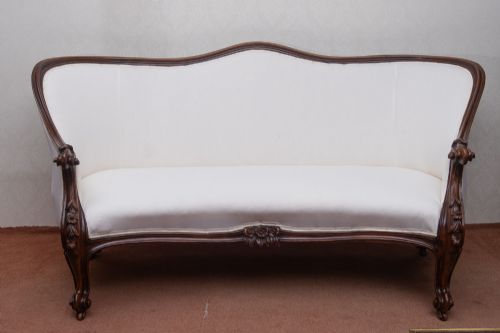
Victorian Carved Wood Couch
A victorian carved wood couch brings heavyweight timber frames and generous upholstery together for serious drawing room lounging.
Victorian Carved Wood Couch
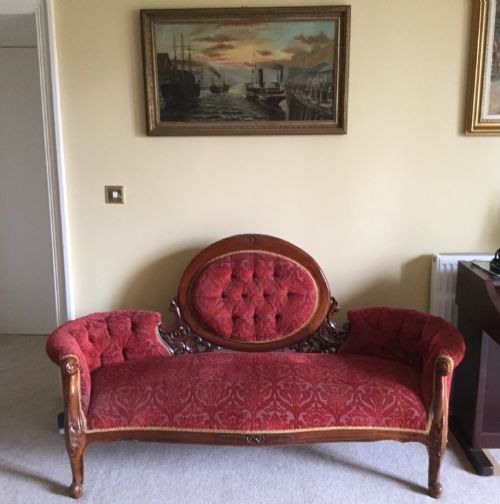
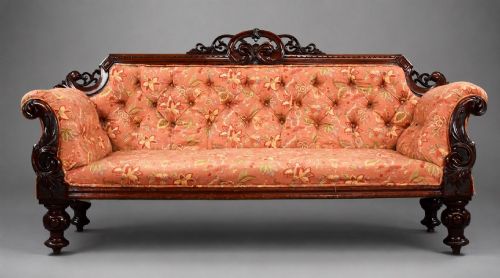
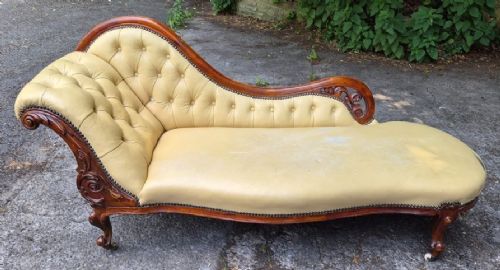
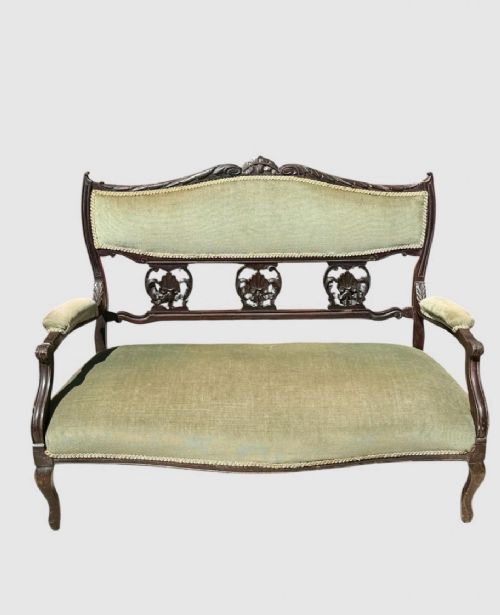
When you search for a victorian carved wood couch, you encounter a range of heavy timber seating designed for the formal nineteenth century parlour, drawing room and library. The selection spans distinct seating forms including double ended sofas, chaise longues, settee bases, and large country house suites.
Mahogany and walnut frame the majority of these pieces, alongside occasional rosewood, ebony, and giltwood. You will regularly meet pieces spanning the Victorian era proper, the William IV transition, and late Victorian revivals.
The style vocabulary is broad, drawing on Victorian Rococo Revival, Chippendale Revival, and Anglo-Indian Colonial ornamentation. These forms share substantial wooden frames shaped with deep relief carving and supported by upholstered pads.
Construction and Materials
Makers built these frames using dense hardwoods like mahogany and walnut, shaping the timber with extensive hand carving. Structural integrity relies on traditional joinery paired with heavy sprung seat bases designed to carry multiple occupants.
Upholstery materials range from deep pile brocade and velvet to leather and standard textiles. Finishing details incorporate brass accents, hand dyed aged leather surfaces, and intricate gilt decoration.
Listings feature timbers including mahogany, walnut, rosewood, and ebony, paired with upholstery ranging from leather to velvet.
Judging the Quality
The distinction between ordinary production and superior work rests entirely on the depth and crispness of the hand carving. Skilled carvers produced lively floral motifs, scroll-ends, and specific details like hawk claw and ball feet with sharp relief that cheaper repetition lacks.
Timber selection and frame scale dictate the architectural presence of the piece. Dense, well figured mahogany or walnut with heavy structural members maintains its rigidity and visual weight far better than lighter, plain timber framing.
Morison And Co Edinburgh
The Victorian Carved Wood Couch Glossary
- Chaise longue
- An elongated upholstered seat intended for reclining, featuring a single raised backrest or scroll end.
- Double ended sofa
- A symmetric couch design with raised rolled headrests at both extremities, allowing users to sit facing either direction.
- Rococo Revival
- A nineteenth century decorative style dominated by exuberant, asymmetrical naturalistic carving, C-scrolls, and floral elements.
- William IV
- The transitional design period immediately preceding the Victorian era, characterised by heavy, robust classical revival proportions.
Victorian Carved Wood Couch: Frequently Asked Questions
Where should I place a heavy wooden couch in my home?
These substantial pieces require adequate floor space and structural weight distribution, making them well suited for living rooms, studies, or large entrance halls. Their carved backs look best positioned against a solid wall or floating in a spacious room.
Keep them away from direct sunlight and heat sources to prevent the timber frames from drying out and the upholstery fabrics from fading.
How do I care for the carved wooden frame?
Dust the carved woodwork regularly using a soft, dry cloth to prevent dirt from settling into the deep recesses of the floral motifs. Apply a quality furniture wax periodically to nourish the mahogany or walnut surface.
Avoid liquid polishes containing silicones, which can build up over time and dull the natural lustre of the nineteenth century timber.
How do I distinguish early Victorian from late Victorian pieces?
Early pieces from the mid nineteenth century often display heavier proportions, rich mahogany framing, and robust Rococo Revival curves. Late Victorian examples frequently utilise walnut or ebonised finishes with lighter, more eclectic revival ornamentation.
Examining the underside construction and the handling of the hand carved details usually reveals the shift in manufacturing confidence across the decades.