



Victorian Bronze Hound
These Victorian bronze hound figures bring the kinetic energy of the nineteenth-century animalier movement directly into your study.
Victorian Bronze Hound
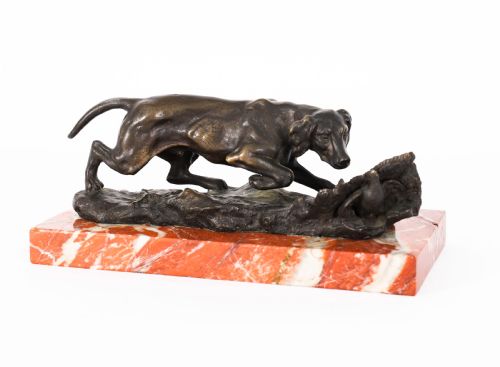
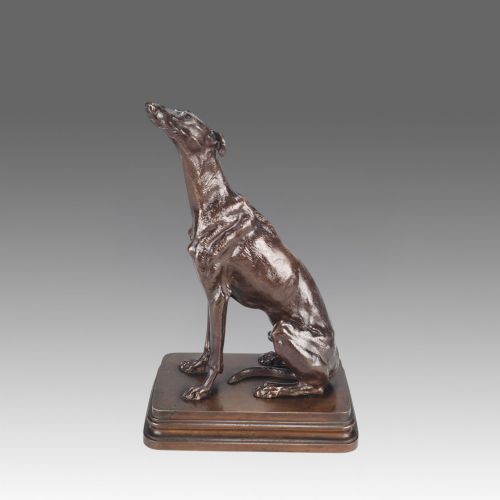
When you search for victorian bronze hound, you encounter nineteenth-century sculptures capturing dogs in moments of rest, pursuit, or play. These pieces range from solitary greyhounds and sighthounds to elaborate hunting groups paired with birds or prey.
The dominant forms on this page belong to the animalier style, produced across the nineteenth century by European and British founders. You will see subjects like the seated lévrier, hunting dogs with balls, and intricate scenes featuring multiple hounds.
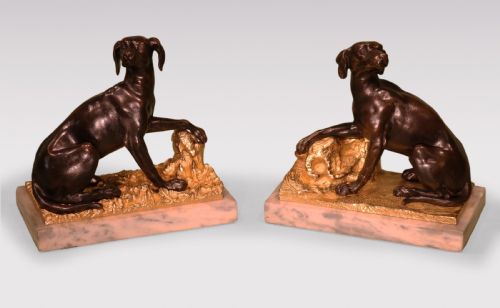
Materials extend beyond plain metal, with several examples mounted upon marble bases or enriched with ormolu details. Their origins span British workshops and continental foundries, particularly French and Austrian studios.
How they were made
Foundries cast these figures in bronze using traditional methods, capturing muscle tension and fur texture in the molten metal. Many works include fine chiselling and patination applied by hand after the initial casting process.
Sculptures are frequently anchored to heavy marble plinths or integrated with carved wooden elements to provide stability. Ormolu accents are occasionally introduced to highlight specific components of the hunting scenes.
Several hounds share their bronze space with unexpected companions, including carefully sculpted pheasants and rubber balls.
What varies in quality
The distinction between tiers rests upon the anatomical precision of the hound and the crispness of the post-cast chasing. Superior examples display subtle musculature and realistic posture that reveal the hand of a master sculptor.
The quality of the secondary materials, such as heavy variegated marble bases and fire-gilt ormolu mounts, elevates certain pieces above standard decorative casts. Signed works associated with known animalier artists also command greater attention.
Carl Kauba·Alfred Dubucand·Pierre Jules Mene·Auguste Nicholas Cain·Arthur Waagen·Joseph Francois Victor Chemin·John Willis Good
The Victorian Bronze Hound Glossary
- Animalier
- A nineteenth-century artistic movement dedicated to the realistic portrayal of animals, particularly in sculpture. Practitioners focused on capturing beasts in motion or repose with strict anatomical accuracy.
- Ormolu
- Gilded bronze achieved through the application of a mercury-gold amalgam to the metal surface. This technique creates a rich golden finish often used for decorative mounts and subsidiary details.
- Patina
- The surface coloration and sheen developed on bronze over time through oxidation or intentional chemical treatment. A well-preserved patina enhances the depth of the metal work.
- Casting
- The process of pouring molten bronze into a mould to form the sculpture. Nineteenth-century founders utilised both sand casting and the lost-wax method to achieve varying levels of detail.
Victorian Bronze Hound: Frequently Asked Questions
What is an animalier bronze?
An animalier bronze is a nineteenth-century sculpture focused on realistic representations of animals, particularly dogs, horses, and wildlife. These works were created by specialised sculptors who studied animal anatomy closely.
Foundries across Europe produced these figures in substantial numbers during the Victorian era, catering to collectors with a passion for naturalism.
How do I identify a Victorian hound?
Victorian hound sculptures typically depict specific breeds like greyhounds, borzois, or hunting dogs in characteristic poses. Look for nineteenth-century casting techniques, patination, and stylistic markers associated with the period.
Many of these pieces are mounted on heavy marble bases or incorporate naturalistic elements like game birds and hunting equipment.
Were these figures used as desk ornaments?
Many smaller Victorian bronze hounds served as decorative desk weights, mantel ornaments, or cabinet figures. Their substantial weight made them practical as well as decorative objects in a nineteenth-century interior.
Larger group scenes were designed primarily for display on pedestals, sideboards, or dedicated sculpture tables.
Why are some hounds paired with marble?
Marble bases provided a stable, weighted foundation for heavy bronze figures while adding a refined architectural element to the display. The contrast between dark patinated bronze and polished stone was highly fashionable in the nineteenth century.
These plinths often matched the formal aesthetic of Victorian studies and drawing rooms.