






Victorian Brass Book Slide
These Victorian brass book slide pieces offer extending utility for the desk, combining robust metalwork with rich hardwoods to keep volumes upright.
Victorian Brass Book Slide
A Victorian brass book slide sits upon the desk as an extending rest designed to hold a row of volumes securely between hinged or fixed ends. When you search for a victorian brass book slide, you encounter expanding mechanisms that allow the platform to lengthen or shorten according to the number of books placed upon it.
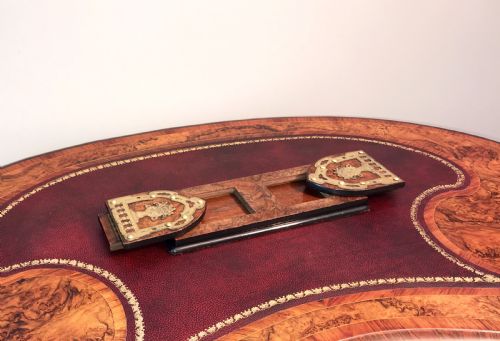
The version you meet most frequently on this page combines a wooden base with brass mounts, hinges, and end plates. Walnut, coromandel, and mahogany provide the primary chassis, whilst the extending action relies on sliding inner trays or concertina linkages.
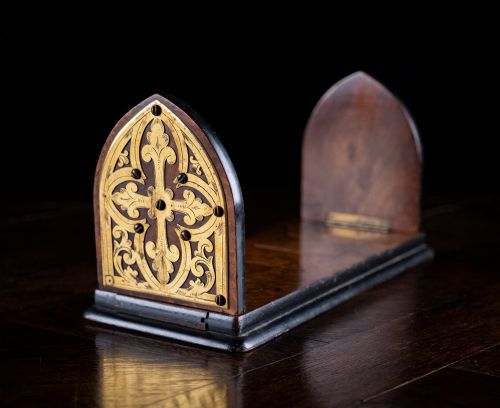
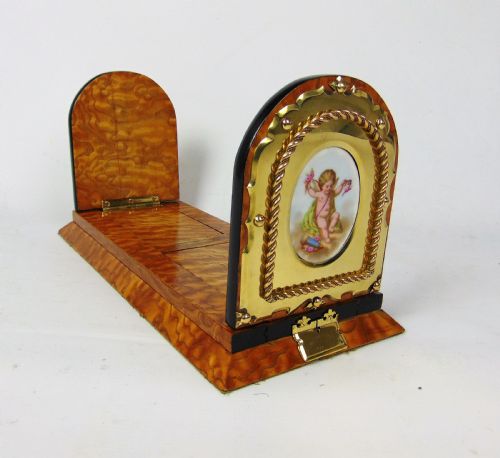
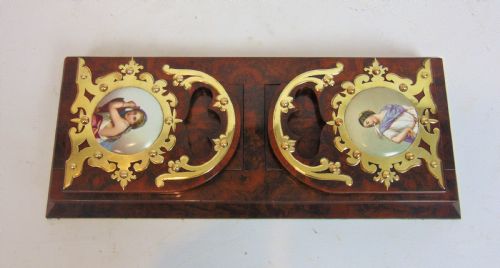
Beyond standard wooden platforms with brass trim, variants incorporate decorative panels, porcelain inserts, or Gothic architectural motifs. These pieces function as both practical desk accessories and ornamental library furniture.
Materials and construction
Cabinetmakers constructed the bases using dense hardwoods such as walnut, coromandel, burr walnut, and mahogany, often pairing them with ebonised wood or oak. These timbers were selected for stability and polished to highlight the natural grain.
Foundries and metalworkers shaped brass into heavy mounts, corner brackets, pierced galleries, and protective edge bindings. Ormolu and bone elements appear alongside the brass framework to add textural contrast.
Patented extending mechanisms, notably those by Betjemann, utilised sliding wooden channels or metal tracks concealed within the base. This allowed smooth expansion without compromising the structural integrity of the book rest.
Victorian Brass Book Slide Retail Price Guide 2026
Typical asking prices for victorian brass book slide among the pieces listed under this phrase on Sellingantiques today, from the lower quarter to the upper quarter. They describe what is for sale here now, not the wider market.
Listings demonstrate that Victorian makers combined brass with coromandel, walnut, and mahogany, frequently incorporating porcelain and bone.
Qualities of distinction
The choice of timber dictates the initial tier of distinction, with figured coromandel and burr walnut occupying a higher station than plain mahogany or oak. Dense grain patterns and unblemished polished surfaces elevate the visual weight of the piece.
The precision of the brass work and the complexity of the extending mechanism separate standard items from finer examples. Pierced brass galleries, engraved mounts, and patented sliding actions demonstrate superior craftsmanship.
Inlaid ornamentation, such as hand-painted porcelain plaques, pietra dura panels, or bone details, introduces an elevated grade of design. Pieces bearing maker stamps or patent marks carry additional documentary interest.
Tiffany and Co·Betjemanns
The Victorian Brass Book Slide Glossary
- Book slide
- An extending desk accessory designed to hold and display a row of books. The base expands or contracts to accommodate varying quantities of volumes.
- Coromandel
- A dense, heavily figured Southeast Asian hardwood with dark brown and black streaks. It was frequently used for luxury Victorian desk accessories.
- Ormolu
- Gilt bronze mounted onto furniture and desk wares. It provides a bright golden metallic contrast against dark hardwoods.
- Pietra dura
- An artistic technique using cut and fitted polished coloured stones to create geometric or pictorial designs. These panels occasionally adorn the ends of book slides.
- Betjemann
- A notable firm associated with patented extending book slide designs. Their mechanical actions allowed the ends to move outward simultaneously.
Victorian Brass Book Slide: Frequently Asked Questions
How do extending book slides work?
Most designs feature an inner wooden base that slides smoothly beneath two fixed or hinged end sections. As you pull the ends outward, the platform expands to hold more volumes.
Patented systems, such as those by Betjemann, use internal mechanisms to ensure both ends move outward simultaneously when adjusted.
What woods were used for these?
Cabinetmakers primarily utilised dense hardwoods including walnut, burr walnut, coromandel, mahogany, and rosewood. These timbers offered the necessary weight and durability for desk use.
Ebonised wood and oak also appear, sometimes paired with contrasting brass bindings and mounts to enhance the visual appeal.
Are all book slides adjustable?
The majority of pieces on this page feature expanding or sliding mechanisms designed to adjust in length. This allows the holder to accommodate a growing or shrinking selection of books.
Fixed bookends and static desk racks also exist within the broader category, though extending variants predominate.
How do I care for brass and wood?
Maintain the timber surfaces by applying appropriate furniture wax periodically to preserve the polish and prevent the wood from drying out. Avoid placing them in direct sunlight.
Clean the brass mounts gently with a dry or very slightly damp cloth, avoiding harsh chemical polishes that might damage adjacent wood or porcelain.