
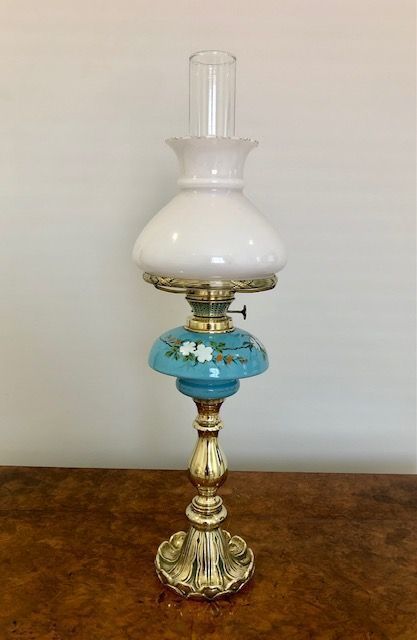


Victorian Blue Glass Lamp
A victorian blue glass lamp brings rich colour and nineteenth-century domestic light into a room, combining brass, ceramic and vibrant glass.
Victorian Blue Glass Lamp
A victorian blue glass lamp combines coloured or cut glass fonts with brass, gilt bronze and ceramic bases. These pieces originate from the nineteenth century, including specific dates such as eighteen fifty, eighteen sixty, eighteen seventy, eighteen eighty, and nineteen hundred.
Most examples take the form of oil lamps, table lamps, lanterns, and ewers, often retaining their original shades or paired with glass globes. English and French workshops produced these domestic lighting fixtures during the Victorian and Edwardian eras.
Buyers encounter columnar designs, font lamps, and converted oil lamps featuring duck egg blue, cut glass, and opal glass elements. The selection ranges from plain brass and ceramic combinations to elaborate Rococo Revival decorative pieces.
Materials and construction
Maker's workshops combined heavy cast brass, gilt bronze, and copper with blown, moulded, or cut blue glass fonts and reservoirs. Bases frequently incorporated black glass, ceramic elements, or stepped metal feet to support the weight of the glass fuel containers.
Burner mechanisms and collars utilised brass threading, while shades employed etched, tinted, or opaline glass configured into globes or decorative flares. Metal components were often embossed, chased, or gilded to complement the intense colour of the glass.
Listings feature periods spanning from eighteen fifty to nineteen hundred, utilising brass, opaline glass, cut glass, and gilt bronze.
Judging quality
Quality rests upon the depth and clarity of the blue glass, the weight and crispness of the brass castings, and the integrity of the original components. Superior examples display precise cutting, well-defined embossing on the metal mounts, and matching period shades.
The relationship between the glass font, the metal stem, and the heavy base dictates the overall balance and proportion of the piece. Finer items retain sophisticated burner assemblies and unblemished glass surfaces without extensive replacement parts.
The Victorian Blue Glass Lamp Glossary
- Font
- The oil reservoir of a lamp, typically formed from coloured or cut glass in these pieces. It holds the fuel beneath the burner mechanism.
- Ewer
- A large jug with a wide spout and handle, adapted in some nineteenth-century examples to serve as an ornamental table lamp. These display decorative handles alongside blue glass bodies.
- Opaline glass
- An opaque or translucent pale glass used for lamp bodies and shades during the nineteenth century. It diffuses light softly through its milky appearance.
- Rococo Revival
- A nineteenth-century decorative style marked by ornate, asymmetrical scrolls, floral motifs, and curved ornamentation. This aesthetic appears on metal mounts and bases of select lamps.
Victorian Blue Glass Lamp: Frequently Asked Questions
What is a blue glass oil lamp?
A blue glass oil lamp is a nineteenth-century lighting device featuring a coloured glass reservoir for oil, mounted on a brass, ceramic or glass base.
These pieces were fueled by paraffin or kerosene before most were later converted for modern electrical use.
How do I date a Victorian lamp?
Dating relies on identifying the style of the burner mechanism, the manufacturing techniques used on the brass components, and the glass colour.
Archival examples and stamped maker names on the metal collars also help narrow down the decade of production between eighteen fifty and nineteen hundred.
Are these lamps converted for electricity?
Many surviving nineteenth-century oil lamps have been safely adapted for modern household electricity while retaining their original burners and fonts.
Conversion methods vary, with some retaining the ability to display the original aesthetic without altering the primary metal and glass structure.
How do I clean a glass and brass lamp?
Glass components benefit from gentle washing with warm soapy water and a soft cloth to preserve the historic surface without scratching.
Brass and gilt bronze require careful dusting and minimal chemical intervention to maintain the natural patina accumulated over the nineteenth century.