


Victorian Aesthetic Armchair
These Victorian aesthetic armchairs bring together the refined geometry and intellectual reform of the late nineteenth century.
Victorian Aesthetic Armchair
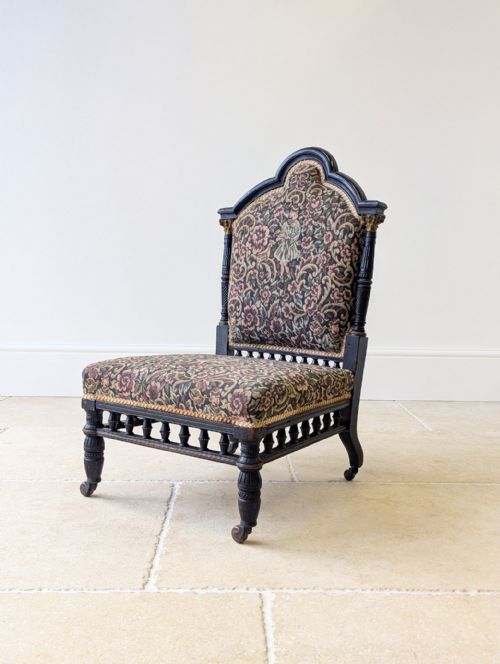
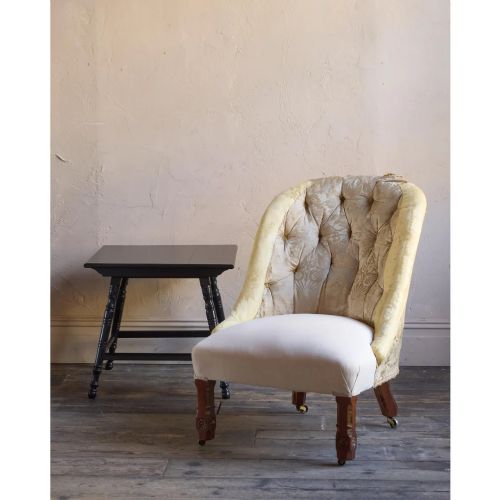
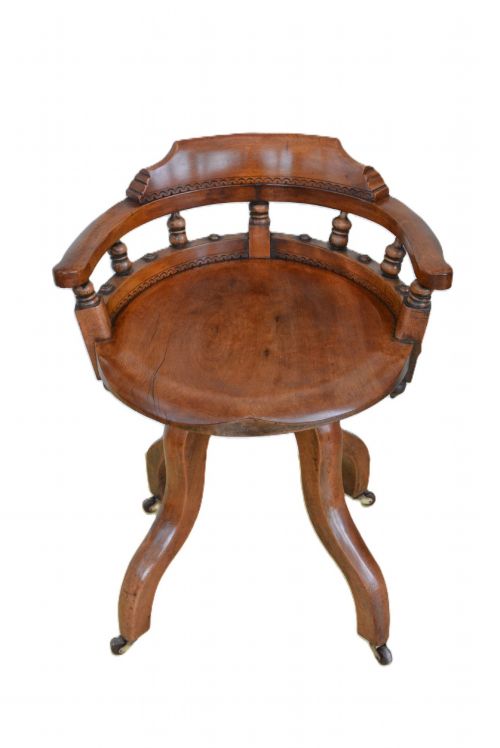
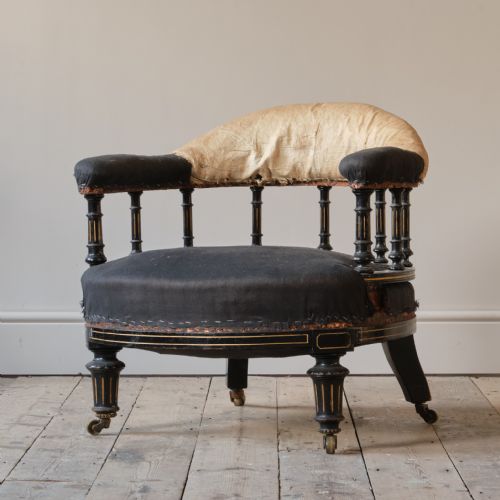
A victorian aesthetic armchair combines the architectural lines and reform ideals of the late nineteenth century with practical domestic seating. You will frequently encounter ebonised wood frames alongside walnut and mahogany, often taking the form of low salon chairs, nursing chairs, and revolving desk chairs.
The selection ranges from simple rush-seated examples to elaborately carved and inlaid open armchairs. These pieces reflect a deliberate move away from heavy mid-century upholstery towards lighter, more linear silhouettes inspired by Japanese design and Anglo-Moorish motifs.
Makers working within this idiom produced specialised seating for every room, including bedroom chairs, corner chairs, and sturdy office chairs. The aesthetic movement influence appears clearly in turned spindles, subtle gilding, and low-slung proportions designed for comfort and visual balance.
Materials and construction
Frames rely heavily on ebonised wood, walnut, mahogany, and oak, frequently paired with brass castors and delicate inlay work. Timber selection dictated the structural integrity, with dense hardwoods allowing for slender legs and intricate turned spindles that do not compromise strength.
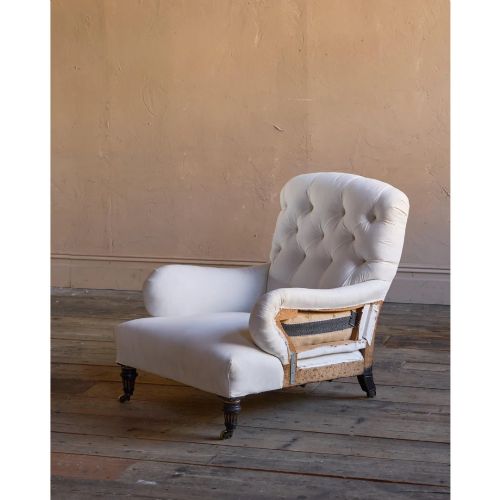
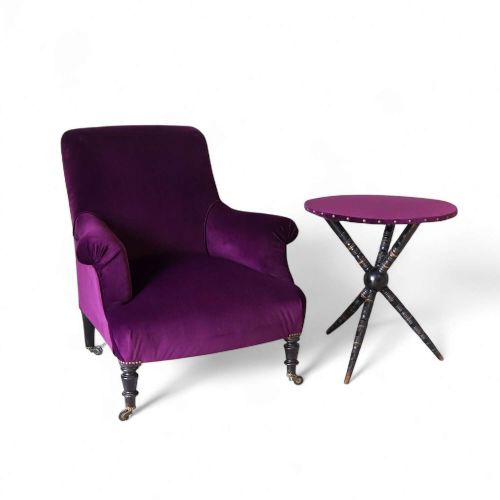
Upholstery uses traditional stuffing over webbing and springs, finished in velvet, plush fabrics, or woven rush. Wood surfaces often received a smooth ebonised finish designed to mimic Japanese lacquer, sometimes highlighted with subtle gilding or incised carving.
Object forms span low salon chairs, nursing chairs, revolving desk chairs, corner chairs, and child chairs.
Distinctions in quality
The distinction between standard commercial production and finer maker pieces lies in the crispness of the turned details, the precision of the joinery, and the quality of the timber preparation. Higher tier examples show careful attention to secondary woods and refined proportions that reward close inspection.
Attribution to prominent makers or designers elevates a piece, as does the survival of original upholstery methods and undisturbed ebonised finishes. Subtle variations in carved decoration and the integration of specialised elements like swivelling mechanisms mark out the superior workshop outputs.
Gillows·E W Godwin·Liberty and Co·Collier and Plucknett·Charles Bevan·Jas James Shoolbred·Maple and Co
The Victorian Aesthetic Armchair Glossary
- Ebonised
- Wood treated with a chemical stain or black finish to imitate ebony. This dark surface was a hallmark of late nineteenth-century fashionable interiors.
- Mashrabiya
- A traditional wooden lattice screenwork panel. These geometric patterns appear on furniture influenced by Anglo-Moorish design.
- Nursing chair
- A low-seated chair designed for comfort near the hearth or nursery. They typically feature low proportions and open arms to accommodate voluminous Victorian skirts.
- Rush seat
- A seating surface woven from dried marsh grasses. This traditional technique provided a durable and textured alternative to upholstered pads.
Victorian Aesthetic Armchair: Frequently Asked Questions
What is an aesthetic movement armchair?
An aesthetic movement armchair is a late nineteenth-century seat designed under the philosophy of art for art's sake. These pieces favour linear geometry, ebonised finishes, and Japanese-inspired motifs over heavy Victorian ornamentation.
They appear in various forms, from low salon chairs to swivelling office chairs, reflecting a broad shift toward lighter and more intellectual domestic design.
How do I identify ebonised wood?
Ebonised wood is timber, often beech or fruitwood, that has been stained or painted black to resemble expensive ebony. Makers used this finish extensively to create stark contrasts against bright fabrics and gilt highlights.
Under close inspection, the natural grain of the underlying wood often remains faintly visible beneath the dark surface layer.
Were these chairs used at desks?
Several variations served workspace functions, including revolving office chairs and desk chairs mounted on swivelling mechanisms. These combine the aesthetic framework with practical mobility for the Victorian study or library.
They feature sturdy timber frames in oak or walnut, paired with low arms to fit neatly beneath writing surfaces.
What is an Anglo-Moorish chair?
An Anglo-Moorish chair incorporates Middle Eastern architectural motifs, such as turned spindles and intricate mashrabiya lattice panels, into standard British furniture forms. This style emerged from a broader Victorian fascination with Islamic design and international exhibitions.
The resulting pieces blend familiar structural silhouettes with exotic geometric surface patterns.