
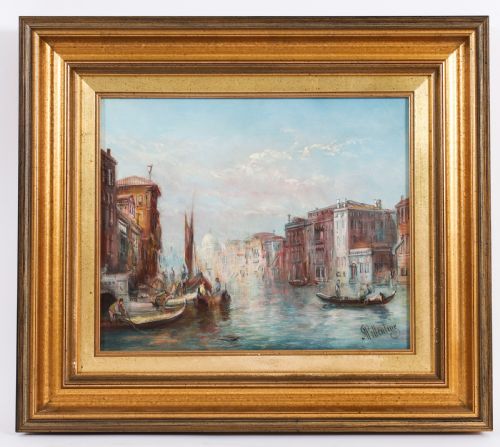
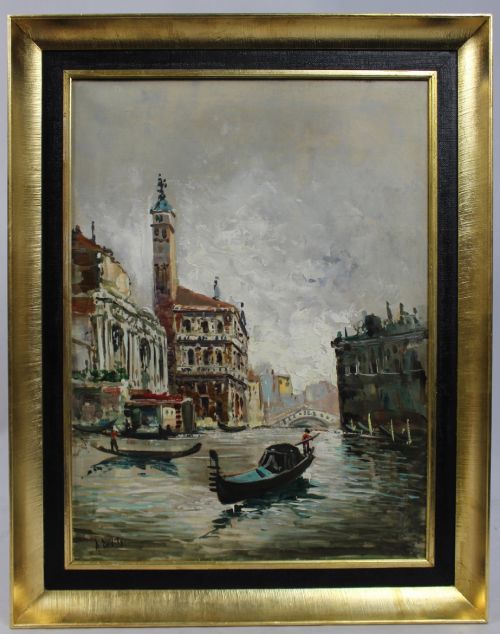
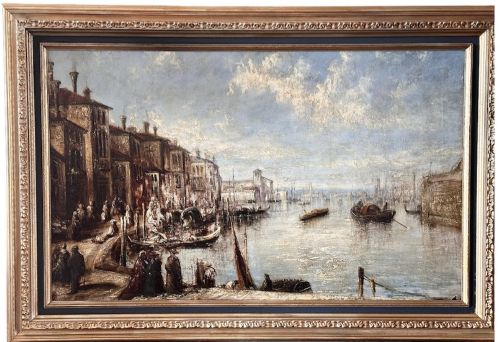


Venice Canal Scene Painting
A venice canal scene painting brings the atmospheric water-streets and historic palazzos of the lagoon directly into a room.
Venice Canal Scene Painting
When you examine a venice canal scene painting, you are looking at topographical and impressionistic views of waterways, gondolas, and bridges. The examples on this page span from the Victorian era through the mid-20th century.
Most pieces you will encounter rely on oil on canvas or delicate watercolour on paper. Subjects frequently centre on the Grand Canal, the Doge's Palace, and quiet backwater canals.
Makers range from named 19th-century British and Italian artists to French impressionist painters. The forms appear primarily as framed paintings ready for display.
Evaluating Quality
Quality rests upon the artist's ability to render light, depth, and architectural perspective accurately across the water's surface. Finer works demonstrate confident brushwork and a sophisticated handling of atmospheric haze.
The sophistication of the original frame, such as carved giltwood, elevates the overall presentation. Stronger pieces reveal a distinct compositional balance between the historic palazzos and the bustling canal traffic below.
Frames of gilded wood and giltwood accompany many of the canvas and paper works originating from British and continental artists.
Alfred Pollentine·Antonio DeVity·Francis Moltino·Claude Jousset·Marc Aldine·William Raymond Dommersen·Vittore Zanetti Zilla·Frank Wasley·William Knox·Helen Donald-Smith
The Venice Canal Scene Painting Glossary
- Oil on Canvas
- A painting medium where pigments bound in drying oil are applied to woven fabric stretched across a wooden frame. It allows for rich colour blending and textured brushwork.
- Watercolour
- A painting method in which the paints are made of pigments suspended in a water-based solution. It produces translucent washes of colour on paper.
- Giltwood
- Wood that has been treated with a thin layer of gold leaf or gold paint. It frequently surrounds antique frames to add reflective warmth.
- Impressionism
- An art style characterised by relatively small, thin yet visible brush strokes and an open composition. It emphasises accurate depiction of light in its changing qualities.
- Gouache
- A water-based paint consisting of pigment and other inert material designed to be used in an opaque painting method. It provides solid, matte colour areas alongside watercolour.
Venice Canal Scene Painting: Frequently Asked Questions
How do I date a Venice painting?
Examine the framing style, canvas preparation, and the artist's active period if a signature is present. Victorian works often feature heavier giltwood frames, whereas mid-century pieces tend toward impressionistic freedom.
Signatures, stretcher construction, and dealer stamps on the reverse provide further chronological clues.
Where should I hang these paintings?
These artworks suit drawing rooms, studies, or hallways where natural light can illuminate the brushwork. Avoid placing them in direct sunlight to protect oil pigments and watercolours from fading.
Pairing a framed painting with traditional wall colours enhances the historic Italian atmosphere.
What is the difference between oil and watercolour?
Oils offer rich textures, deeper colour saturation, and a robust canvas support. Watercolours provide a lighter, luminous transparency on paper that requires protective glass.
Both mediums successfully capture the reflective quality of Venetian canals, though through different technical means.
Are these views historically accurate?
Many 19th-century and early 20th-century artists painted from direct travels to Italy, recording recognizable landmarks like the Bridge of Sighs and Santa Maria della Salute. Some impressionistic works prioritize atmospheric mood over strict architectural precision.
Both approaches reflect how artists interpreted the enduring appeal of the lagoon.