
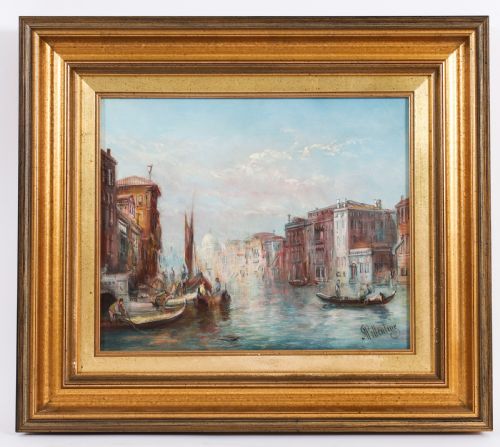
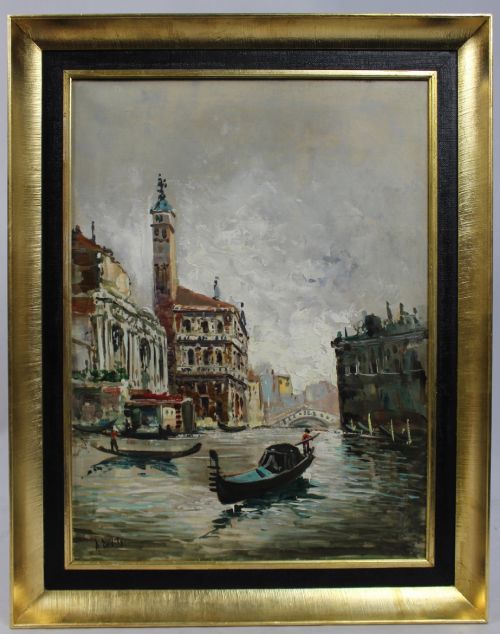
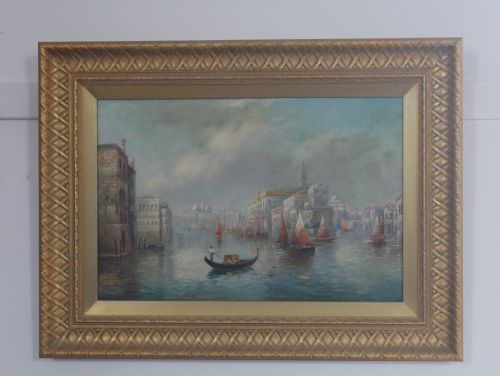
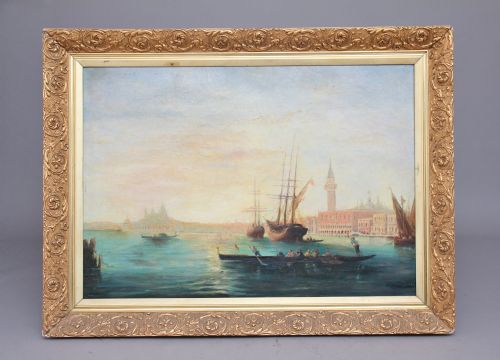


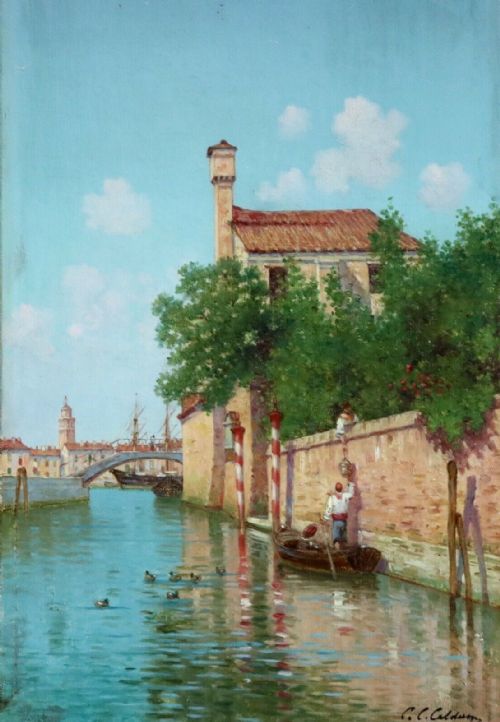
Gondola Oil on Canvas
A gondola oil on canvas captures the timeless light of the Venetian lagoon, bringing historical maritime atmosphere straight to your wall.
Gondola Oil on Canvas
When you search for gondola oil on canvas, you enter a world of Venetian scenes created across the nineteenth and twentieth centuries. These paintings depict famous locations such as the Grand Canal, the Bridge of Sighs, and the Ducal Palace.
The pieces on this page span several distinct periods, including Victorian, 19th Century Romanticism, and Mid-Century Impressionism. You are most likely to meet works from the nineteenth century through to the mid-twentieth century.
Artists record the water and architecture using oil paint applied to canvas supports, often framed in giltwood. These artworks function as traditional windows into historic Italy.
What varies in quality
Quality rests in the handling of light, shadow, and architectural perspective. Stronger works demonstrate a confident command of brushwork that brings movement to the water and gondolas.
The fidelity of the framing also influences the overall standard. Original giltwood frames that complement the painting elevate the piece significantly compared to later replacements.
Many a Victorian painter surely braved the Venetian swell with easel in hand just to catch a gondolier mid-stroke.
Alfred Pollentine·Antonio DeVity·Jane Vivian·Charles Clement Calderon
The Gondola Oil on Canvas Glossary
- Canvas
- A heavy woven fabric used as a surface for oil painting. It is typically stretched over a wooden frame before the artist begins.
- Giltwood
- Wood that has been coated with a thin layer of gold leaf or gilt. This finish is common on the frames surrounding nineteenth-century paintings.
- Impressionism
- A style of painting that focuses on capturing the visual impression of a moment, especially regarding shifting light. Works in this vein often use visible brush strokes.
- Oil Paint
- A slow-drying paint made with pigmented particles suspended in oil. It provides artists with rich colours and the ability to blend tones smoothly.
Gondola Oil on Canvas: Frequently Asked Questions
How do I date a gondola oil on canvas?
Dating relies on examining the canvas stretchers, the style of the wooden frame, and the painting technique itself. Nineteenth-century works often exhibit different canvas preparations compared to mid-century examples.
Signatures and biographical details of artists like Alfred Pollentine or Antoine Bouvard Senior also help narrow down the period of creation.
Where should I hang a Venetian canal painting?
These paintings suit traditional reception rooms, studies, or hallways where lighting can be controlled. Placing them away from direct sunlight preserves the oil pigments.
Pairing the canvas with a period-appropriate giltwood frame enhances its visual impact within an interior setting.
How do I care for an oil painting on canvas?
Keep the canvas away from extreme temperature fluctuations and high humidity to prevent the fabric from warping or cracking. Dust the surface gently with a soft, dry brush.
Avoid using liquid cleaners or touching the paint layer directly, as the oil medium remains sensitive over time.
What subjects appear in these Venetian artworks?
The compositions frequently feature gondolas moored near palaces or gliding under bridges such as the Bridge of Sighs. Landmarks like the Grand Canal and the Ducal Palace recur across various eras.
Artists also focus on the atmospheric lagoon light and everyday maritime life in Venice.