
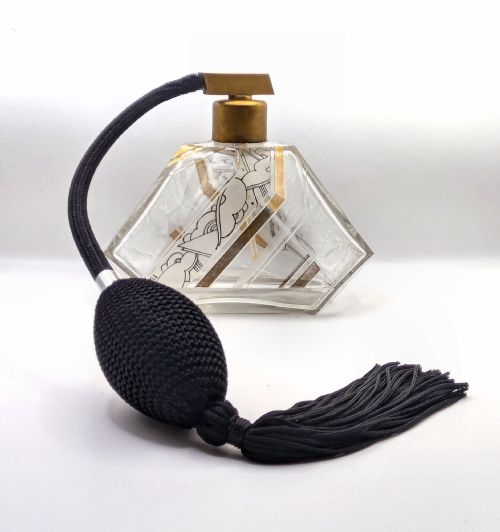


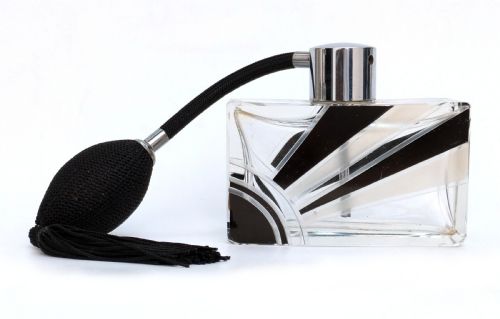


Vanity Glass Scent Spray
These vanity glass scent spray pieces are glamorous dressing table accessories that bring a touch of period style to a modern room.
Vanity Glass Scent Spray
A vanity glass scent spray is a functional dressing table container designed to mist perfume using an attached bulb and metal mechanism. These examples sit firmly in the Art Deco period, drawing on French and Bohemian design from the nineteen twenties and nineteen thirties.
The pieces on this page appear primarily as perfume atomisers and scent bottles, often featuring stands or decorative enclosures. Form follows function closely, pairing heavy glass reservoirs with metal collars and atomising hardware.
Materials and construction
Makers utilised moulded glass, cut crystal, and coloured glass to form the main bodies of these perfume atomisers. Surface decoration was achieved through cutting, enamelling, and incorporating fabric details alongside metal mountings.
Hardware components combine chrome, brass, and early plastics such as bakelite for the mounts and spray mechanisms. The joining of metal collars directly to glass reservoirs required precise fitting to maintain an airtight seal.
These glittering bottles were once considered essential vanity equipment for diffusing French perfume across the boudoir.
Assessing quality and design
Quality in a vanity glass scent spray rests upon the weight and clarity of the glass, alongside the complexity of the cutting. Pieces featuring elaborate Bohemian or French designs display sharper facets and deeper colour saturation than standard commercial production.
The refinement of the metal hardware and the presence of named maker attribution elevate individual pieces. Items incorporating stands or integrated enamel work represent the more ambitious output of the period.
Karl Palda·Rudolf Hlousek·René Lalique·Hermanova
The Vanity Glass Scent Spray Glossary
- Atomiser
- A device used to turn liquid perfume into a fine mist through air pressure. This mechanism sits atop the glass reservoir.
- Bakelite
- An early synthetic plastic utilised for decorative caps and bases during the Art Deco period. It provides a distinct tactile contrast to the surrounding glass.
- Enamel
- Opaque glass paste fused to the surface of the bottle through heat decoration. It adds colourful geometric patterns typical of the nineteen thirties.
- Cut crystal
- Glass with a high lead content shaped by grinding geometric patterns across the surface. This technique maximises light refraction across the dressing table.
Vanity Glass Scent Spray: Frequently Asked Questions
How do these scent sprays work?
The mechanism relies on a squeeze bulb that forces air across a small tube inside the bottle, drawing the liquid upward into a fine mist.
Modern users should inspect the internal tubes and metal collars carefully before attempting to fill them with fragrance.
Are these bottles French or Czech?
Both origins appear frequently, with French makers producing restrained luxury designs and Bohemian workshops centring on bold coloured glass.
Specific signatures or stylistic traits usually indicate whether a piece originated in France or central Europe.
How should I clean a glass atomiser?
Warm water and a gentle bottle brush help clear old perfume residue from the interior without damaging the glass walls.
Harsh chemical solvents must stay away from the external enamel, chrome, and bakelite components.
Can I still use these for daily perfume?
Many people display them purely as dressing table ornaments due to the age of the rubber internal parts.
Replacement squeeze bulbs and lines can sometimes restore full function to the atomiser mechanism.