


Upholstered Footstool Chest
An upholstered footstool chest provides a seat and hidden storage, offering a practical addition to period interiors.
Upholstered Footstool Chest
An upholstered footstool chest combines the function of a seat with a hidden compartment, appearing across Victorian, Regency, and early twentieth-century periods. These pieces serve as ottomans, blanket boxes, or window stools, providing functional storage alongside padded upholstery.
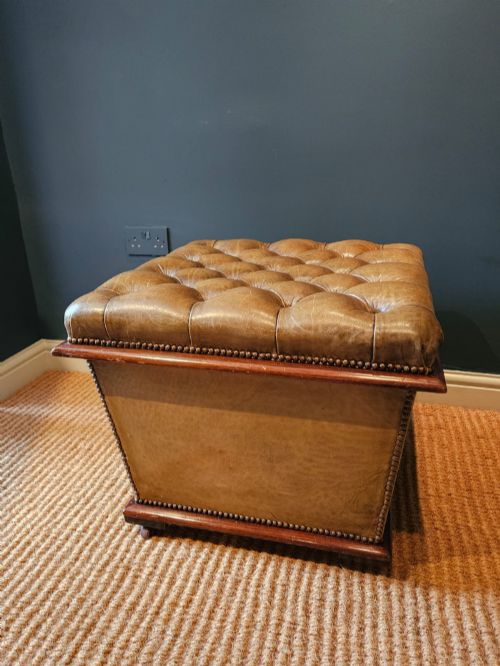
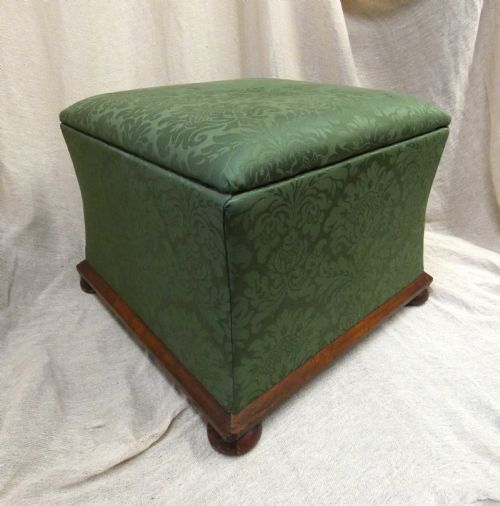
The versions most commonly met on this page date from the nineteenth century, including specific Regency and Victorian examples. Formats range from box ottomans with hinged lids to concave shaped blanket boxes and waisted window stools.
Materials span traditional hardwoods such as mahogany and rosewood, paired with fabric, leather, or velvet coverings. Certain examples feature brass detailing or carved feet, reflecting the stylistic preferences of their respective eras.
Materials and Construction
Construction relies primarily on hardwoods like mahogany, rosewood, and walnut to form the structural chest and frame. These timbers provide the durability required for furniture intended to double as a seat.
Upholstery methods incorporate leather, velvet, and fabric coverings, frequently finished with deep buttoning or original needlework such as gros-point. Interior compartments are integrated to house blankets, work items, or household goods.
Some nineteenth-century chests feature carved lions paw feet, allowing your storage to literally stand on its own four paws.
Distinctions in Quality
Quality in an upholstered footstool chest is revealed through the selection of timber and the precision of the cabinet work. Finer examples utilise dense hardwoods like rosewood or well-figured mahogany, paired with substantial frames designed to endure regular seating use.
Upholstery detailing separates standard pieces from finer ones, visible in the execution of deep buttoning, leather work, or specialised needlework tops. The inclusion of decorative elements, such as lions paw feet or shaped concave profiles, distinguishes more ambitious workshop production.
Hallett & Sons
The Upholstered Footstool Chest Glossary
- Ottoman
- A padded seat or footstool, typically featuring a hinged lid that opens to reveal storage space inside.
- Gros-point
- A type of heavy needlepoint embroidery using wool yarn, frequently seen on historical upholstery tops.
- Box ottoman
- A rigid chest form with an upholstered top designed to serve dual purposes as furniture and storage.
- Window stool
- A long seating form intended to sit beneath a window, sometimes constructed with a waisted profile.
Upholstered Footstool Chest: Frequently Asked Questions
What is an upholstered footstool chest used for?
These pieces function primarily as dual-purpose furniture, offering a comfortable seat or footrest alongside a concealed interior compartment. Historically, they accommodated blankets, linens, and sewing materials while serving sitting rooms and bedrooms.
Today, they integrate into living spaces to provide hidden storage without sacrificing floor seating, maintaining the utility established during the nineteenth century.
How do I date a Regency ottoman?
Dating a Regency piece involves examining the timber selection, such as rosewood or mahogany, alongside distinct decorative motifs. Details like lions paw feet and specific architectural silhouettes point toward the early nineteenth century.
Comparing the construction methods and upholstery styles against established period examples helps clarify the manufacturing decade.
Can I use these daily?
Historical footstool chests are built from durable hardwoods like mahogany and walnut, making them structurally sound for regular everyday seating. The internal storage compartments remain practical for modern household organisation.
Placing the furniture away from direct heat sources helps preserve the underlying timber and the integrity of the antique upholstery.
What is a Canterbury stool?
A Canterbury stool is a specific form of low seating, often incorporating compartmentalized storage originally intended for sheet music or folios. Victorian examples frequently combine timber framing with upholstered elements.
This variant offers a distinct architectural profile compared to standard box ottomans while maintaining similar multi-functional utility.