

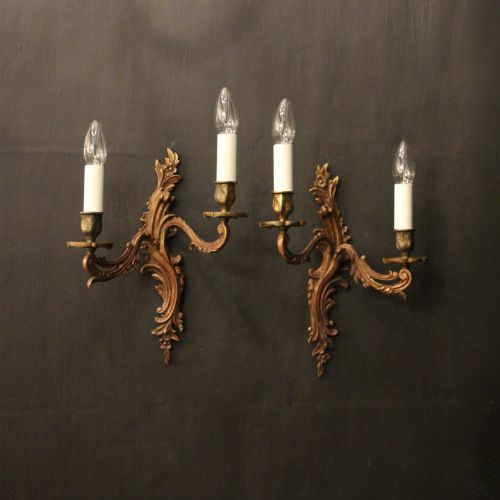
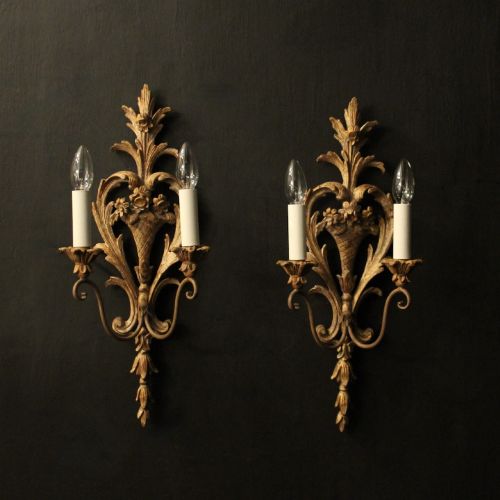
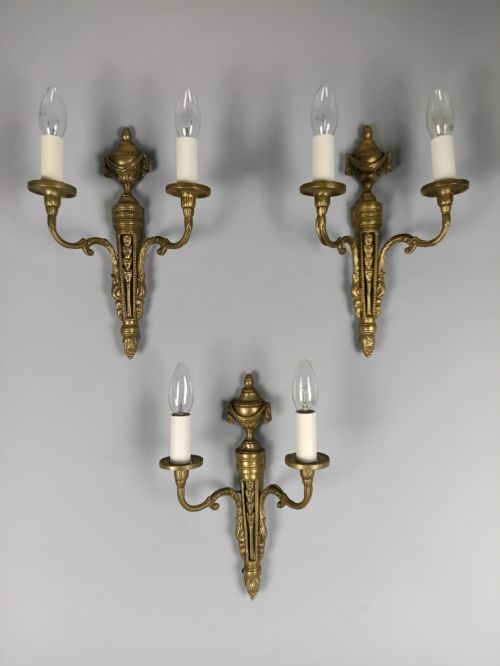
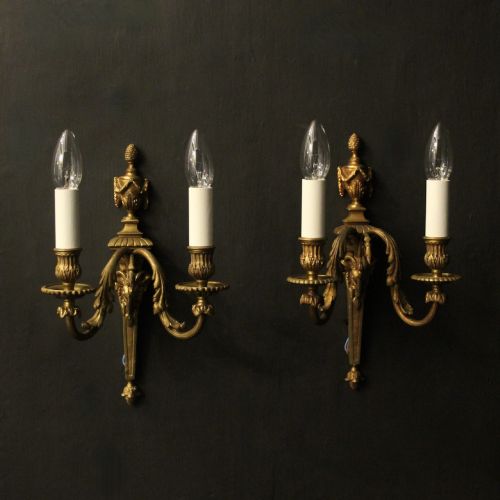
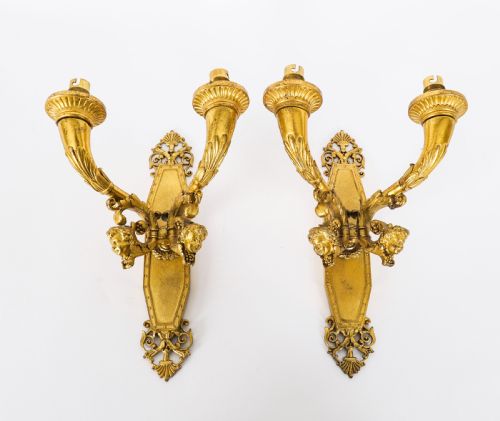
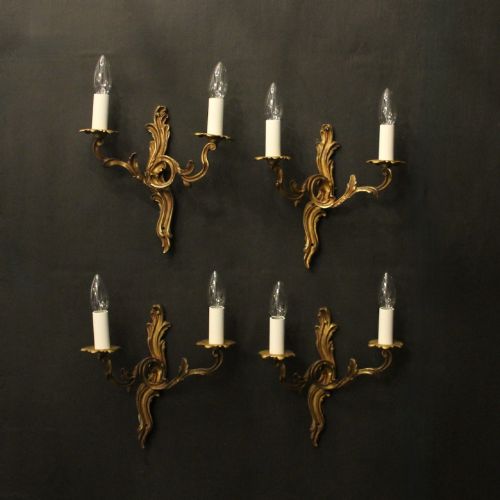
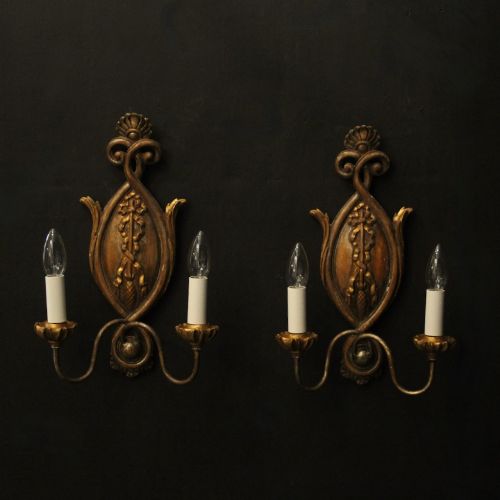
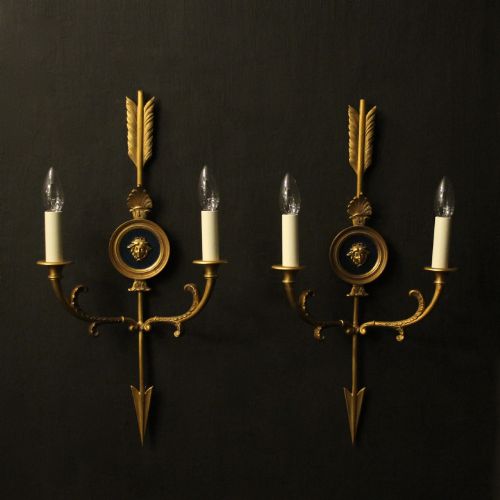
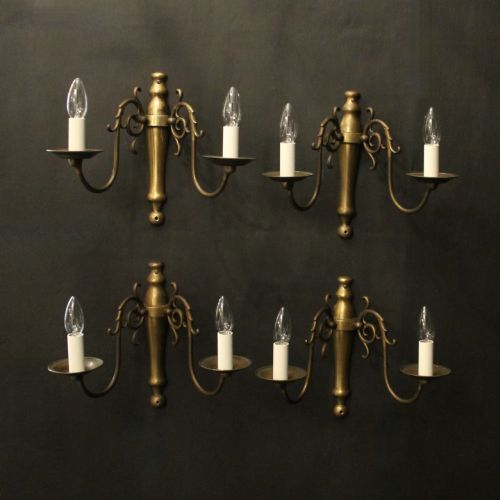
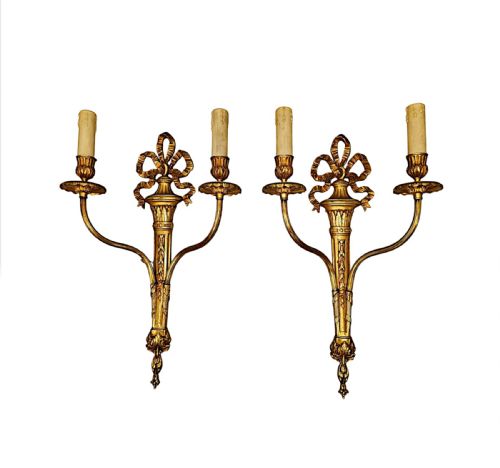
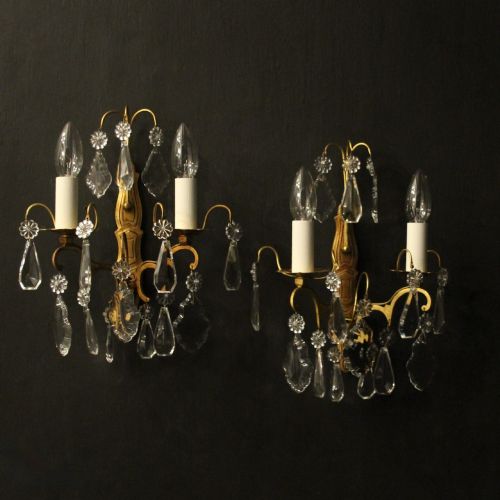
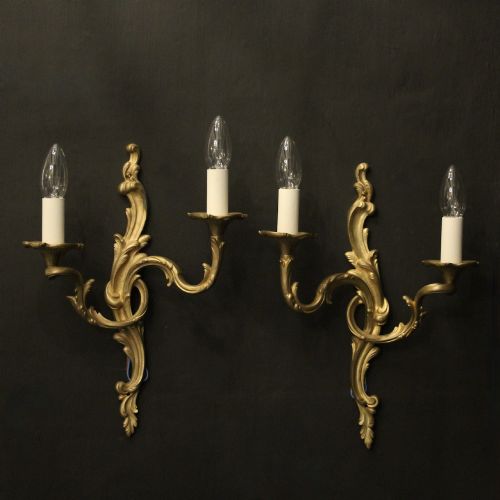
Twin Light Wall Appliques
Twin light wall appliques bring ambient illumination and decorative presence to interiors, taking the form of paired wall lights and sconces sourced primarily from French workshops.
Twin Light Wall Appliques
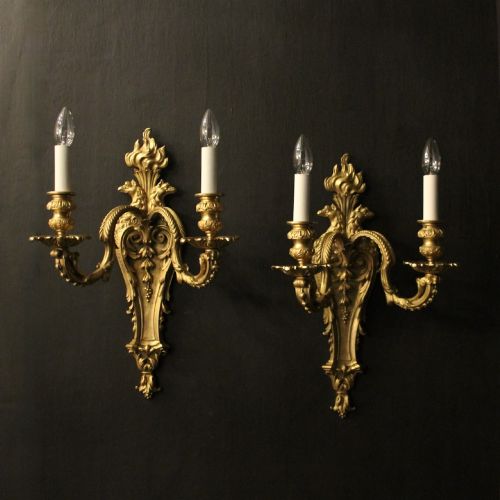
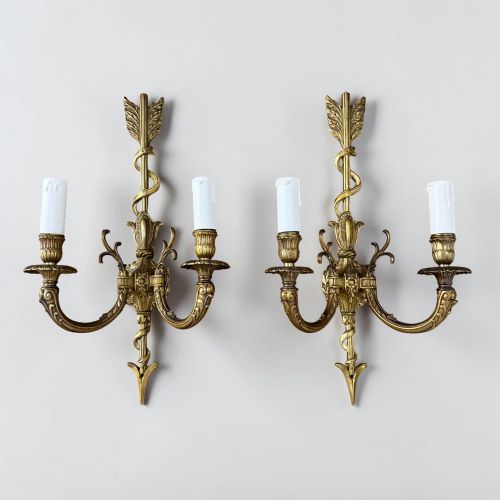
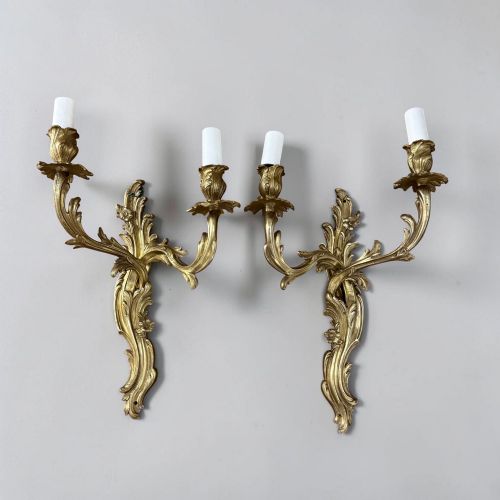
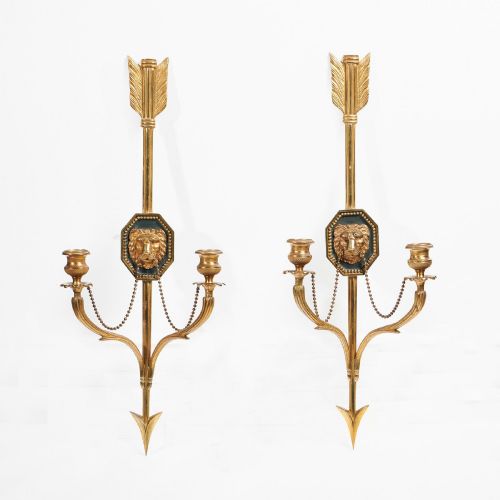
Twin light wall appliques comprise dual-arm lighting fixtures designed to mount directly onto vertical surfaces, providing balanced illumination through two distinct light points. The pieces encountered here emerge predominantly from French origins, alongside examples from English and Italian makers, spanning periods from the nineteenth century through the 1930s.
The dominant forms present as twin-arm wall lights and wall sconces, appearing in configurations ranging from pairs to sets of three, four, or six. Stylistic influences draw heavily on French Rococo, Louis XIV Revival, Empire, Neoclassical, and Florentine designs, integrating elements such as ribbons, cherubs, and crystal drop accents.
Materials span cast and gilded metals, notably brass, bronze, ormolu, and silver giltwood, occasionally paired with burr walnut, green enamel, or Murano glass components. These fixtures reflect both traditional candle-carrying designs and electrified adaptations suited to historic and contemporary interiors alike.
Materials and construction
Metal components utilise brass, bronze, and ormolu, often treated with surface gilding to achieve a reflective metallic sheen across the twin arms and backplates. These metals undergo casting and chasing techniques to produce decorative motifs associated with Rococo and Empire styles.
Wooden elements incorporate giltwood and burr walnut, carved or veneered to form structured backplates and supportive brackets. Silver gilding is applied to wood surfaces in specific Florentine pieces to create a contrasting metallic finish.
Glass and crystal elements, including Murano glass components and crystal drops, complement the metal frameworks by catching and dispersing light from the dual branches.
Twin Light Wall Appliques Retail Price Guide 2026
Typical asking prices for twin light wall appliques among the pieces listed under this phrase on Sellingantiques today, from the lower quarter to the upper quarter. They describe what is for sale here now, not the wider market.
Listings feature brass, gilded bronze, ormolu, and giltwood materials across Victorian, Edwardian, and twentieth-century periods.
The markers of distinction
The definition and depth of the chasing on bronze and brass surfaces dictate the visual impact of the metalwork, separating sharply rendered cast details from softer, worn impressions. Heavier gauge metalwork provides structural rigidity to the twin arms and backplates.
The application and preservation of gilding influence the overall appearance, where intact layers of ormolu or gold leaf retain their intended luminosity. Secondary materials, such as integrated Murano glass or carved giltwood, show varying degrees of sculptural ambition and material purity.
Proportion and symmetry between the paired branches determine the visual balance of the fixture when mounted, distinguishing unified matched pairs from pieces with discrepancies.
F. & C. Osler·Maison Baguès
The Twin Light Wall Appliques Glossary
- Applique
- A wall-mounted lighting fixture designed to hold candles or electric lamps. These pieces project outward from vertical surfaces.
- Ormolu
- Gilded bronze utilised for decorative mounts and metalwork on furniture and lighting. This technique involves applying finely ground gold-mercury amalgam to bronze.
- Giltwood
- Timber treated with a thin layer of gold leaf or powder over a prepared gesso ground. This finish decorates carved wooden wall fixtures.
- Sconce
- A wall bracket light fixture historically utilised for holding candles. Modern interpretations accommodate electrical wiring.
- Rococo
- An ornate design style characterised by asymmetrical scrolls, plant motifs, and C-curves. This aesthetic heavily influences nineteenth and twentieth-century French metalwork.
Twin Light Wall Appliques: Frequently Asked Questions
How do I install them?
These wall lights mount directly onto vertical surfaces using backplates secured with appropriate fixings. Professional wiring ensures safe connection to household electrical supplies.
Placement height depends on room proportions and ceiling height, typically positioning the fixtures at eye level to optimize illumination and visual balance.
Are they wired for electricity?
Many surviving fixtures feature updated electrical wiring suited for modern domestic use, while others retain historical configurations requiring conversion.
Buyers should examine specific listings to confirm whether electrical components meet current safety standards or require rewiring by a qualified electrician.
How do I clean gilded bronze?
Maintenance requires gentle dusting with a soft, dry cloth to prevent accumulation on intricate cast surfaces. Moisture and abrasive cleaners damage delicate gilt layers.
Preserving the original metal surface relies on avoiding chemical polishes that strip historical ormolu or surface gilding.
What periods do they represent?
The available selection spans the nineteenth century, the Edwardian era, and the 1930s, incorporating revival styles from earlier French reigns.
Identifying periods involves examining casting techniques, fastening methods, and stylistic motifs characteristic of specific manufacturing decades.