



Twentieth Century Marine Art
Twentieth century marine art brings coastal landscapes, naval vessels and harbour scenes into a room through oil and watercolour paintings.
Twentieth Century Marine Art
Twentieth century marine art encompasses paintings created across the decades from the Edwardian era through to the nineteen-sixties, recording coastal views, working ports and naval operations. The pieces on this page lean heavily towards British and French coastal subjects, executed in oils and watercolours by regionally recognised painters.
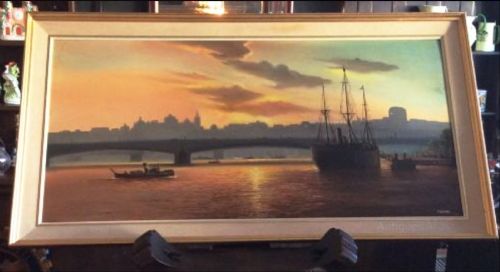
Buyers encounter oil paintings on canvas and board alongside delicate watercolours on paper, framed predominantly in wood. These works capture specific locations such as St Ives, Runswick Bay and the Thames at Waterloo Bridge, alongside broader maritime scenes of fishing boats and sea battles.
The selection ranges from early twentieth century impressions to mid-century modernist interpretations of the coast. Subjects stretch from tranquil harbour anchorages to dramatic depictions of historic vessels like the RMS Lusitania and naval seaplane carriers.
Assessing quality
Quality in these paintings rests upon the surety of the drawing and the artist's command of atmospheric light over water. Stronger works demonstrate a convincing sense of space and movement in the depiction of waves, skies and vessels.
The distinction between a standard topographical record and a superior piece lies in the handling of tone and colour harmony. Works by established painters associated with regional schools tend to show greater compositional confidence than anonymous decorative pieces.
Listings feature works from the nineteen-tens through to the nineteen-sixties, executed in oil and watercolour on paper, canvas and wood.
Clifford Hanney·Vincenzo D’Esposito·Robert Leslie Howey·Frank H. Mason·Ernest F. Hill·William Lambert Bell·Frank Wood·Owen Bowen·Harold E Frecker·William Savage Cooper·Edmund Gouldsmith·Paul-Louis Barruel·Snaffles·Maurice Sijs·Rowland Henry Hill
The Twentieth Century Marine Art Glossary
- Coble
- A traditional type of open fishing boat native to the north-east coast of England, distinguished by a high bow and flat bottom. These craft frequently feature in regional marine watercolours.
- Gouache
- An opaque watercolour paint consisting of pigment mixed with a water-binding agent and a white inert material. Painters used it alongside transparent watercolour to create solid highlights on water and clouds.
- Newlyn School
- An art colony based in Cornwall during the late nineteenth and early twentieth centuries. Painters associated with this group worked out of doors to capture natural light in coastal settings.
- Post-Impressionism
- A predominantly French art movement that developed roughly between eighteen-eighty-six and nineteen-fourteen. It extended Impressionism while rejecting its limitations, favouring more structured forms and expressive use of paint.
Twentieth Century Marine Art: Frequently Asked Questions
What subjects appear in twentieth century marine art?
The works depict coastal landscapes, busy harbours, fishing fleets and naval vessels. Scenes range from quiet Cornish coves to industrial rivers and historic sea battles.
Artists recorded specific locations across Britain and France, capturing the daily life of coastal communities alongside working ships and liners.
How do I distinguish watercolours from oil paintings?
Watercolours are painted on paper and typically displayed behind glass within a frame. They rely on transparent washes of pigment that allow the white of the paper to illuminate the composition.
Oil paintings use thick pigments suspended in drying oil, applied to canvas or wood board. They present a textured surface that reflects light differently from works on paper.
Where were these marine artists active?
Many painters based themselves in established coastal art colonies such as St Ives and Newlyn in Cornwall. Others travelled along the Yorkshire coast, Brittany and the Thames.
Their choice of location was driven by the presence of fishing fleets, dramatic cliffs and bustling ports that offered immediate visual material.
How should I frame and care for a marine painting?
Paintings on canvas or board benefit from stable indoor environments away from direct sunlight and excessive humidity. Traditional wood frames protect the edges of the canvas and complement the period of the artwork.
Watercolours on paper require acid-free mounts and glass protection to prevent fading of the pigments over time. Regular gentle dusting of the frame helps maintain the overall condition.