
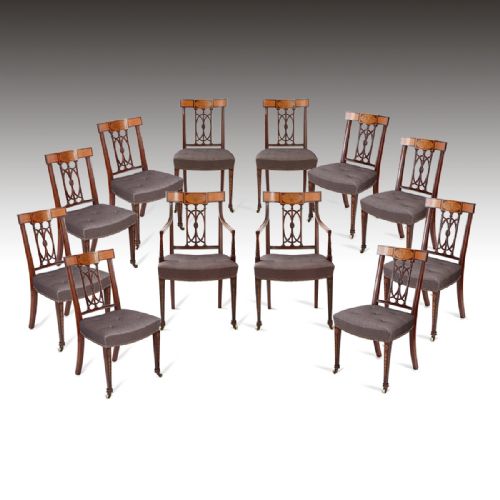
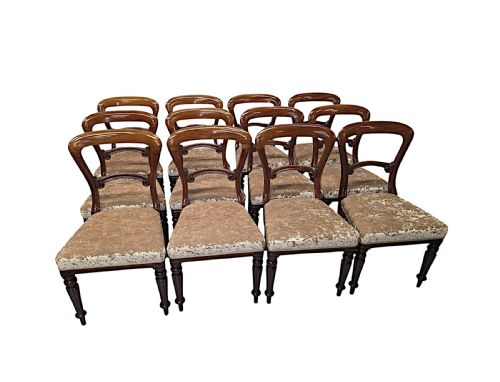
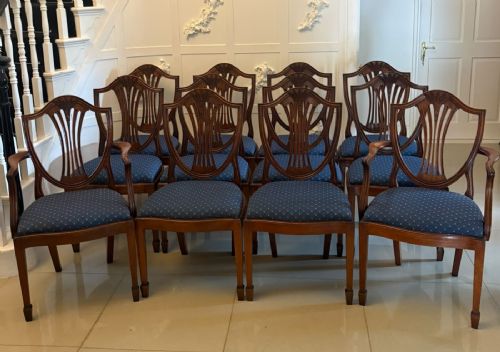
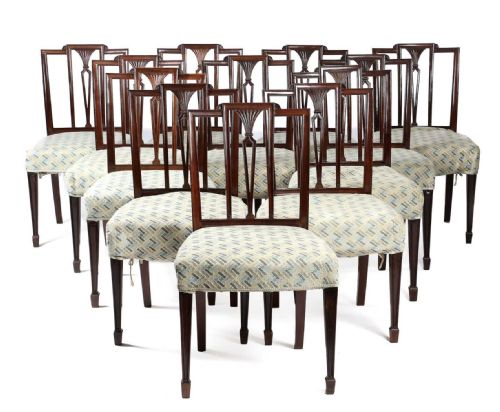

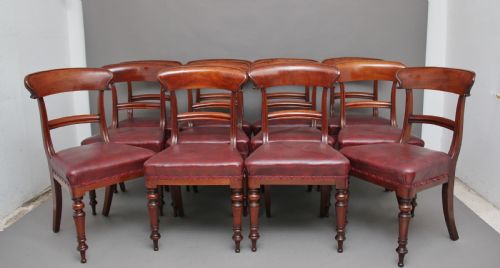


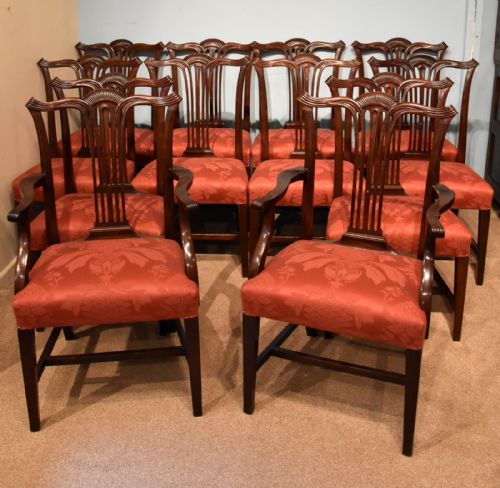
Twelve Mahogany Dining Chairs
These twelve mahogany dining chairs bring generous seating capacity together with robust timber framing for formal dining rooms.
Twelve Mahogany Dining Chairs
Twelve mahogany dining chairs satisfy the demand for large, uniform seating arrangements suitable for substantial dining tables. A buyer searching for twelve mahogany dining chairs encounters sets spanning the 18th century through to the late 19th and early 20th centuries. These groupings typically comprise a combination of single chairs and carvers, offering matched armchairs for the heads of the table alongside side chairs.
The prevalent forms draw heavily on established design vocabularies including Chippendale, Regency, Hepplewhite, and Victorian balloon back styles. Many examples incorporate fabric, leather, or velvet upholstery across drop-in or padded seats, while others retain exposed timber framing. Sets frequently emerge as assembled or matched groups rather than original single-workshop productions, though intact suites from prominent makers do survive.
How they were made
Makers utilised solid mahogany for structural integrity, often selecting dense Cuban mahogany for exceptional figure and weight in finer periods. Timber components were shaped using traditional joinery techniques, incorporating carved splats, pierced backs, and moulded rails.
Surface ornamentation frequently involved subtle inlay work using satinwood, alongside brass details where appropriate. Seats were traditionally stuffed with upholstery materials and covered in durable textiles or leather to provide functional comfort.
Several sets thoughtfully include precisely ten side chairs and two carvers, sparing hosts the awkward arithmetic of seating twelve hungry guests.
What varies in quality
Quality in twelve mahogany dining chairs rests upon the consistency of the timber grain across the entire set and the crispness of any carved detailing. Uniformity in colour and patination distinguishes a cohesive suite from a group pieced together over time.
The structural robustness of the joints and the depth of the mahogany timber dictate the longevity and overall presence of the chairs. Subtle refinements in proportion and the finesse of stylistic execution separate standard utilitarian seating from exceptional workshop productions.
Gillows·Marsh, Jones and Cribb·James Garvie and Sons·James Shoolbred and Co
The Twelve Mahogany Dining Chairs Glossary
- Carver
- An armchair designed to match a set of dining chairs, typically placed at the head of a dining table. These pieces feature integrated armrests for added support.
- Balloon back
- A rounded, curved chair back popular during the Victorian era that resembles the outline of a balloon. This style provided ergonomic comfort through its flowing timber frame.
- Shield back
- A chair back shaped in the form of a heraldic shield, characteristic of Hepplewhite designs. This form often incorporates delicate pierced splats and inlaid decoration.
- Ribbon back
- An intricate carved chair back design where the central splat mimics intertwined ribbons or fluttering fabric. This labour-intensive style is frequently associated with Chippendale interpretations.
- Splat
- The vertical central slat of timber running from the seat up to the top rail of a chair back. It provides structural support while offering a canvas for decorative carving.
Twelve Mahogany Dining Chairs: Frequently Asked Questions
How do I spot a matched set?
Examine the timber grain, colour tone, and subtle variations in carving depth across all twelve chairs. Matched sets often reveal minor discrepancies in construction or timber selection that indicate individual chairs were gathered together later.
Look closely at the underside of the seat frames and the joinery methods used. Consistent tool marks and uniform wear patterns help confirm whether the chairs originated as a single unified suite from a workshop.
What is the difference between single chairs and carvers?
Single chairs are built without armrests to allow multiple pieces to tuck neatly along the sides of a dining table. Carvers feature integrated arms and slightly wider proportions, intended specifically for the ends of the table.
Traditional dining sets typically paired ten single chairs with two carvers to maintain symmetry. This arrangement offered designated seating for hosts while preserving space for guests.
How should I care for mahogany dining chairs?
Maintain the timber by keeping the chairs away from direct sunlight and strong heat sources that can dry out the mahogany. Regular dusting with a soft, dry cloth preserves the natural polish without building up excess residue.
Inspect the upholstery periodically and ensure the structural joints remain stable under normal use. Professional maintenance of the polish and fabric safeguards the long-term condition of antique seating.
How do I identify Regency style features?
Regency style dining chairs often display classical influences derived from ancient Roman and Greek designs. Look for sabre legs, reeded framing, and restrained brass inlay rather than heavy carving.
The timber selection in Regency pieces is frequently dark and heavily figured, emphasising clean architectural lines and balanced proportions. This restrained aesthetic distinguishes Regency work from earlier, more ornate Georgian periods.