
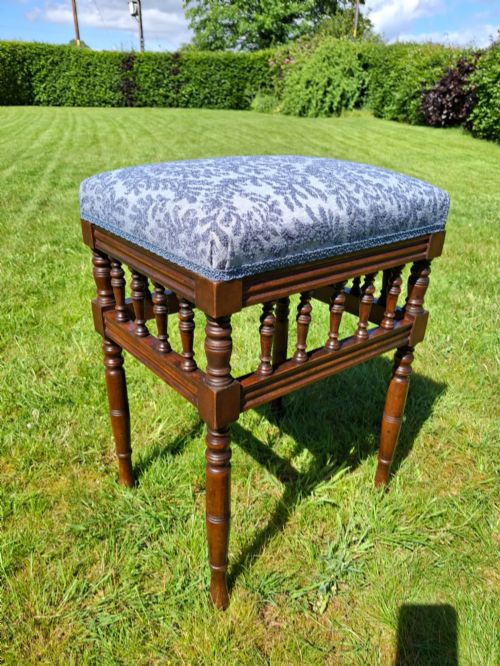


Turned Leg Music Seat
A turned leg music seat offers the steady support and practical adjustment needed at the keyboard, combining everyday utility with period character.
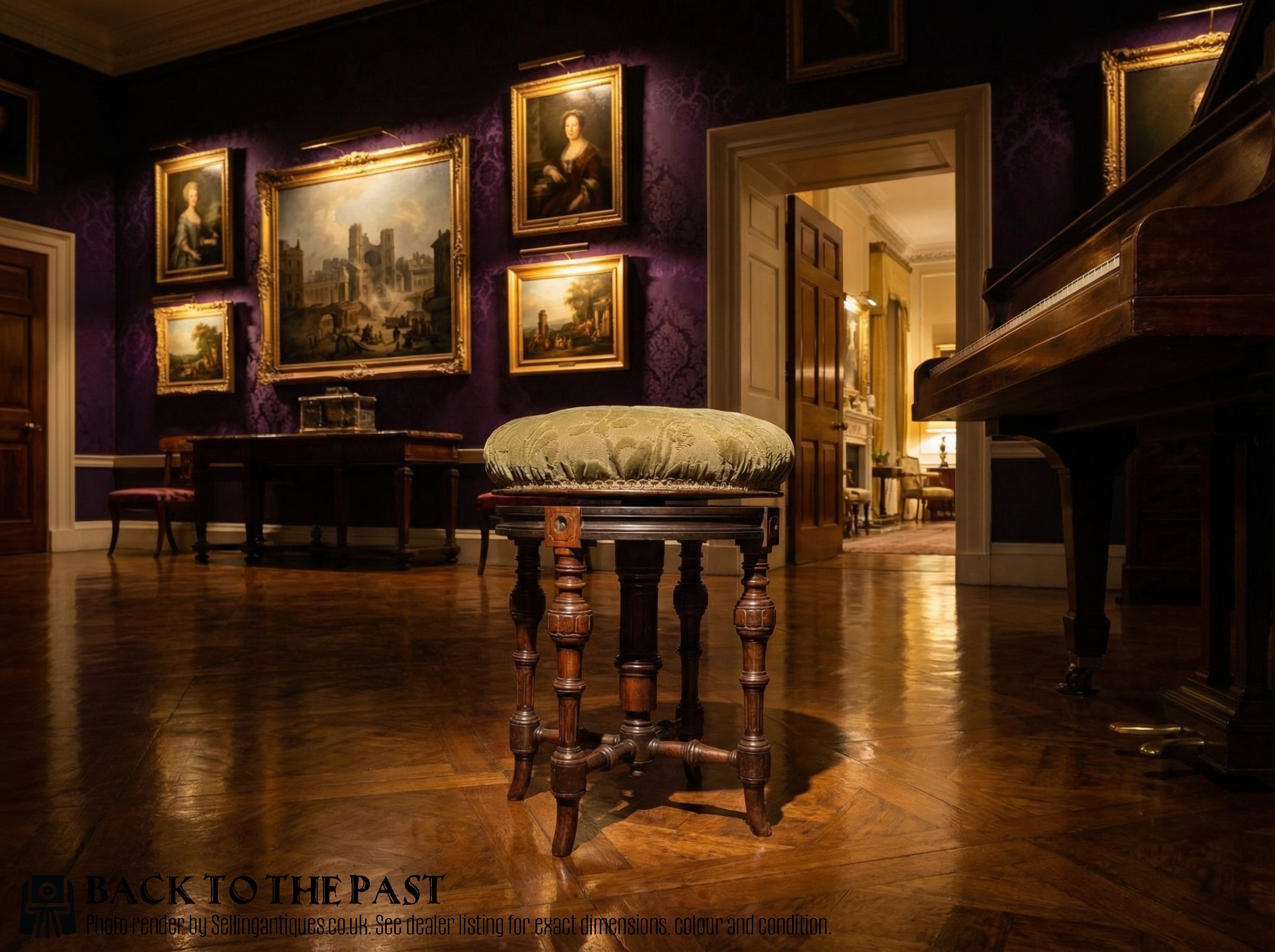
Turned Leg Music Seat
When you search for a turned leg music seat, you encounter piano stools and piano seats dating from the nineteenth and early twentieth centuries. These pieces were designed for the upright and grand pianos of the parlour, providing a firm perch for the musician.
You are most likely to meet Victorian and Edwardian examples on this page, alongside occasional Regency and early twentieth-century pieces. Mahogany is the dominant timber, often paired with ebonised wood or rosewood.
Many of these designs feature swivel tops or adjustable mechanisms that alter the height of the seat. They take the form of single stools or wider duet stools intended for shared playing.
How they were made
The construction relies heavily on solid mahogany, rosewood, and ebonised wood turned on a lathe to create the characteristic legs. Cabinet makers shaped these timbers to support the twisting mechanisms of revolving tops and adjustable screws.
Upholstery forms the upper portion of the seat, utilising materials such as fabric, velvet, and textile over padding. Brass components are frequently incorporated into the revolving screw mechanisms and foot caps.
The listings on this page span the nineteenth and early twentieth centuries, featuring mahogany, rosewood, and ebonised wood alongside fabric and velvet upholstery.
What varies in quality
The sophistication of the revolving or adjustable mechanism dictates much of the distinction between standard examples and finer workshop pieces. Smooth action in the screw thread or swivel joint shows the care taken by the maker.
The choice of dense timbers such as rosewood or figured mahogany, combined with well-executed woodturning on the legs, separates robust utilitarian pieces from more decorative seating.
Gillows·James Shoolbred·H Brooks and Co
The Turned Leg Music Seat Glossary
- Duet stool
- A wider seat designed to accommodate two people playing the piano together. These often share the turned leg styling of single stools.
- Ebonised wood
- Timber treated to resemble ebony, creating a dense black finish popular on nineteenth-century piano seating.
- Revolving top
- A seat mechanism that rotates 360 degrees on a central wooden or metal screw thread, allowing the player to adjust their position.
- Swivel base
- An alternative term for a revolving mechanism that permits the upper portion of the stool to turn freely.
Turned Leg Music Seat: Frequently Asked Questions
How do I adjust the height on these?
Many of these seats use a central wooden or metal screw mechanism hidden beneath the upholstery. Turning the top clockwise or anti-clockwise raises or lowers the sitting surface.
Some models feature a side handle or lever to lock the height once adjusted to the player's preference.
Were these seats only used for pianos?
While primarily designed as piano stools to assist musicians at the keyboard, their stable proportions made them useful as general parlour seating. The adjustable height also suited writing desks and dressing tables.
Today, they function equally well as occasional chairs or small side tables in domestic interiors.
How do I tell Victorian from Edwardian pieces?
Victorian examples often feature heavier proportions, rich mahogany or ebonised finishes, and elaborate turnings. They frequently incorporate cast iron or brass mechanical parts within the swivel base.
Edwardian pieces tend to display lighter framing, more restrained decoration, and simpler turned leg profiles reflecting changing interior tastes.
Are duet stools harder to find?
Duet stools appear less frequently than single piano stools because fewer were manufactured for standard domestic parlours. Their wider proportions accommodated two players sharing a musical score.
They require more floor space than single variants but share the same turned leg construction and upholstery styles.