

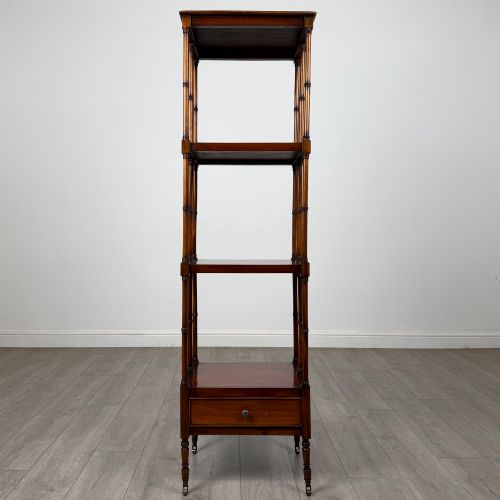
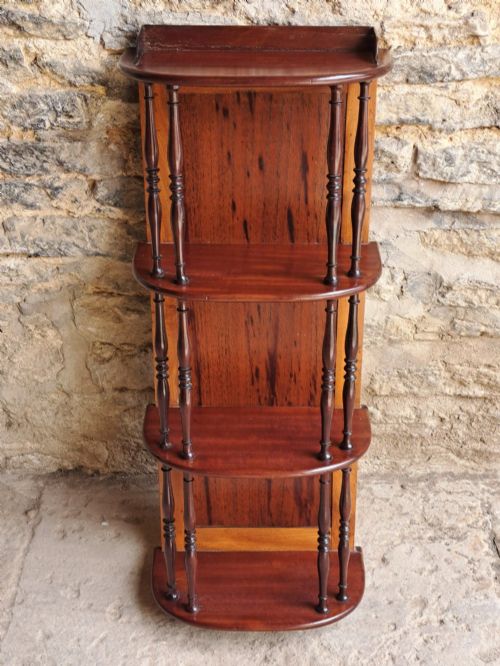
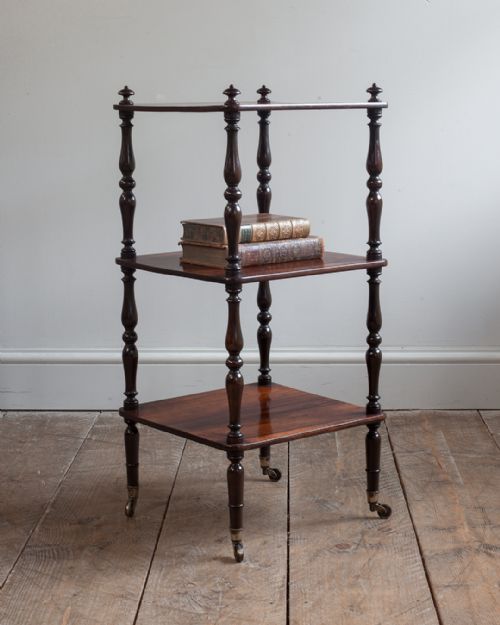
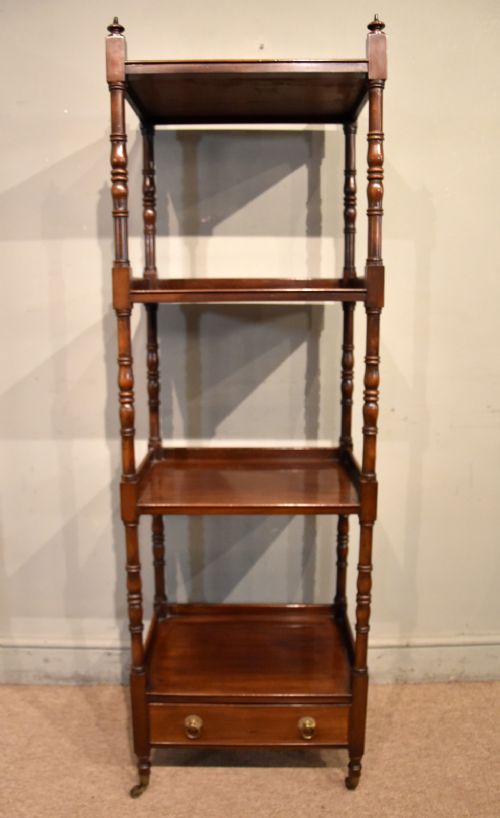




Turned Column Tier Shelf
Turned column tier shelf designs provide tiered display space through stacked open platforms supported by slender vertical timber or brass shafts.
Turned Column Tier Shelf
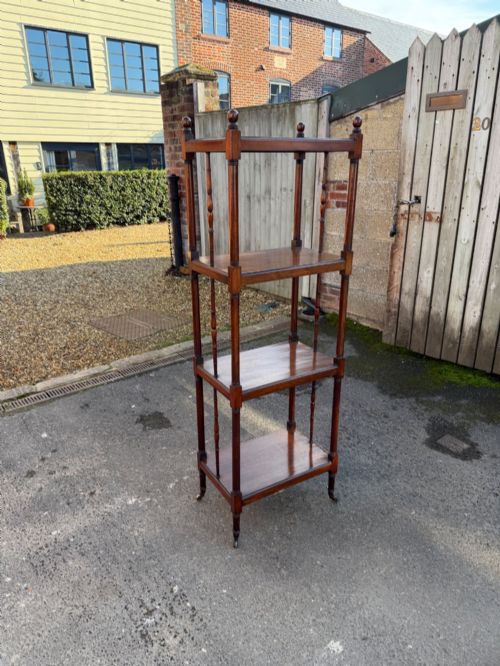
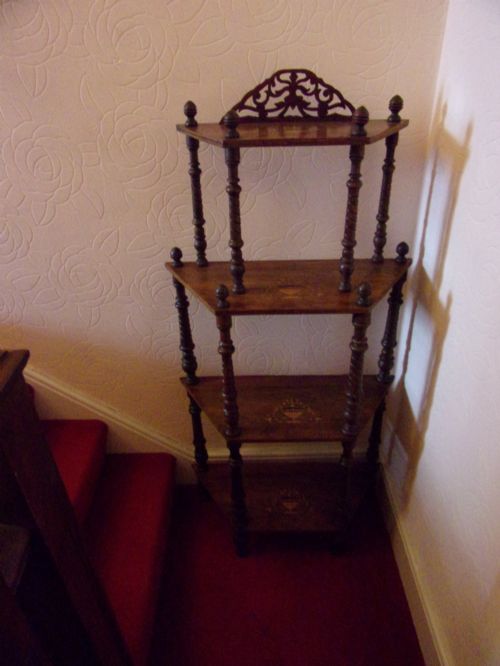
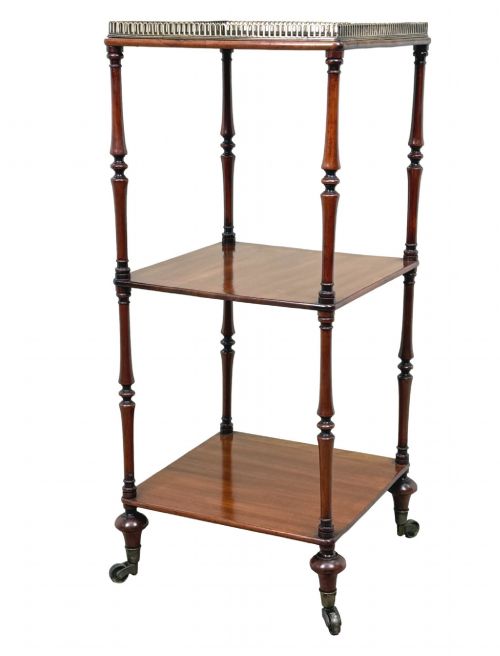
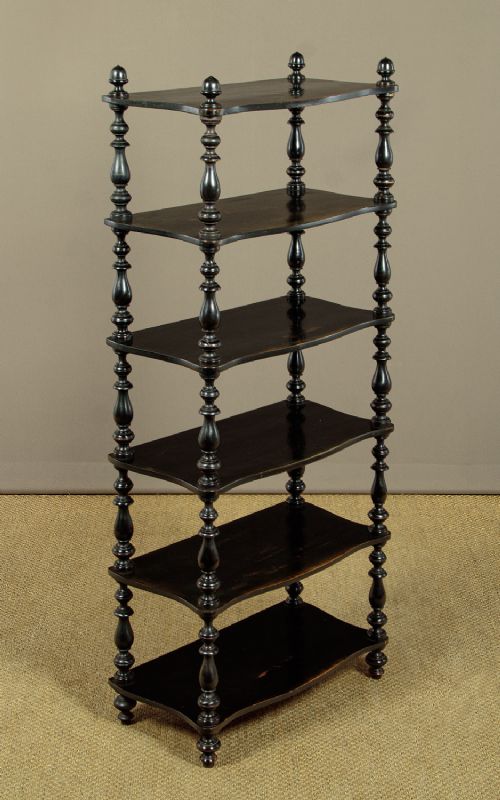
A turned column tier shelf takes the form of an open display stand, whatnot, or étagère, designed to hold books, ornaments, and small objects across multiple levels. These pieces appear most frequently in mahogany, walnut, and rosewood, spanning Georgian, Regency, and Victorian periods.
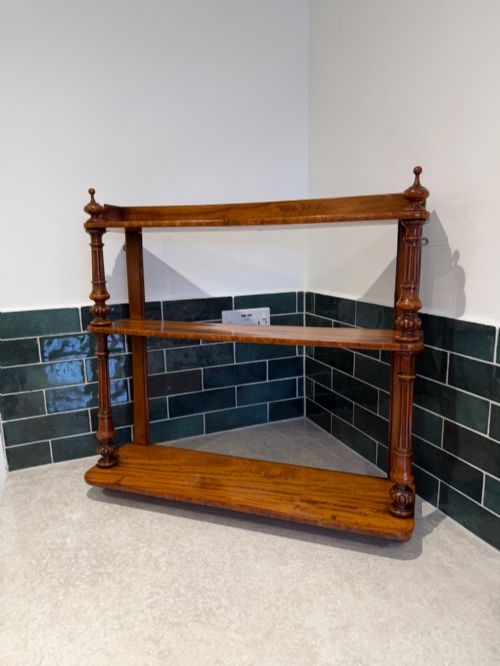
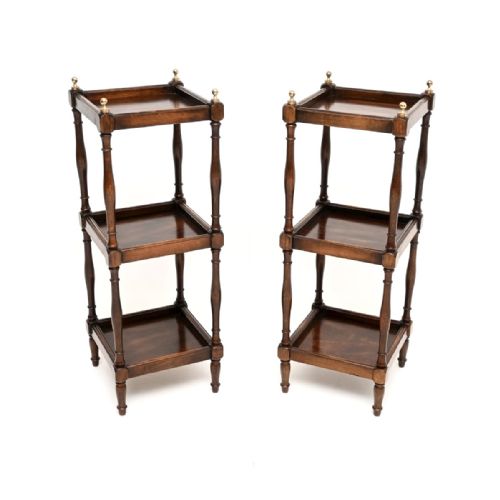
The layout relies on a vertical stack of graduated or uniform shelves held apart by slender turned pillars, columns, or upright supports. Buyers encounter freestanding standing models alongside smaller wall-hanging variations and corner configurations.
Origins stretch from the late eighteenth century through the nineteenth century, encompassing Georgian, Regency, William IV, and Victorian iterations. Makers utilised decorative timbers including satinwood, burr walnut, and ebonised wood to build these multi-tiered storage forms.
Materials and construction methods
Carpenters constructed these tier shelves primarily from dense hardwoods such as mahogany, walnut, and rosewood, often accenting surfaces with satinwood inlay or birdseye maple veneers. Structural stability depended on accurately turned vertical pillars and upright supports secured between horizontal platforms.
Joinery combined traditional corner posts and threaded or dowelled columns to bear the weight of stacked tiers without warping. Brass details occasionally appeared as galleries, finials, or structural accents on Regency and Victorian iterations.
Turned Column Tier Shelf Retail Price Guide 2026
Typical asking prices for turned column tier shelf among the pieces listed under this phrase on Sellingantiques today, from the lower quarter to the upper quarter. They describe what is for sale here now, not the wider market.
Listings span Georgian, Regency, and Victorian periods, utilising mahogany, walnut, rosewood, and satinwood across whatnot and étagère forms.
Distinctions in build and design quality
Superior examples separate themselves through the selection of finely figured timbers like burr walnut, rosewood, and satinwood, contrasted with plain or secondary woods on lesser pieces. The precision of the turning on the supporting columns and the crispness of any inlaid decoration dictate the refinement of the finished stand.
The Turned Column Tier Shelf Glossary
- Whatnot
- An open shelving unit with multiple tiers designed for displaying ornaments and small decorative objects. These pieces first appeared in the eighteenth century and remained popular throughout the Victorian era.
- Étagère
- A French term for a piece of furniture consisting of a set of open shelves for holding small articles. They match the tier shelf form closely in function and appearance.
- Column
- A vertical structural element that supports the individual shelves in a tier unit. Turned examples feature circular profiles shaped on a lathe.
- Inlay
- A technique where pieces of contrasting timber, such as satinwood, are inserted into recessed cavities on the primary surface to create decorative patterns.
- Dumb Waiter
- A tiered serving stand or multi-level shelving unit used originally for holding dishes or books. These freestanding pieces often incorporate turned central pillars.
Turned Column Tier Shelf: Frequently Asked Questions
What is a turned column tier shelf used for?
These pieces function as open display furniture for books, ceramics, and decorative objects across multiple horizontal platforms.
Historically, they served in drawing rooms and parlours to keep small possessions accessible yet organised off the floor.
How do I identify a Regency tier shelf?
Regency examples typically feature dense mahogany construction, restrained classical proportions, and finely turned upright pillars.
They often display clean lines without the heavy carved ornamentation seen on later Victorian versions.
Are these shelves freestanding or wall mounted?
The majority of pieces function as freestanding floor-standing units supported by turned columns at the corners.
Certain variations are built specifically for hanging on walls or fitting directly into room corners.
What woods were used for these shelves?
Cabinetmakers worked predominantly with imported hardwoods including mahogany, rosewood, and walnut.
Finer versions incorporated decorative veneers such as satinwood, burr walnut, and birdseye maple alongside ebonised finishes.