
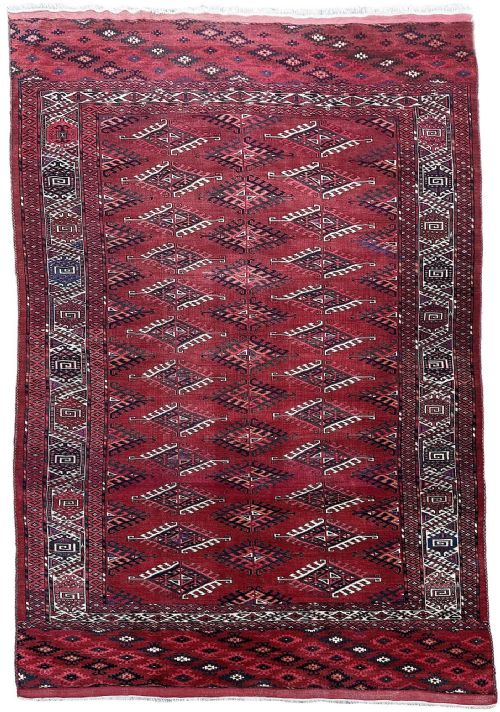


Turkmen Gol Rug
These turkmen gol rug pieces bring centuries of Central Asian tribal artistry into a modern room through bold geometric motifs and rich red wool.
Turkmen Gol Rug
A turkmen gol rug is a woven textile featuring the characteristic octagonal medallion known as a gol, originating from Central Asian tribal weaving traditions. These pieces include large carpets, smaller dowry rugs, torbas, and fragmentary survivals from various nomadic groups.
The versions most commonly met on this page span from the eighteenth century up to around nineteen hundred, representing distinct tribal groups such as the Yomut, Salor, Tekke, and Ersari. They appear as both complete floor coverings and smaller utilitarian hangings or storage bags.
How they were made
Weavers constructed these textiles primarily using hand-spun wool for the pile, set against foundations often composed of wool, cotton, or linen. Natural dyes provided the characteristic warm red colour palettes seen across the tribal groups.
The manufacture relied entirely on traditional hand-knotting techniques executed by tribal makers in locations such as the Akhal and Merv oases. Dense knotting yielded the fine weave observed in smaller dowry examples and larger floor carpets alike.
Nomadic weavers packed these portable geometric treasures full of dreams and dowries before crossing the windswept Central Asian oases.
What varies in quality
Quality in these textiles depends heavily on the density and fineness of the weave, which dictates the crispness of the geometric gol motifs. Early examples and specific tribal pieces such as fine Tekke dowry rugs demonstrate exceptional precision in knotting.
The depth and vibrancy of the natural dyes also set the standard for these weavings, alongside the intactness of the piece. Complete carpets and well-preserved fragments each show distinct grades of wool preparation and chromatic balance.
The Turkmen Gol Rug Glossary
- Gol
- The primary octagonal medallion motif repeated across the field of these tribal weavings. Each tribe utilised distinct variations of this design.
- Torba
- A small, wide tribal bag face used for wall storage inside a yurt. These pieces display finely detailed gul patterns in miniature scale.
- Chuval
- A large storage bag face produced by nomadic weavers. They often survive as prized textile fragments preserving ancient tribal designs.
- Mafrash
- A rectangular storage bag panel or end piece. These objects showcase secondary tribal patterns alongside primary gol motifs.
- Dowry rug
- A special weaving created for a bride's household furnishings. Such pieces typically exhibit finer knotting and greater care in execution.
Turkmen Gol Rug: Frequently Asked Questions
How are turkmen gol rug pieces dated?
Dating relies on structural analysis, wool quality, and dye characteristics rather than explicit inscriptions. Early examples often display specific tribal palettes and knot densities associated with eighteenth or nineteenth century production.
Comparison with documented museum pieces and known tribal weaving traits helps narrow the period of origin. Changes in material availability towards the end of the nineteenth century also provide helpful chronological markers.
Where were turkmen gol rug pieces woven?
These textiles originated across Central Asia within nomadic and semi-nomadic tribal territories. Regions such as the Akhal and Merv oases in Turkmenistan served as major centres for groups like the Tekke and Yomut.
Other related groups, including the Ersari and Salor, produced distinctive variations across neighbouring landscapes. The geography of these tribes directly influenced their specific wool sources and dye recipes.
How do I care for a turkmen gol rug?
Gentle vacuuming without a beater bar removes surface dust safely from the wool pile. Keeping the textile out of direct sunlight preserves the natural red dyes over time.
Professional cleaning by specialists familiar with antique tribal textiles prevents damage to the foundation fibres. Allowing adequate airflow beneath the piece prevents moisture accumulation.
What is a gol motif?
A gol is the recurring octagonal medallion that acts as the focal point of these tribal designs. These shapes served as tribal emblems or totemic markers identifying specific groups.
Mastering the precise rendering of a gol required traditional knowledge passed down through generations of weavers. Variations in the internal quarters of the motif distinguish one tribe from another.