
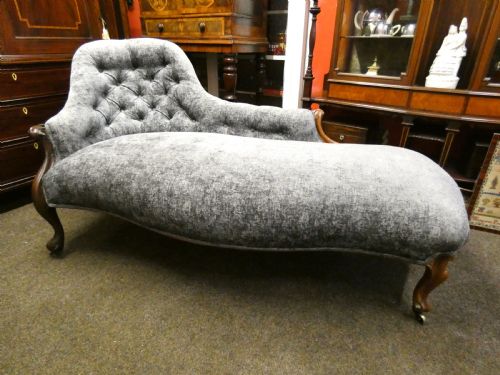
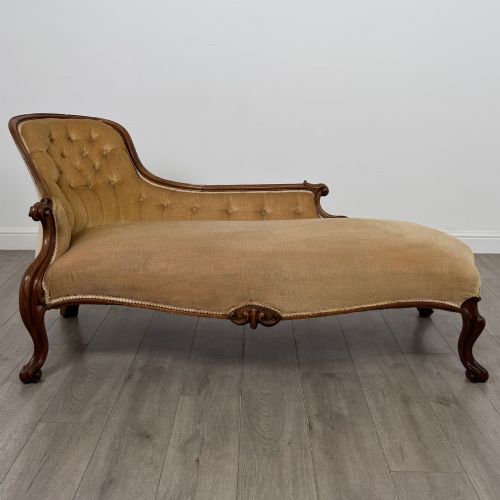
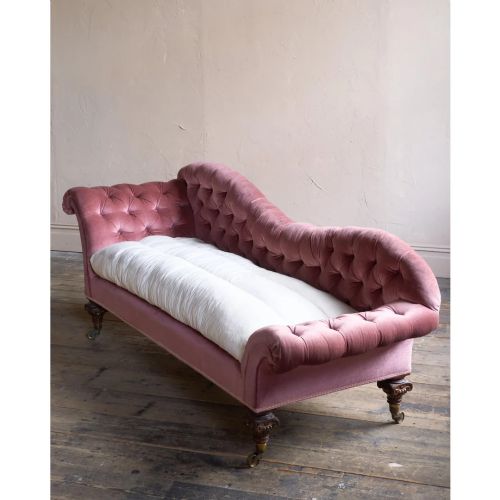
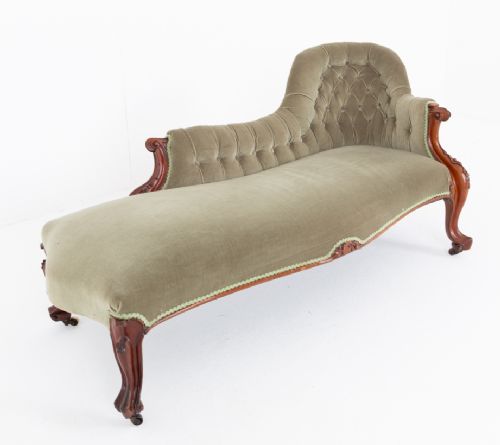


Tufted Velvet Chaise Longue
A tufted velvet chaise longue offers deep upholstery and a reclined seat, bringing a classic resting form into your room.
Tufted Velvet Chaise Longue
A tufted velvet chaise longue brings together 19th Century and Victorian seating forms designed for reclining and lounging. You encounter examples shaped as day beds, kidney sofas, and conversation seats alongside traditional single-ended forms.
The pieces on this page span the Regency period through the Victorian era, utilising diverse frames. Standard variations include carved rosewood, mahogany, and walnut structures, often featuring buttoned upholstery and low-backed profiles.
Makers and workshops of the 19th Century produced these day beds and settees for domestic drawing rooms and salons. The primary focus remains on single-ended lounging designs with deep buttoning and padded arm supports.
How they were made
Construction relies on dense timber frames of mahogany, rosewood, and walnut, providing a rigid structural base for the upholstered upper sections. Carved details and turned components appear on legs and supports.
Upholstery techniques involve plush velvet stretched over deep buttoning, securing the inner padding firmly to the frame. Brass casters and iron hardware frequently support the wooden feet for mobility.
Listings feature nineteenth-century seating constructed from mahogany, rosewood, and walnut, upholstered in velvet.
What varies in quality
The sculptural refinement of the wooden frame separates standard joinery from superior cabinet work, particularly in carved rosewood or mahogany. Crisp detailing on Ionic columns or barley twist turnings demonstrates higher craftsmanship.
The execution of the velvet buttoning and the tautness of the sprung upholstery define the interior build quality. Denser frames and substantial hardwood structures maintain their integrity across the Victorian periods better than lighter alternatives.
Howard and Sons
The Tufted Velvet Chaise Longue Glossary
- Chaise longue
- An elongated chair for reclining, combining the characteristics of a chair and a sofa. These pieces feature a single raised end for head support.
- Buttoned
- An upholstery technique where buttons are pulled deep into the padding to create a tufted diamond pattern. This secures the filling and adds texture.
- Day bed
- A long seat designed primarily for resting or sleeping during daytime hours. They appear frequently within nineteenth-century domestic interiors.
- Barley twist
- A type of decorative wood turning resembling a twisted rope. This detail often appears on the legs or structural frames of Victorian furniture.
- Ionic column
- A classical architectural column style featuring scroll-shaped ornaments on the capital. Some nineteenth-century day beds utilise these carved forms as structural supports.
Tufted Velvet Chaise Longue: Frequently Asked Questions
What is a tufted velvet chaise longue?
A tufted velvet chaise longue is a nineteenth-century reclining seat designed with deep button upholstery and an extended deck for resting.
These pieces combine wooden frames in mahogany or rosewood with plush fabric coverings to create a statement seating option.
How were nineteenth-century day beds used?
Nineteenth-century day beds and chaise longues served as comfortable lounging furniture for drawing rooms, boudoirs, and parlours.
Occupants used them for daytime resting, reading, and informal reclining without retiring to a bedroom.
How do I identify a Victorian chaise longue?
Victorian examples typically feature dark timber frames such as walnut, mahogany, or rosewood, paired with buttoned velvet upholstery.
Look for design details like carved woodwork, low armrests, and occasional turned legs supported by brass casters.
Where should I place a chaise longue?
A chaise longue works best positioned against a wall or floating in a spacious room where its single-ended silhouette remains visible.
Ensure adequate clearance around the piece to highlight the carved wooden frame and extended reclining platform.