




Tufted Spoonback Armchair
A tufted spoonback armchair brings nineteenth-century seating comfort and curving timber forms to a room.
Tufted Spoonback Armchair
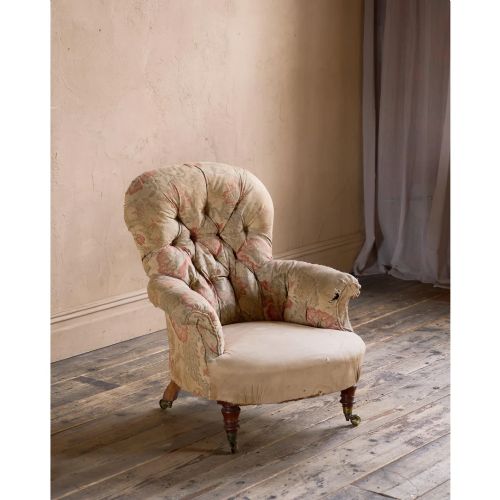
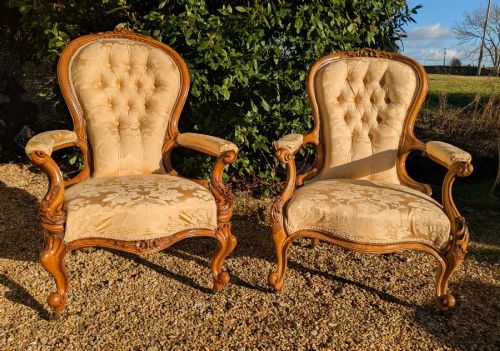
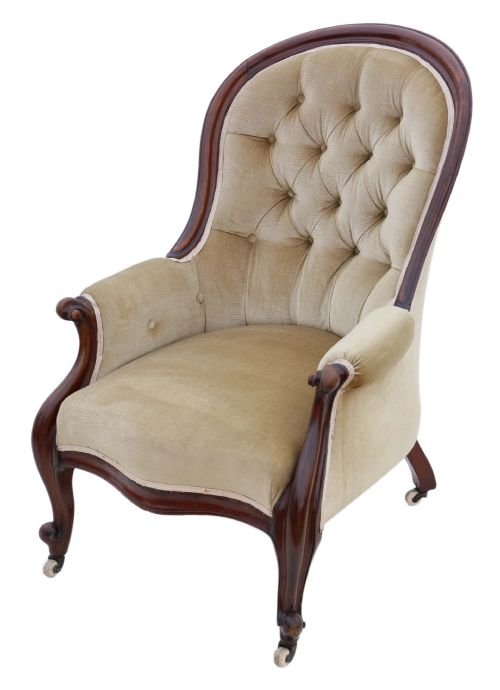
A tufted spoonback armchair is a nineteenth-century seat defined by a curved backrest resembling the bowl of a spoon. These pieces emerge primarily from the Victorian era, spanning dates from eighteen-fifty to eighteen-seventy alongside general nineteenth-century examples. A buyer searching this phrase is looking at Victorian parlour chairs, fireside seating, and gentleman's or ladies' open armchairs.
The most common versions met on this page are Victorian mahogany and walnut framed chairs featuring buttoned upholstery and cabriole legs. Variations include rosewood showwood frames and occasional pieces showing grand Regency style influences with lyre fronts. These chairs combine upholstered comfort with exposed timber frames.
Makers such as Holland and Sons and C. Hindley and Sons produced notable examples during the nineteenth century. The forms range from low fireside seats to larger open armchairs designed for nineteenth-century parlours and drawing rooms.
How they were made
Makers constructed the exposed showwood frames using dense hardwoods like mahogany, walnut, and rosewood. Craftsmen carved these timbers to create the distinctive curved spoonback profile and cabriole legs.
Upholsterers finished the seating using velvet, satin, and various textiles, securing the padding with deep button tufting. Workshops frequently mounted the lower frames on brass castors to aid movement.
Listings feature nineteenth-century pieces from the Victorian era, utilising mahogany, walnut, rosewood, brass, velvet, and satin.
What varies in quality
Quality in a tufted spoonback armchair rests upon the crispness of the timber carving and the selection of the primary wood. Walnut and rosewood showwood frames generally indicate a finer grade of nineteenth-century production compared to standard mahogany.
The sophistication of the frame's structural lines, from the sweep of the spoonback to the shaping of the cabriole legs, separates standard workshop output from pieces bearing maker attributions.
Holland and Sons·C. Hindley and Sons
The Tufted Spoonback Armchair Glossary
- Spoonback
- A chair back shaped with a concave oval recess that resembles the bowl of a spoon. This nineteenth-century form provides ergonomic support to the spine.
- Showwood
- Exposed polished timber on a chair frame where the wood is visible around the upholstered sections. This decorative element highlights the grain of walnut, mahogany, or rosewood.
- Cabriole leg
- A furniture leg that curves outward at the knee and tapers inward toward the foot. The design appears frequently on Victorian seating.
- Castor
- A small wheel mounted on a swivel attached to the base of furniture legs. Brass versions are common on nineteenth-century armchairs to facilitate movement across carpets.
- Buttoning
- Upholstery technique where deep buttons are pulled tight through the padding in a geometric pattern. This creates recessed indentations across the tufted backrest.
Tufted Spoonback Armchair: Frequently Asked Questions
What is a tufted spoonback armchair?
A tufted spoonback armchair is a nineteenth-century seat featuring an oval, concave backrest and buttoned upholstery. These chairs typically display exposed timber frames in mahogany, walnut, or rosewood.
Craftsmen built these pieces during the Victorian era, incorporating styles such as cabriole legs and brass castors for domestic parlour and fireside use.
Where were these armchairs used?
These armchairs served primarily as parlour seating, fireside chairs, and drawing room furniture in nineteenth-century homes. Ladies' and gentleman's variants offered different proportions for sitting.
The inclusion of brass castors allowed owners to reposition the heavy hardwood chairs easily across reception rooms.
What woods were used in these chairs?
Makers relied on durable hardwoods including mahogany, walnut, and rosewood for the exposed showwood frames. These timbers took fine carving along the curved backrests and legs.
Workshops polished the wood to highlight the natural grain beneath the upholstered tufting.