
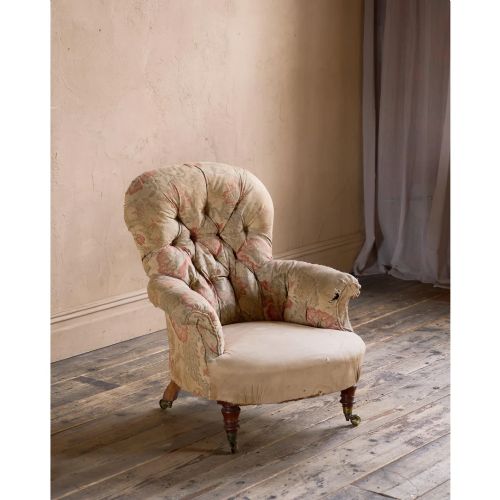
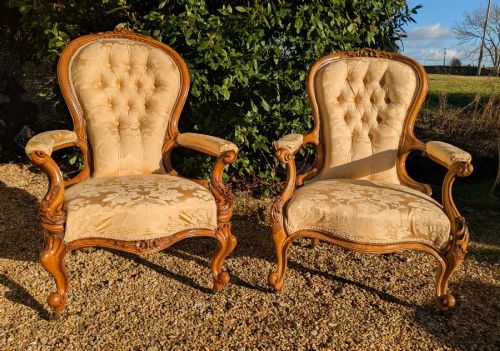
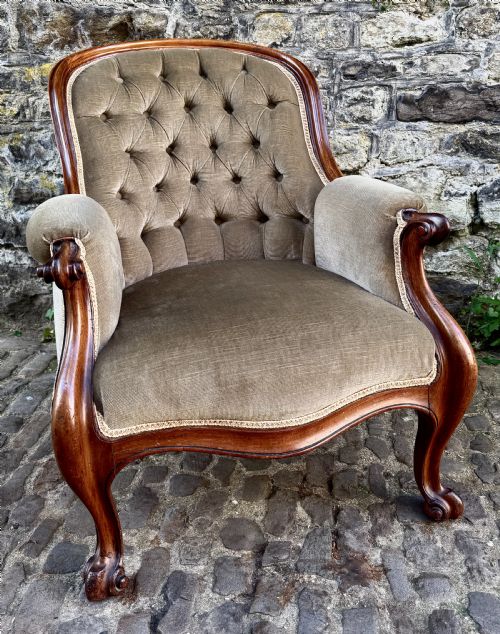
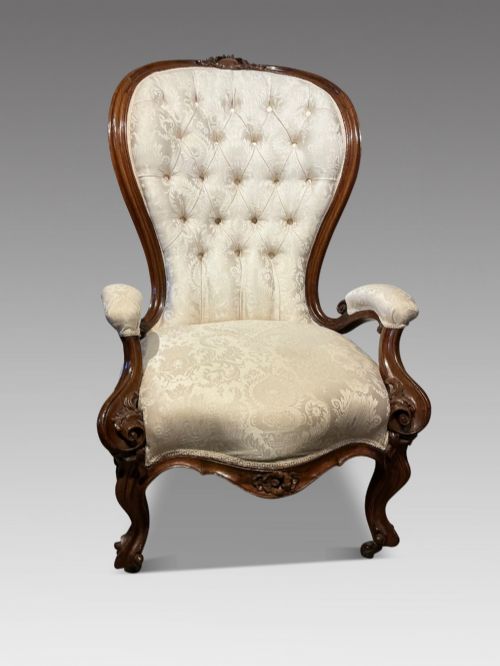
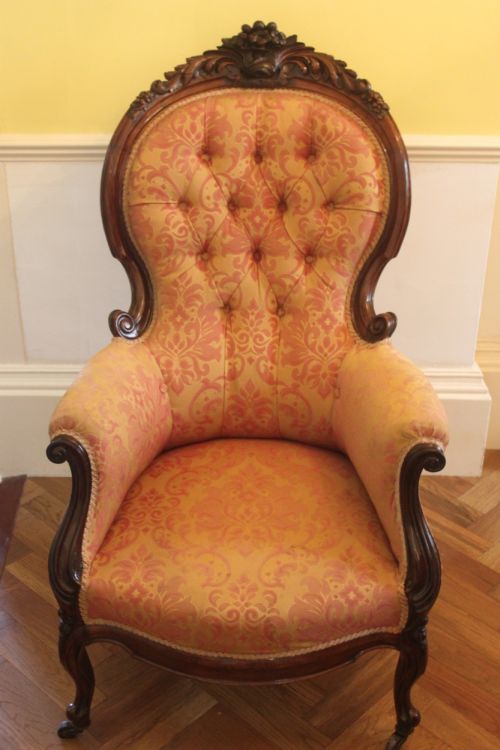
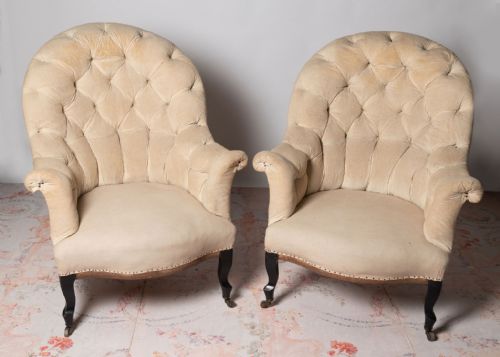


Tufted Spoon Back Armchair
A tufted spoon back armchair offers deep buttoned comfort and curved wooden framing, bringing Victorian parlour elegance straight to the fireside.
Tufted Spoon Back Armchair
A tufted spoon back armchair is defined by its rounded, concave upholstered backrest resembling the bowl of a spoon. When searching for a tufted spoon back armchair, buyers encounter nineteenth-century walnut and mahogany examples originating from the Victorian era.
The selections span gentleman's chairs, ladies chairs, and nursing chairs featuring low seats and scrolling frames. Many pieces display buttoned upholstery in velvet, damask, or fabric, alongside open arms and carved wooden supports.
While the core of the inventory dates from the Victorian period with Rococo Revival styling, occasional Regency and later nineteenth-century interpretations appear. These seating forms served primarily as fireside, salon, or library chairs in period homes.
Materials and construction
Cabinetmakers constructed the supportive frames of these seats using solid walnut and mahogany, often shaping the wood with carved details and cabriole legs. Brass hardware and metal components appear on select pieces, whilst frames sometimes incorporate painted or silver gilt finishes.
Upholstery techniques relied on textile coverings such as velvet, damask, and calico pulled tight over deep buttoning. Craftsmen shaped the characteristic spoon back by steaming and carving timber to cradle the seated figure.
Listings feature Victorian walnut and mahogany frames paired with velvet, damask, and brass.
Markers of quality
The standard of carving on the wooden frame distinguishes superior examples from simpler ones. Crisp, deep relief work on walnut or mahogany indicates skilled hand craftsmanship.
The precision of the buttoning and the choice of textile covering dictate the refinement of the upholstery. Firmness in the sprung seat and balanced proportions in the open arms reveal superior workshop production.
Holland & Sons·C. Hindley & Sons
The Tufted Spoon Back Armchair Glossary
- Spoon back
- An oval or round upholstered backrest with a concave shape that resembles the bowl of a spoon. This distinctive profile emerged during the nineteenth century to fit the human form.
- Button back
- An upholstery technique where twine pulls the fabric deep into the padding to secure rows of fabric-covered or metal buttons. It creates a tufted texture across the backrest.
- Cabriole leg
- A furniture leg that curves outward in a convex arc and then bends inward in a concave arc, terminating in a foot. This form draws on eighteenth-century design revived in Victorian styling.
- Gentleman's armchair
- A generously proportioned upholstered seat featuring low open arms designed for ease of sitting. These chairs typically date from the Victorian era.
- Nursing chair
- A low-seated upholstered chair originally built to assist women with infant care or needlework. They often feature spoon backs without arms or with low padded supports.
Tufted Spoon Back Armchair: Frequently Asked Questions
How do I date a spoon back armchair?
Dating relies on timber choice, leg shape, and upholstery style. Walnut and mahogany frames with deep buttoning typically point to the nineteenth century and the Victorian period.
Subtle shifts from early Victorian proportions to later Rococo Revival carving help narrow the decade of origin.
What is the difference between a gentleman's and a ladies chair?
Gentleman's armchairs are built with broader proportions and open arms to accommodate men's attire and build. Ladies chairs are generally more compact and often lack arms to allow room for wide skirts.
Both share the characteristic curved wooden frame and upholstered back.
Where should I place an antique armchair at home?
These armchairs suit fireside settings, studies, or bedrooms as accent seating. Their curved wooden backs look striking when viewed from behind in an open room.
Pairing them with low tables or reading lamps highlights their nineteenth-century silhouette.
Are these chairs comfortable for daily use?
The sprung seats and padded buttoned backs provide robust support suited to relaxed sitting. The low seat height is designed for drawing room comfort.
Upholstered cushioning varies by piece depending on whether the internal webbing and padding remain original or have been restored.