

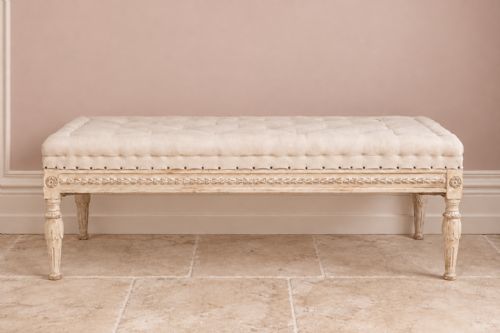
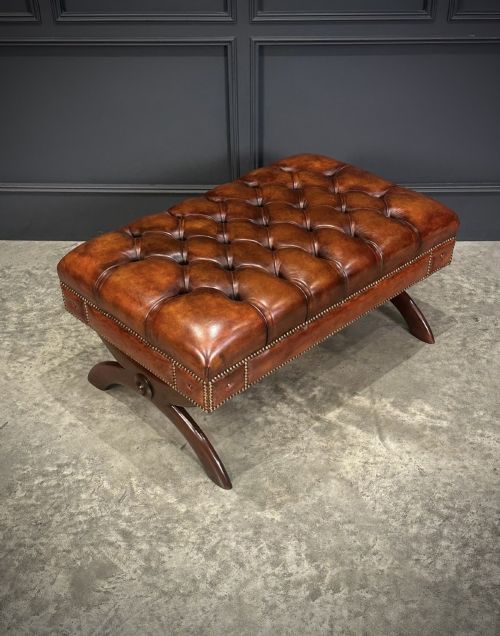
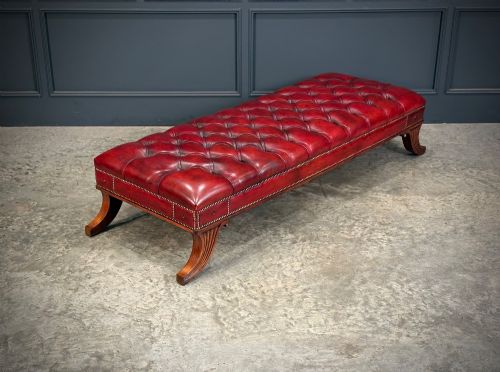
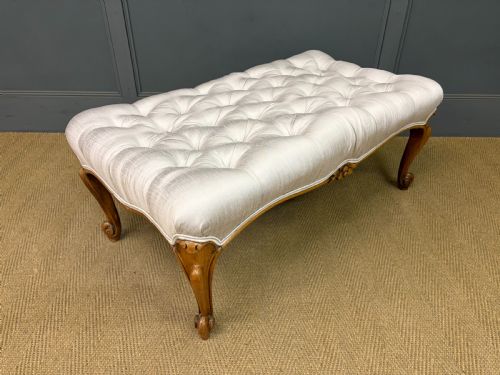
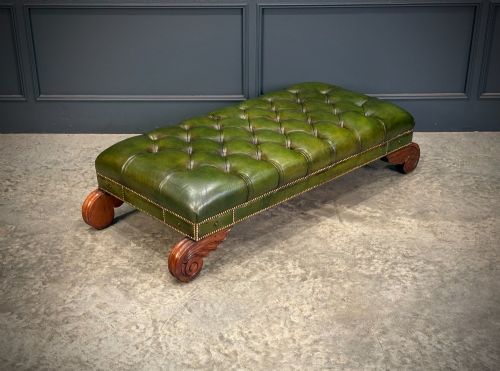
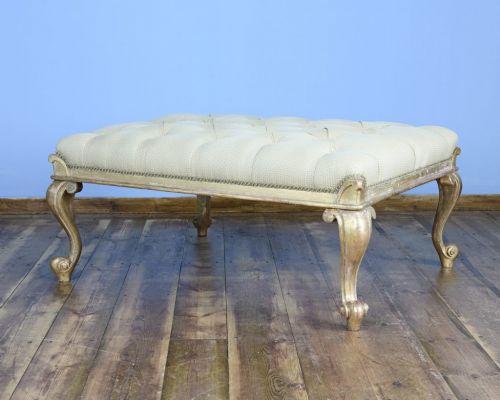


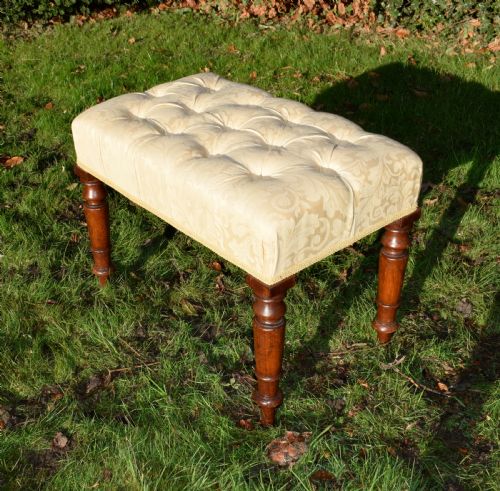

Tufted Ottoman Bench
These tufted ottoman bench designs bring deep buttoned leather and plush upholstery to traditional seating, offering both comfort and rich historical character.
Tufted Ottoman Bench
When you search for a tufted ottoman bench, you encounter a variety of low upholstered seating forms including footstools, long benches, and window seats. These pieces range from compact footstools to grand scale country house ottomans suited for central placement.
The versions most commonly met on this page span the Victorian and Regency periods, alongside Georgian and early twentieth-century examples. Makers constructed these items primarily in mahogany, walnut, and painted wood, often mounting them on castors or traditional legs.
Object types include salon stools, long benches, and footstools that double as coffee tables. Many feature buttoned leather surfaces finished with brass-studded details.
What varies in quality
The calibre of a piece rests heavily on the timber selection and the depth of the frame construction, with grand scale examples demonstrating more substantial joinery. Superior items often incorporate hand-dyed leather and precise buttoning that maintains tension across the entire surface.
Proportion and decorative enrichment also set pieces apart, such as the inclusion of fluted legs, cabriole supports, or carved wood details. The refinement of the upholstery work and the integrity of the original wood frame dictate the overall standing of each bench.
Tufted Ottoman Bench Retail Price Guide 2026
Typical asking prices for tufted ottoman bench among the pieces listed under this phrase on Sellingantiques today, from the lower quarter to the upper quarter. They describe what is for sale here now, not the wider market.
Listings feature items from the Regency and Victorian eras, utilising mahogany, walnut, and hand-dyed leather across various stool and bench forms.
James Shoolbred
The Tufted Ottoman Bench Glossary
- Buttoned
- A upholstery method where stitches pull the fabric or leather deep into the padding to form a geometric pattern of tufts. This technique secures the internal stuffing and creates a textured surface.
- Cabriole leg
- A furniture leg that curves outward and then tapers inward, typically ending in a pad or scroll foot. This shape draws inspiration from animal limbs and appears frequently on Victorian seating.
- Parcel gilt
- A decorative treatment where thin gold leaf is applied only to specific carved portions of a wooden frame. It highlights particular architectural details against a darker wood background.
- Window seat
- A long, narrow form of seating designed specifically to fit within the recess of a window. These pieces often feature upholstered tops and supportive wooden frames.
- Castor
- A small wheel mounted in a swivel housing attached to the base of a furniture leg. It allows heavy seating to move smoothly across floor surfaces.
Tufted Ottoman Bench: Frequently Asked Questions
What is a tufted ottoman bench?
A tufted ottoman bench is a low upholstered seat featuring deep buttoning across its leather or fabric surface. These pieces serve multiple functions as footstools, coffee tables, or long benches within a room.
Originating largely in nineteenth-century workshops, they combine sturdy hardwood frames with padded tops designed for comfort and extended seating.
How do I date a Victorian footstool?
Dating a Victorian footstool involves examining the framing timber, such as walnut or mahogany, alongside the specific upholstery style. Pieces from this era frequently utilise deep buttoned leather and may sit upon castors or cabriole legs.
Documented examples from the middle to late nineteenth century often display distinct regional English craftsmanship and heavier proportions.
Can I use an ottoman as a coffee table?
Using a large buttoned leather ottoman as a coffee table is a practical way to integrate antique seating into a modern living space. The firm, tufted surface supports trays and books while retaining its structural integrity.
Many antique long stools and ottomans share proportions similar to standard coffee tables, making them suitable alternatives.
What woods were used for these benches?
Makers constructed these benches primarily using durable hardwoods like mahogany and walnut for their strength and fine grain. Some examples feature painted wood surfaces or parcel gilt accents to enhance the visual design.
These timbers provided the necessary foundation to support the heavy padding and frequent seating use.