


Tufted Back Chaise Longue
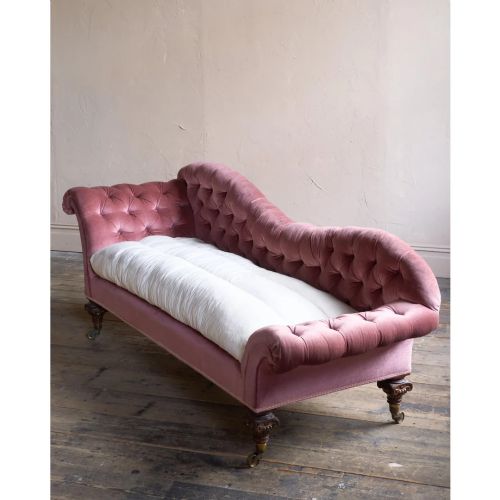
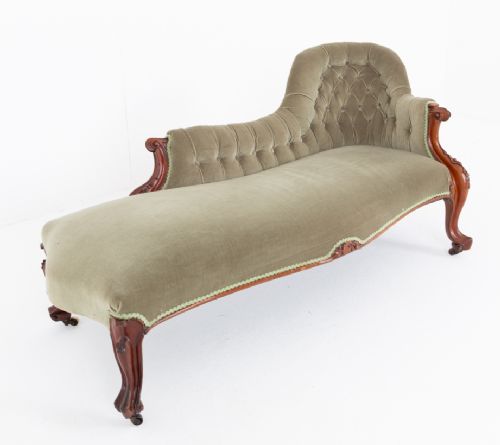
A tufted back chaise longue offers single-ended reclining elegance for the drawing room, shaped by Victorian and Regency makers.
Tufted Back Chaise Longue
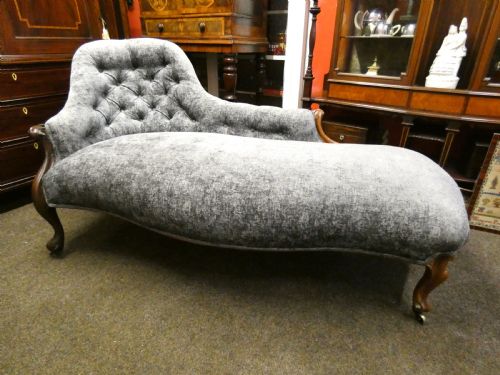
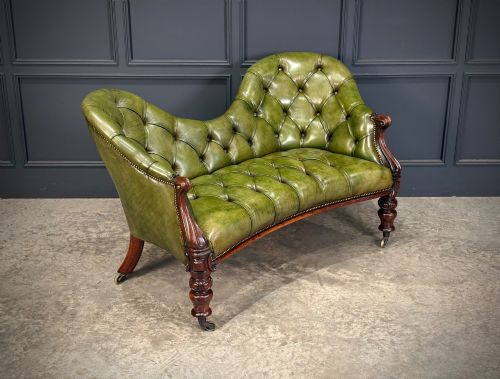
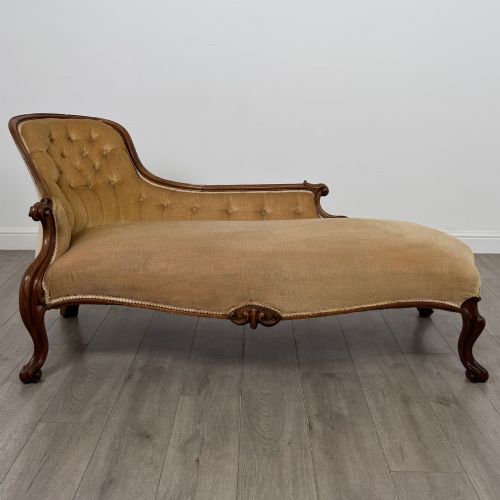
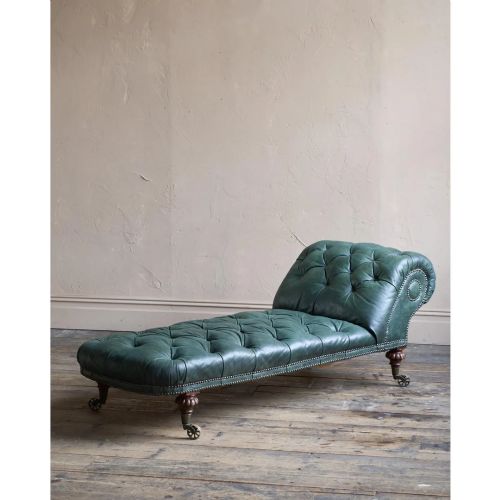
A tufted back chaise longue is a daybed or long seat designed for reclining in a semi-recumbent posture, originating in forms like the Victorian green buttoned leather double spoon-back sofa or the English Regency mahogany upholstered day bed. These pieces provide a single elevated headrest supported by an open or enclosed back, intended for daytime resting rather than sleep.
The versions most commonly met on this page span the nineteenth century, including early Victorian, Victorian Rococo revival, and French nineteenth-century styles. They appear in forms ranging from simple mahogany day beds to ornate walnut and rosewood frames with carved details.
Makers and workshops constructed these pieces as singular statements of luxury, utilising rich timbers to frame deep upholstery. They function visually as focal points in a salon or drawing room, combining the posture of an armchair with the length of a settee.
Materials and construction
Timber frames form the structural core, utilising dense hardwoods such as mahogany, walnut, and rosewood. Craftsmen shaped these woods through carving, sometimes adding gilt decoration or structural elements like ionic column legs and barley twist frames.
Upholstery defines the character of the piece, employing buttoned velvet and leather secured over padded foundations. Brass details appear on castors or mounts, while secondary woods support the internal frame beneath the fabric.
Periods represented span from Regency through to early Victorian and later nineteenth-century revivals.
Evaluating quality and craftsmanship
The refinement of the timber carving dictates the grade of the frame, where hand-carved rosewood or walnut displays crisp detail compared to simpler mouldings. Dense figuring in the mahogany or walnut veneers elevates the visual presence of the woodwork.
The execution of the button tufting and the selection of covering materials indicate the workshop standard. Deep, even buttoning in quality leather or velvet requires rigorous internal webbing and stitching that preserves the silhouette of the scroll end.
Holland & Sons·Miles & Edwards·Howard and Sons
The Tufted Back Chaise Longue Glossary
- Buttoned
- An upholstery technique where strings or twine are pulled through the padding and secured with buttons to create a diamond pattern. This method holds the internal stuffing firmly in place.
- Spoon-Back
- A padded chair or settee back shaped in the outline of an egg or spoon, deeply recessed to fit the human form. It is characteristic of mid-nineteenth-century seating.
- Day Bed
- A long piece intended for daytime resting, closely related to the chaise longue and often featuring a similar upholstered deck and headrest.
Tufted Back Chaise Longue: Frequently Asked Questions
Where should I place a chaise longue?
These pieces suit drawing rooms, large bedrooms, or studies where floor space allows them to sit away from the wall. Their asymmetrical shape means they look best when viewed from the open front.
Position the headrest to face towards the natural light from a window or away from a high-traffic walkway to maintain an unobstructed line of sight down the length of the frame.
How do I care for leather upholstery?
Leather surfaces benefit from regular dusting with a dry cloth and occasional treatment with appropriate conditioning balms to prevent drying. Avoid placing the piece in direct sunlight to protect the whisky brown or green tones.
Keep the material away from direct heat sources such as radiators, which can cause the hide and the underlying button tufting to shrink and crack over time.
What is the difference between a day bed and a chaise longue?
A chaise longue typically possesses a raised backrest that drops down along one side, creating a clear distinction between the head and foot. This design supports a seated or semi-reclined posture.
By contrast, a day bed often maintains a uniform height or a simpler frame structure, though nineteenth-century terminology frequently used the terms interchangeably for similar reclining furniture.
How do I identify Victorian pieces?
Victorian examples often display heavy timbers such as walnut or rosewood, combined with deep buttoning and rich upholstery fabrics like velvet or leather. Look for characteristic revival styles including Rococo curves and carved rosewood frames.
Makers from this era also incorporated turned elements like barley twists or architectural details such as ionic columns into the legs and supports of the day beds.