
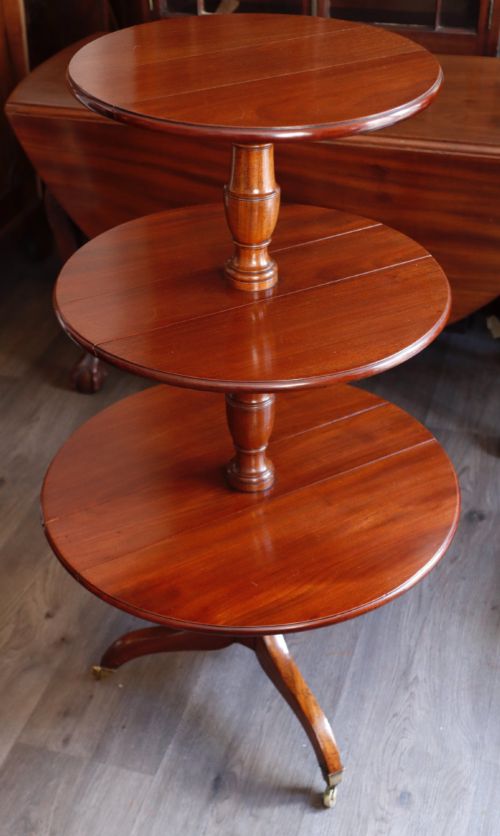


Tripod Leg Dessert Stand
These tripod leg dessert stand pieces are tiered dining room servers built for holding food and servingware during formal meals.
Tripod Leg Dessert Stand
A tripod leg dessert stand is typically encountered here in the form of a dumb waiter, providing multiple stacked tiers supported by a central pillar and three spreading feet. These pieces originate across the Georgian and Regency periods, spanning the eighteenth and early nineteenth centuries.
The objects appear predominantly as two-tier or three-tier tables, with several examples featuring folding mechanisms to save space when not in use. Mahogany is the dominant timber across these listings, alongside occasional walnut and marquetry inlay work.
Makers designed these items to stand beside dining tables or in corners, holding dessert courses, wine bottles, and plates within easy reach of guests and servants.
Construction and materials
Cabinetmakers utilised solid timbers such as mahogany and walnut, turning the central columns on lathes and shaping the three supporting legs by hand. Brass fittings often appear on these stands, particularly around the moving joints of folding tiers or castor mountings.
Marquetry inlay work adds decorative surface patterns to select walnut examples, contrasting with the plain, polished dark wood grains found on standard Georgian and Regency pieces.
These wooden waiters were called dumb because they held food silently, letting dinner guests gossip without servants listening in.
Assessing quality in tiered servers
The distinction between standard examples and the finest pieces rests upon the crispness of the turned column and the graceful sweep of the three tripod legs. Timber selection also dictates grade, with richly figured mahogany and intricate marquetry inlay denoting superior workshop output.
Complexity of construction, such as functional folding mechanisms on multi-tiered dessert stands, demonstrates a higher level of joinery skill than fixed tier equivalents.
The Tripod Leg Dessert Stand Glossary
- Dumb waiter
- A tiered serving table fitted with a central column and tripod legs, designed to hold dishes without domestic staff present.
- Tripod leg
- A three-legged base configuration that provides stable support on uneven dining room floors.
- Marquetry inlay
- Decorative patterns formed by fitting contrasting veneer pieces into the primary wood surface of the table tiers.
- Tiered table
- A piece of furniture featuring multiple horizontal surfaces stacked vertically above one another.
Tripod Leg Dessert Stand: Frequently Asked Questions
What is a tripod leg dessert stand used for?
These tables served as auxiliary dining room furniture during the eighteenth and nineteenth centuries. They held extra plates, glasses, and dessert courses during long meals.
Today, they function well as display surfaces for plants, books, or decorative objects in living spaces.
How do I identify a Georgian dumb waiter?
Georgian examples utilise heavy timbers like mahogany or walnut, often featuring robust turned columns and simple tripod bases. The joinery employs period techniques and hand-finished surfaces.
Look for multi-tiered configurations that may include folding mechanisms designed for compact storage.
Are these stands stable on carpets?
The three-legged base design provides inherent stability on flat surfaces by distributing weight across three distinct points. However, thick carpets can cause slight wobbling on older tables.
Placement on hard floors or low-pile rugs ensures the best stability for the central pillar.
What is the difference between two and three tiers?
Two-tier models offer a simpler profile with a main serving surface and a secondary lower shelf. Three-tier versions increase the vertical capacity for holding multiple courses.
Both variants utilise the same central tripod leg support structure.