

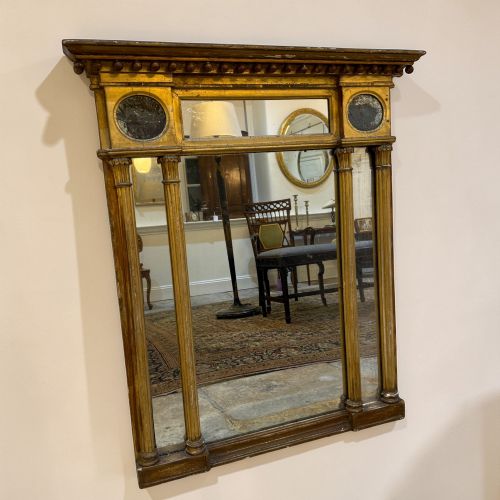
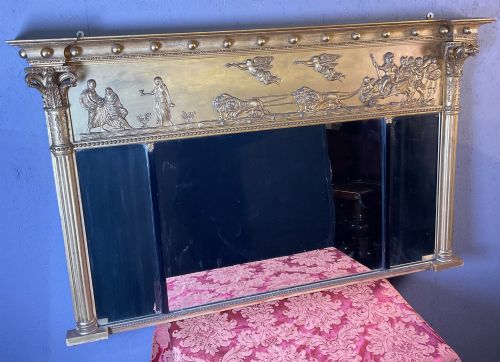


Tripartite Gilded Wall Mirror
A tripartite gilded wall mirror delivers architectural balance to a room, dividing reflections across three plates.
Tripartite Gilded Wall Mirror
A tripartite gilded wall mirror is a grand interior furnishing designed to span chimney breasts or expanses of wall. These three-plate glasses appear primarily as overmantel mirrors and wall mirrors spanning several historical periods.
The examples gathered here range from George II and Georgian styles through Regency and Victorian pieces to early twentieth-century interpretations. Most frequent are the nineteenth-century overmantel mirrors finished in giltwood and gilded gesso.
Makers and retailers such as Ciceri & Co. and Nosotti's occasionally stamped or labelled these large frames. Forms vary from simple rectangular plates to elaborate carved mahogany and ebonised wood designs.
How they were made
Cabinet makers built the primary carcass from timber such as mahogany, walnut, or pine before applying preparation layers. Gesso was laid over the wood base to receive the gold leaf finish.
Carvers shaped intricate details directly into the gesso or wood, producing neoclassical, rococo revival, and Chippendale style ornaments. Mirror glass was then fitted into the tripartite frame, often divided by vertical slips or mouldings.
Tripartite Gilded Wall Mirror Retail Price Guide 2026
Typical asking prices for tripartite gilded wall mirror among the pieces listed under this phrase on Sellingantiques today, from the lower quarter to the upper quarter. They describe what is for sale here now, not the wider market.
The selection spans from the eighteenth century through the nineteenth century to early twentieth-century examples.
What varies in quality
The depth and crispness of the carved ornamentation separate standard production from superior craftsmanship. Finely executed giltwood and gesso retain sharp relief in their decorative motifs.
The integrity of the original mirror glass and gilding dictates the overall character of the piece. Untouched surfaces displaying genuine age hold greater visual coherence than later regilt finishes.
Ciceri & Co.·Nosotti's
The Tripartite Gilded Wall Mirror Glossary
- Giltwood
- Wood carved and coated with gold leaf. This material forms the primary shimmering surface of the finest frames.
- Gesso
- A plaster mixture applied to wood frames to receive gilding. Carvers modelled intricate details directly into this surface before applying gold leaf.
- Overmantel mirror
- A large glass designed to hang above a fireplace mantelpiece. These horizontal mirrors often feature tripartite division to reflect maximum light.
- Pier mirror
- A tall glass made to fit the wall space between windows. They share the gilded finishes typical of larger wall mirrors.
- Tripartite
- Divided into three distinct sections. In these mirrors, three separate glass plates sit side by side within the single frame.
Tripartite Gilded Wall Mirror: Frequently Asked Questions
What is a tripartite mirror?
A tripartite mirror is a wide looking glass divided into three distinct vertical sections within a single frame. This layout was favoured for spanning the width of fireplace mantels.
The tripartite division creates a panoramic reflection that helps distribute light evenly across a principal reception room.
Where should I hang an overmantel mirror?
Overmantel mirrors are traditionally hung directly above a fireplace mantelpiece, anchored securely to the wall studs. Their horizontal proportions suit the expansive wall space found in period chimney breasts.
Placing the mirror at this height allows the glass to capture and reflect light from opposing windows throughout the day.
How do I identify a Regency mirror?
Regency mirrors often display classical motifs such as ball ornamentation, reeded columns, and breakfront cornices. The frames are typically finished in bright giltwood or gesso.
Proportions during this period lean towards architectural clarity and restrained classical elegance rather than heavy ornamentation.
What is gilt gesso?
Gesso is a fine plaster mixture built up over a wooden carcass to create a smooth surface for gilding. Craftsmen carved intricate decorative details directly into this hardened compound.
Gold leaf was then applied over the gesso base to achieve the characteristic metallic sheen seen on antique frames.