


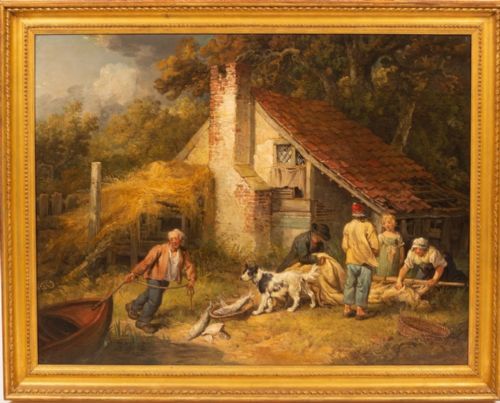
Traditional Rural Genre Scenes
Traditional rural genre scenes capture nineteenth-century agricultural life on canvas and board, offering buyers a direct window into pastoral history.
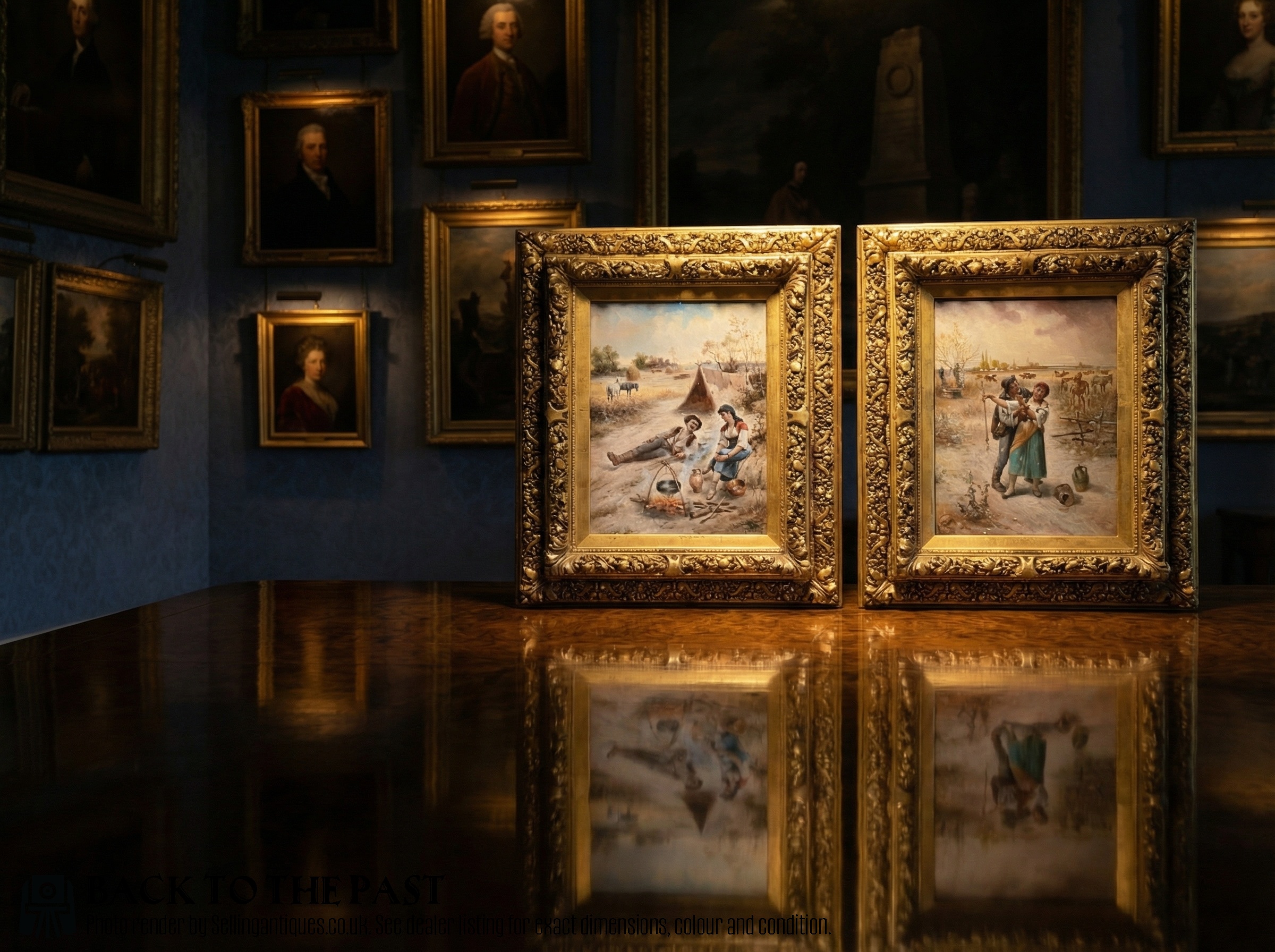
Traditional Rural Genre Scenes
Traditional rural genre scenes depict everyday agricultural and country life, focusing on farmyards, cottage doors, blacksmiths and pastoral landscapes.
Most examples found here date from the nineteenth century into the early twentieth century, spanning the Victorian period.
These works typically show figures engaged in rural tasks such as ploughing, scything, feeding livestock or returning from the fields.
How they were made
Artists applied oil paint onto stretched canvas or wooden board, often building up rich surface textures.
Many works are housed in period frames constructed from wood and gesso, frequently finished with gold leaf or gilt.
Periods represented stretch from the Victorian era into the early twentieth century.
What varies in quality
Quality depends upon the artist's ability to render human anatomy and animal forms with convincing detail and natural movement.
The sophistication of the composition and the handling of atmospheric light separate standard decorative works from accomplished fine art paintings.
Miles Birkett Foster·James Kyd·Henry John Yeend King·James Hardy Junior·Arthur Longley Vernon·Edward Brice Stanley Montefiore·Daniel Pasmore·Ernest Walbourn·Alfred Banner·John Frederick Herring Jnr·Arthur Claude Strachan·George Cole·James Ward·Thomas Blinks·John F. Pasmore
The Traditional Rural Genre Scenes Glossary
- Genre painting
- A style of painting that depicts aspects of everyday life by portraying ordinary people engaged in common activities. These works focus on domestic or rural scenes rather than historical or mythological subjects.
- Oil on canvas
- A traditional painting technique where pigments bound in oil are applied to a woven fabric support stretched over a wooden frame. This medium allows for deep colour saturation and gradual blending.
- Oil on board
- A method where the artist applies oil paint directly to a rigid wooden panel or heavy card substrate. It provides a firm surface that resists the flexing associated with canvas.
- Gesso
- A traditional paint mixture consisting of a binder mixed with chalk, gypsum, or pigment used to prepare wooden substrates or carve decorative mouldings on frames. It creates a smooth, absorbent surface for gilding.
- Gilt wood
- Woodwork that has been coated with a thin layer of gold leaf or metallic powder. It is commonly found on nineteenth-century picture frames to enhance the visual presentation of the artwork.
Traditional Rural Genre Scenes: Frequently Asked Questions
What subjects appear in these scenes?
The works show farmworkers, horses, blacksmiths, cottages and domestic animals in rural settings.
Common activities include ploughing, scything and bringing in the harvest.
Are these paintings dated?
Many pieces originate from the nineteenth century and the Victorian era, often bearing the artist's signature.
Stylistic elements and frame construction also help indicate the period.
What materials were used?
Artists worked primarily with oil paint on canvas or board, though watercolour examples also occur.
Original frames frequently utilise wood, gesso and gold leaf.
How do I hang an oil painting?
Secure fixings suited to the weight of the wooden frame should be attached directly to wall studs.
Placement away from direct sunlight and moisture helps preserve the canvas and gilt finish.