
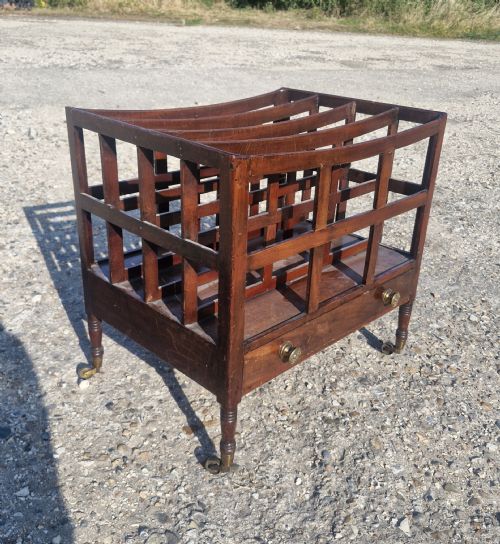
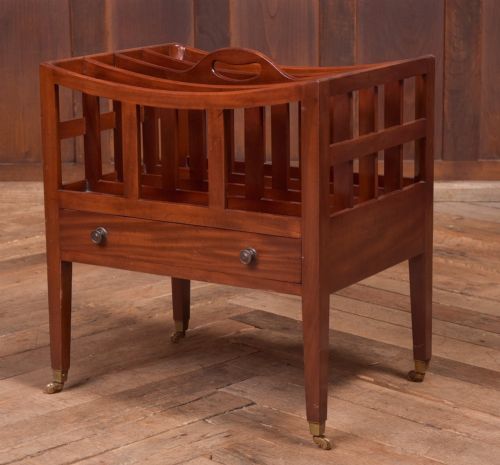


Traditional Mahogany Canterbury
A traditional mahogany canterbury is a piece designed to hold sheet music or periodicals, bringing genuine period utility to a sitting room.
Traditional Mahogany Canterbury
A traditional mahogany canterbury is an occasional piece built with slatted divisions to store books, papers, or folios neatly off the floor. They appear in forms spanning the nineteenth century, Edwardian era, and later revivals, keeping spaces orderly.
The versions met most frequently on this page date from the nineteenth century, including Victorian, Regency, and William IV examples. These pieces combine compartmented racks with low legs, often incorporating castors for ease of movement.
Makers adapted the form over decades, resulting in varied configurations such as three-tier magazine racks, revolving bookcases, and standard music stands. Each type serves the fundamental purpose of accessible storage within a domestic interior.
How they were made
Craftsmen built these pieces primarily from solid mahogany and flame mahogany veneer, occasionally introducing contrasting satinwood inlay for visual detail. Timber selection determined the depth of grain and the richness of the polished finish.
Listings feature pieces spanning the 1800s through the Edwardian era, constructed in mahogany, rosewood, and brass.
What varies in quality
The refinement of the timber and the crispness of the turning on the upright supports separate standard utility items from finer examples. Finer pieces demonstrate careful attention to grain alignment and decorative stringing.
Proportion and structural integrity define the higher end of the range, where slender divisions remain rigid and secure within the frame. Substantial proportions, as seen in oversized George III pieces, depend on balanced design rather than mere scale.
The Traditional Mahogany Canterbury Glossary
- Flame mahogany veneer
- A thin slice of timber cut from the fork of the mahogany tree, displaying a distinctive flickering flame pattern. It decorates the exterior surfaces of finer cabinets.
- Satinwood inlay
- A contrasting light-coloured wood inserted into recesses cut into the mahogany surface to form geometric or linear patterns. This decorative technique highlights the borders and panels.
- William IV
- A British design period spanning the early nineteenth century, characterised by robust proportions and classical revival motifs. Pieces from this era often utilise dense rosewood or mahogany.
- Castor
- A small wheel mounted on a swivel attached to the foot of a piece of furniture, allowing easy repositioning. They are frequently cast in brass on nineteenth-century examples.
Traditional Mahogany Canterbury: Frequently Asked Questions
What is a traditional mahogany canterbury used for?
These pieces were originally built to hold sheet music, folios, and books near a piano or seating area. Today, they function well as magazine racks or general storage beside a sofa.
Their open slatted design allows titles and papers to remain visible and accessible within a living space.
How do I identify a Regency canterbury?
Regency pieces typically date from the early nineteenth century and reflect classical architectural influences. They often feature clean lines, dark mahogany surfaces, and precise turned supports.
Proportions tend to be balanced and restrained, lacking the heavier carving associated with later Victorian furniture.
Where should I place a canterbury in my home?
A canterbury suits a study, library, or sitting room where periodicals and books accumulate. Because they are compact and often feature castors, they sit easily beside armchairs or desks.
Keep them away from direct heat sources to protect the polished mahogany timber and any delicate veneer.
Are Edwardian canterburys different from Victorian ones?
Edwardian versions often display lighter construction and sometimes incorporate Arts and Crafts influences or simpler lines. Victorian examples tend to be heavier, utilising rich mahogany and occasionally rosewood with more pronounced turnings.
Both periods maintain the core compartmented structure designed for paper storage.
What maintenance do these wooden stands require?
Maintain the finish by dusting regularly with a soft, dry cloth to prevent the buildup of particles on the carved or veneered surfaces. Occasional application of a suitable wax feed preserves the moisture and sheen of the mahogany.
Avoid using modern liquid polishes that contain silicone, as they can damage antique wood finishes over time.