


Traditional Locking Tallboy
These traditional locking tallboy chests combine vertical storage with secure locking pilasters, offering both elegance and utility.

Traditional Locking Tallboy
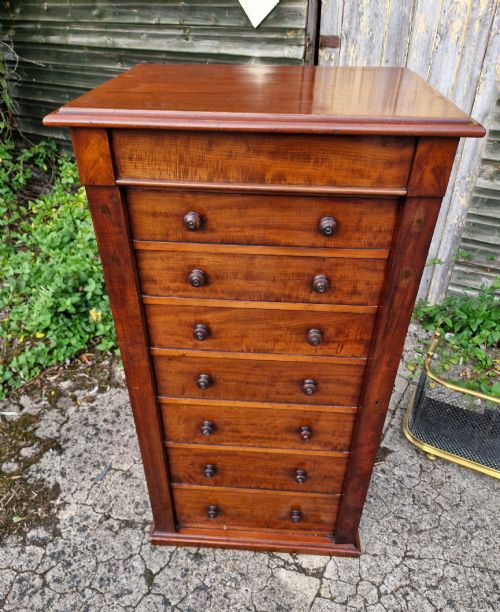
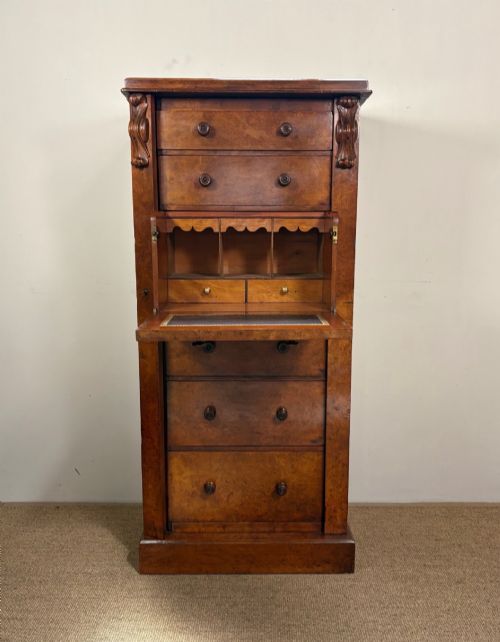
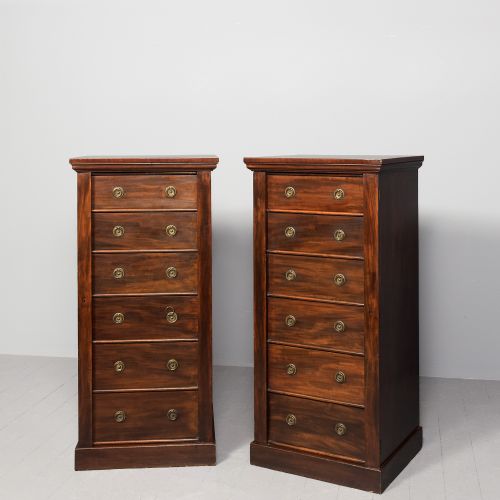
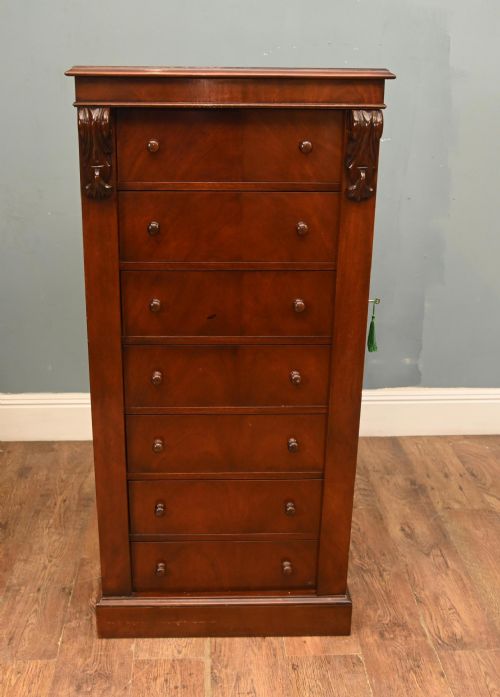
A traditional locking tallboy usually takes the form of a Wellington chest, characterised by a narrow vertical stack of drawers secured by a hinged locking side pilaster. These pieces originate predominantly from the nineteenth century, with Victorian examples appearing frequently alongside Edwardian and William IV items.
The layout typically incorporates five to seven drawers, sometimes complemented by a hinged fall writing section or secretaire drawer. Buyers encounter these chests in rich timbers, occasionally finished with country house scumble paint or delicate inlay work.
How they were made
Cabinet makers utilised solid mahogany and walnut for the primary structure of these tall chests, pairing the dense timber with brass hardware for handles and locking mechanisms. Secondary woods like pine appear within the internal drawer construction.
Surface treatments range from polished mahogany veneers to decorative paint finishes such as scumble, reflecting the diverse aesthetic preferences of the Victorian and Edwardian eras.
What varies in quality
The distinction between standard examples and finer pieces lies in the precision of the timber matching, the crispness of any inlaid satinwood detailing, and the integrity of the locking mechanism. Original brass fittings and smooth drawer operation elevate a piece significantly.
Subtle variations in proportion and the quality of the internal secondary wood construction also separate straightforward utility pieces from more refined workshop productions.
The Traditional Locking Tallboy Glossary
- Wellington chest
- A tall, narrow chest of drawers featuring a hinged locking pilaster on one side that secures all drawers simultaneously. This form became particularly popular during the nineteenth century.
- Pilaster
- A vertical architectural element applied to the front sides of the chest that swings outward to unlock the drawers. On these pieces, it holds the locking mechanism.
- Scumble paint
- A decorative surface finish applied to create simulated wood grain or mottled patterns. It appears on country house furniture of the period.
- Secretaire
- A drawer fitted with a hinged fall front that drops to reveal a writing surface and small compartments. It integrates utility into the upper section of the chest.
Traditional Locking Tallboy: Frequently Asked Questions
What is a traditional locking tallboy?
A traditional locking tallboy is a tall, narrow chest of drawers designed to maximise vertical storage space while occupying a small floor footprint. These pieces typically feature a hinged locking side pilaster that secures the drawers.
The listings demonstrate that these items originate largely from the nineteenth and early twentieth centuries, spanning Victorian, Edwardian, and Regency periods.
How does the locking mechanism work?
The locking mechanism relies on a hinged wooden pilaster positioned down one side of the chest face. When closed and secured with a key, this side bar blocks the drawer edges from opening.
This design allowed owners to secure valuable papers or items securely within a compact footprint before the widespread use of individual drawer locks.
Which woods were used for these chests?
Mahogany serves as the predominant timber across the listed selection, often finished with a rich polish. Walnut and satinwood also appear alongside painted surfaces.
Cabinet makers selected these dense hardwoods for their durability and attractive grain patterns, which suited the formal aesthetic of nineteenth-century interiors.
How do I fit one into a room?
These tall chests require minimal floor space due to their narrow, vertical proportions, making them suitable for bedrooms or studies. Clearance must be allowed beside the chest for the locking pilaster to swing open fully.
Their upright scale provides substantial drawer capacity without dominating the surrounding wall area.