



Traditional Livestock Wall Art
Traditional livestock wall art captures pastoral life through oil paintings and watercolour paintings spanning the eighteenth, nineteenth, and early twentieth centuries.
Traditional Livestock Wall Art
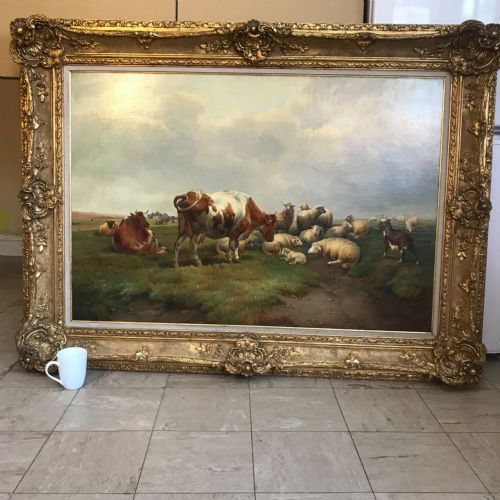
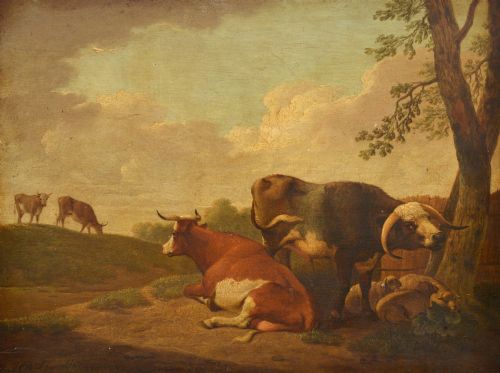
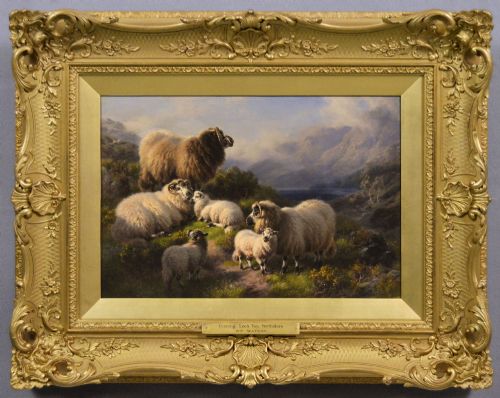
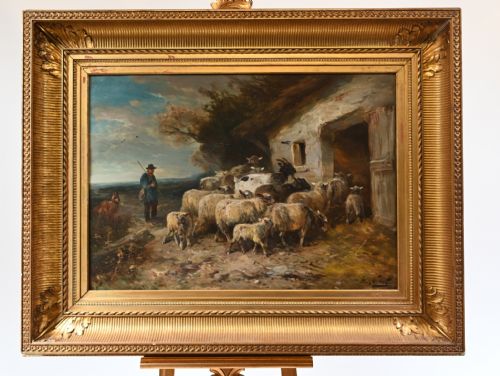
Traditional livestock wall art comprises framed paintings depicting farm animals, cattle, sheep, and rural landscapes across the eighteenth, nineteenth, and early twentieth centuries. These works record agrarian scenes from Scottish highlands, Welsh valleys, and English riversides, often framed in gesso or giltwood.
The pieces appearing here are predominantly nineteenth-century oil paintings and watercolours rendered on canvas or paper. Subjects range from solitary bulls and grazing sheep flocks to farmyard scenes with cattle and poultry.
Examples stretch from eighteenth-century Dutch influences through Victorian realism and pastoral styles up to early twentieth-century interpretations. Each piece reflects the enduring rural focus of British and European landscape art.
How traditional livestock wall art was made
Painters used oil paint or watercolour applied to canvas or paper to build up depth and texture in animal coats and rural backgrounds. Canvases were typically stretched over wood supports and housed in decorative frames.
Frames themselves combined wood with moulded gesso, often gilded to create rich giltwood borders. These materials protected the paintings while adding weight and presence to the finished wall art.
Traditional Livestock Wall Art Retail Price Guide 2026
Typical asking prices for traditional livestock wall art among the pieces listed under this phrase on Sellingantiques today, from the lower quarter to the upper quarter. They describe what is for sale here now, not the wider market.
The works span Victorian realism, pastoral styles, and eighteenth-century Dutch influences through oil and watercolour mediums.
What varies in quality in traditional livestock wall art
Quality rests on the precision of brushwork and the anatomical accuracy of the animals depicted. Master painters captured the texture of wool, the musculature of cattle, and the play of light across a landscape with convincing realism.
The execution of the surrounding landscape and atmospheric effects distinguishes finer canvases from simpler decorative works. Frame construction also varies, with hand-carved giltwood frames offering greater craftsmanship than standard wooden mouldings.
Hendrik Willem Schweickhardt·William Watson Jnr·Henry Schouten·William Henry Mander·Thomas Sidney Cooper·Eugene Verboeckhoven·Arthur Charles Dodd·Claude Cardon·Henry Brittan Willis·Edgar Hunt·Henry Cheadle·William Sidney Cooper·W. A. Clark·Charles Jones·William Huggins·Thomas E Francis·Thomas Baker of Leamington
The Traditional Livestock Wall Art Glossary
- Oil on Canvas
- A painting medium where pigments suspended in drying oils are applied to stretched fabric. This combination allows for rich colour blending and lasting durability.
- Giltwood
- Wood carved and coated with a thin layer of gold leaf or metallic powder. It provides ornate framing for traditional paintings.
- Gesso
- A plaster-like mixture applied to wood frames to create smooth surfaces for moulding decorative details. It forms the base for subsequent gilding.
- Victorian Pastoral
- An artistic style celebrating rural life, agriculture, and farm animals during the nineteenth century. These scenes emphasise calm, idealised country settings.
- Animalier
- A fine art genre specifically focused on the realistic depiction of animals. Practitioners render domestic livestock and wildlife with anatomical precision.
Traditional Livestock Wall Art: Frequently Asked Questions
What subjects appear in traditional livestock wall art?
These works feature cattle, sheep, horses, and poultry placed within rural landscapes, farmyards, and riverbanks. Artists documented specific regional settings such as Kent, the Scottish Highlands, and Welsh valleys.
Compositions range from quiet grazing scenes to detailed portraits of prize bulls and working sheep flocks.
How do I date these paintings?
Dating relies on stylistic clues, artist signatures, framing materials, and canvas construction techniques. Victorian works often show distinct realism, while eighteenth-century pieces lean towards Dutch pastoral traditions.
Inscribed dates and biographical records of named painters help narrow the period of creation further.
Are these works painted on canvas?
Many examples consist of oil paint applied to stretched canvas, while others utilise watercolour on paper. Canvas works are typically secured to wooden stretcher bars and protected by traditional frames.
Support materials varied according to the artist's preference and the intended scale of the pastoral scene.
How should I hang and care for them?
Paintings require stable indoor environments away from direct sunlight and excessive moisture to protect canvas, oil paint, and giltwood frames. Proper hanging hardware supports the weight of framed wooden panels securely.
Dusting should be performed gently with a soft brush, avoiding chemical cleaners on the painted surface or gilded frame.