
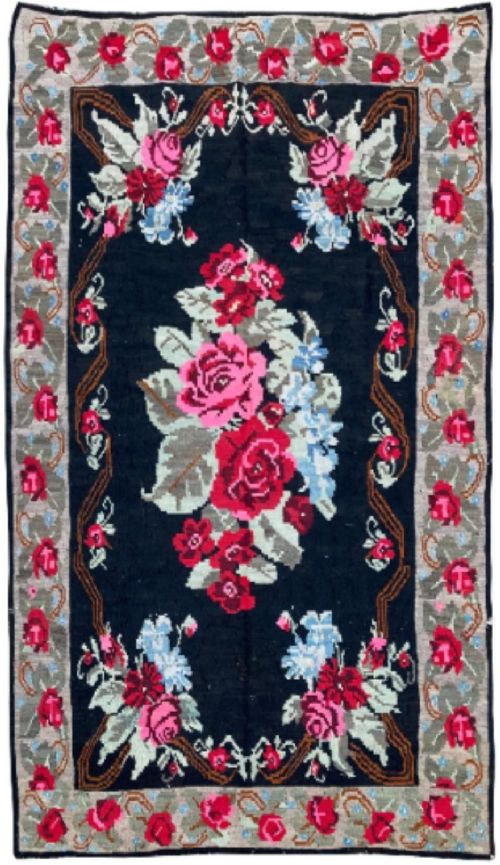
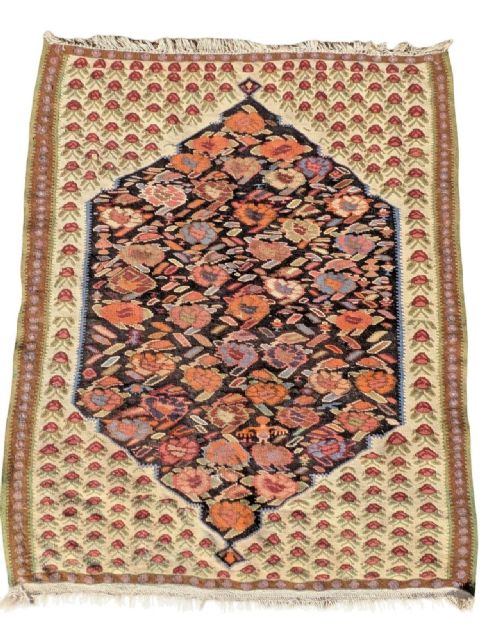


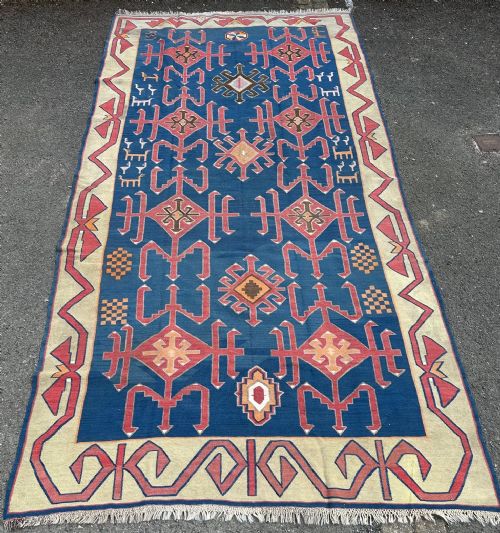


Traditional Flatweave Runner Rug
When choosing a traditional flatweave runner rug, you select a tactile, durable textile woven by tribal makers across Anatolia, the Caucasus, Persia, and Central Asia.
Traditional Flatweave Runner Rug
A traditional flatweave runner rug is a long, narrow floor covering created without a pile, relying instead on the interlacing of warp and weft threads. These textiles originate primarily from nomadic and village traditions in regions such as Anatolia, the Caucasus, Persia, and Central Asia.
The pieces available span from the late nineteenth century through to the mid-twentieth century, encompassing regional identities like Turkish kelims, Uzbek Suzani kilims, and Caucasian Soumaks. Narrow formats often served specific architectural purposes in hallways or tents, dictated by the reach of the weaver's loom.
Buyers encounter distinct tribal aesthetics, from the bold graphic designs of Central Asian Gajeri kilims to the intricate medallion patterns of Caucasian weaving. Each piece reflects the specific heritage and techniques of the district where it was produced.
How they were made
These runners rely fundamentally on wool and cotton, with hand-spun wool frequently utilised for the structural warp and visible weft threads. Natural dyes provide the historic palette, yielding soft reds, indigos, and earth tones that weather with character over decades.
Techniques range from standard slit-weave kilim construction, where colour blocks meet without interlocking, to Soumak wrapping and multi-strip panel assembly. Uzbek examples often demonstrate construction from multiple narrow strips woven separately and joined together to achieve greater width or length.
Listings feature flatweave runners spanning from 1850 to 1940, utilising hand-spun wool, cotton, and natural dyes across tribal traditions.
What varies in quality
Quality in these runners is grounded in the tightness of the weave and the precision of the geometric or pictorial execution. Finer structures require greater skill from the weaver, resulting in sharper pattern definition and increased structural longevity under foot.
The integrity of the natural dyes and the preservation of original flatweave ends further distinguish exceptional examples from standard survivors. Uniformity in width across long formats and the condition of historical wool yarns complete the measure of the piece.
The Traditional Flatweave Runner Rug Glossary
- Kilim
- An unpiled flat-woven textile produced by tightly interweaving warp and weft strands. This construction method creates a lightweight rug with identical patterns visible on both sides.
- Warp
- The stationary vertical threads stretched tightly on the loom before weaving begins. The weft threads are passed over and under these foundational yarns.
- Weft
- The horizontal threads passed through the warp to build the pattern and colour of the textile. In flatweaves, the weft completely conceals the warp structure.
- Soumak
- A brocade-like flatweaving technique where supplementary weft threads are wrapped around the warp yarns. This method adds considerable thickness and durability to the finished textile.
- Slit-weave
- A specific kilim technique where the weft threads loop back at the edge of a colour area rather than sharing a warp. This creates small vertical slits between distinct colour blocks in the design.
Traditional Flatweave Runner Rug: Frequently Asked Questions
Where were traditional flatweave runner rugs made?
These rugs were produced by nomadic tribes and village weavers across traditional weaving centres including Anatolia, the Caucasus, Persia, and Central Asia. Specific regions like Shirvan, Daghestan, and Khorassan developed distinct regional patterns.
Production methods and wool sources varied by geography, reflecting the local materials available to the weavers of each specific district.
How do I care for a flatweave runner?
Maintenance requires regular gentle vacuuming without a rotating brush roll to protect the flat structure and historic wool fibres. Professional cleaning tailored to antique textiles preserves the natural dyes.
Using a suitable underlay prevents slipping on smooth floors and reduces friction between the wool and the ground beneath.
What is the difference between a kilim and a Soumak?
A kilim is constructed using flat interlocking or slit-weave techniques that leave the textile thin and reversible. The pattern is formed entirely by the coloured weft threads.
A Soumak incorporates wrapped structural threads across the surface, providing a thicker handle and leaving loose trailing threads on the reverse side of the rug.
Why are some runners woven in strips?
Narrow portable looms used by nomadic groups limited the maximum width a weaver could produce in a single piece. Producing long runners or larger formats required weaving multiple narrow strips and joining them edge to edge.
This construction method appears frequently in Central Asian and Anatolian textiles where portability dictated loom dimensions.