

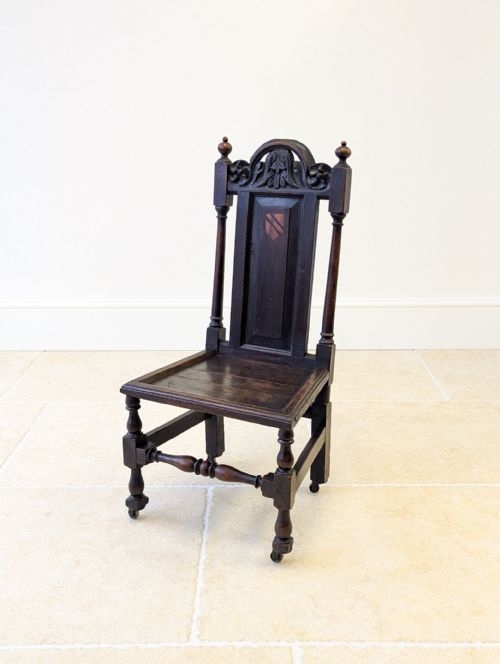
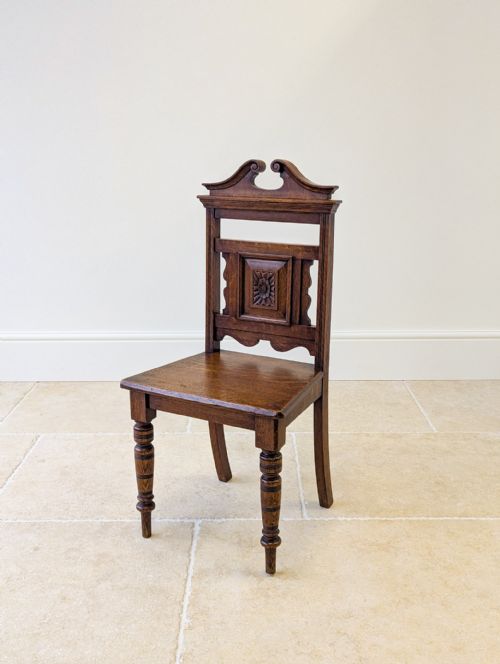
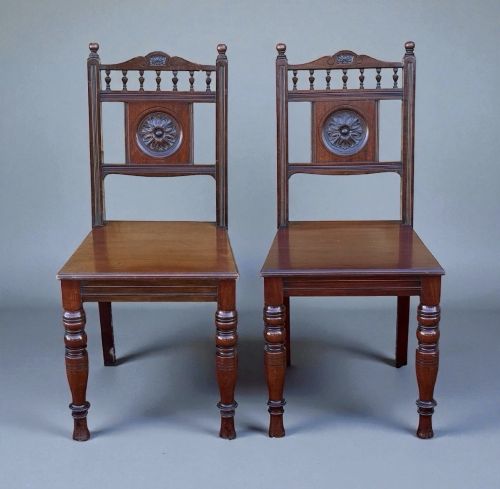
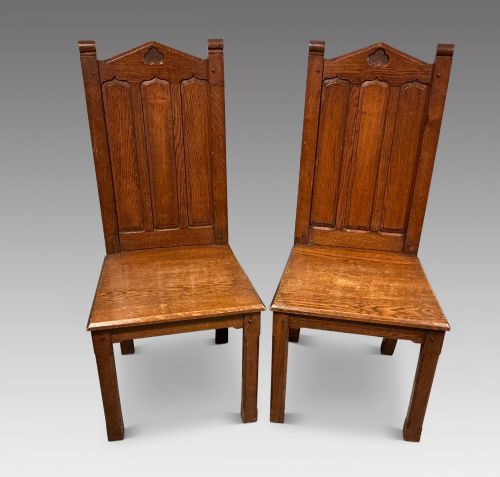


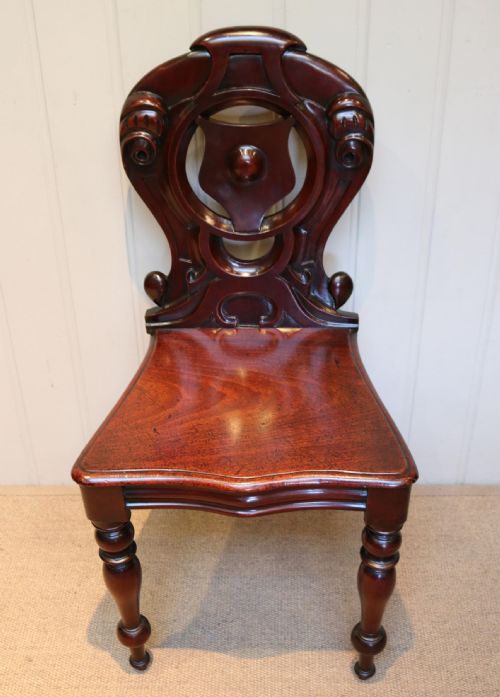


Traditional Entry Chairs
Traditional entry chairs welcome visitors with firm backs and sturdy timber seats, setting the tone for the entire house.
Traditional Entry Chairs
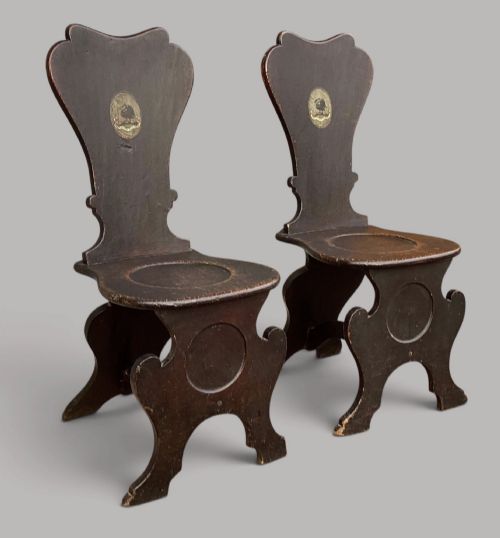
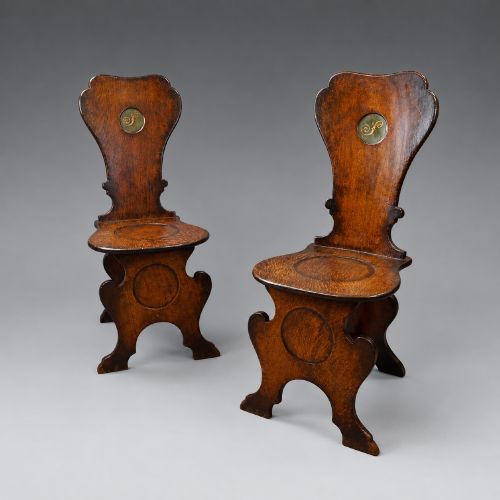
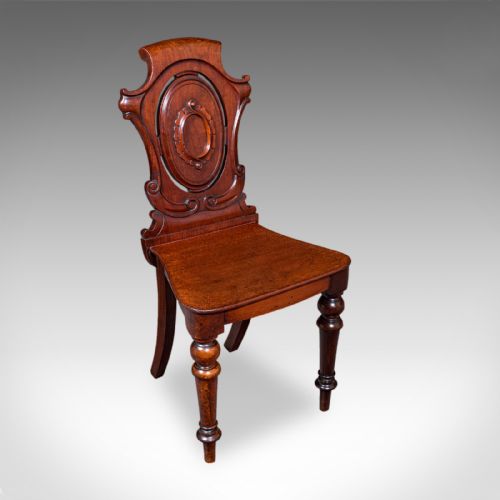
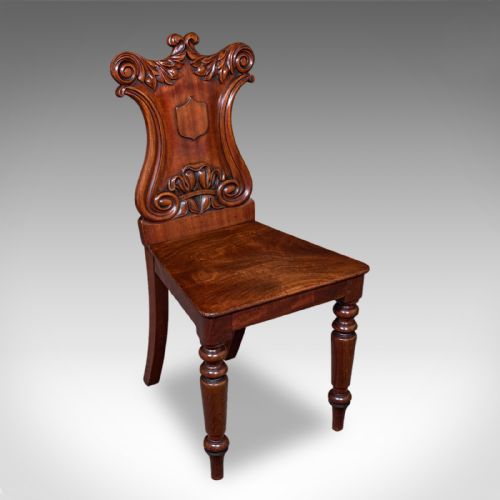
Traditional entry chairs encompass hall chairs, settles, benches, and monks benches designed for hallways and reception spaces. These items span Georgian, Regency, and Victorian periods, alongside later twentieth-century examples.
Origins range from English workshops to Scottish and Hungarian provincial makers, employing distinct regional carving traditions. Buyers select these pieces to provide both practical seating and architectural character in entranceways.
How they were made
Cabinetmakers utilised hardwoods such as oak, mahogany, walnut, and cherrywood to construct these substantial items. Timber selection dictated the depth of carving possible on shield backs and solid wooden seats.
Joinery methods combined pegged mortise and tenon joints with heavy turning and applied mouldings. Certain seats featured woven rush inserts or upholstered fabric pads secured with brass tacks.
Traditional Entry Chairs Retail Price Guide 2026
Typical asking prices for traditional entry chairs among the pieces listed under this phrase on Sellingantiques today, from the lower quarter to the upper quarter. They describe what is for sale here now, not the wider market.
Listings feature oak, mahogany, walnut, and cherrywood timbers spanning the Georgian, Regency, and Victorian eras.
What varies in quality
The distinction between standard utility seating and exceptional reception chairs rests upon the crispness of the carved detail and timber selection. Master carvers produced deeply sculpted shield backs and pierced splats with sharp relief.
Proportion and structural integrity separate workshop output from ordinary production. Heavier framing, well-figured mahogany or oak grain, and balanced symmetry elevate the presence of a hallway seat.
Gillows·Holland & Sons
The Traditional Entry Chairs Glossary
- Hall chair
- A rigid wooden seat designed for an entrance hall or passage, usually featuring a solid timber seat and decorative back. These pieces were rarely intended for long periods of lounging.
- Monks bench
- A convertible furniture form with a hinged back that folds down over the arms to transform the seat into a table. This dual purpose suited smaller domestic spaces.
- Sgabello
- An Italian Renaissance chair form characterised by a sculpted wooden seat supported by two trestle-like boards rather than legs. Revival versions appeared in nineteenth-century interiors.
- Settle
- A wooden bench featuring a high solid back to block drafts, frequently incorporating a box compartment beneath the seat for storage. Hungarian and English country versions display painted or panelled construction.
- Shield back
- A chair back shaped in the outline of a heraldic shield, popularised during the Georgian and Regency periods. Carved details often occupy the centre of the wooden panel.
Traditional Entry Chairs: Frequently Asked Questions
Why do hall chairs have hard wooden seats?
Hall chairs were built for brief waiting periods rather than comfortable lounging, which kept corridors clear for passing guests.
Their solid timber construction also prevented dust and mud from embedding into fabric upholstery in busy entranceways.
How do I use a monks bench in a modern hallway?
A monks bench serves as a compact hallway seat for putting on shoes while hiding clutter inside the box compartment.
When folded flat, the top surface functions as a temporary console table for keys and post.
Were hall chairs always made in pairs?
Many formal reception and hall chairs were produced in pairs or larger sets to stand symmetrically against hallway walls.
Single examples and sets of four or five also occur depending on the original commission.
How can I tell a Victorian hall chair from a Georgian one?
Georgian examples often display lighter proportions and refined mahogany carving influenced by neoclassical design.
Victorian versions frequently employ heavier oak timbers with Gothic, Jacobean, or Renaissance revival detailing.