




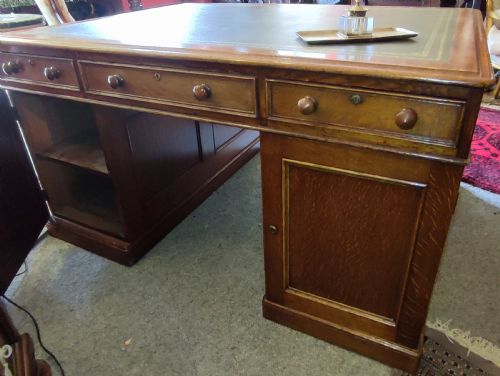


Traditional Double Sided Desk
Traditional double sided desk pieces are large two-sided workspaces built to be shared, offering drawers and cupboards accessible from both faces for serious study or estate management.
Traditional Double Sided Desk
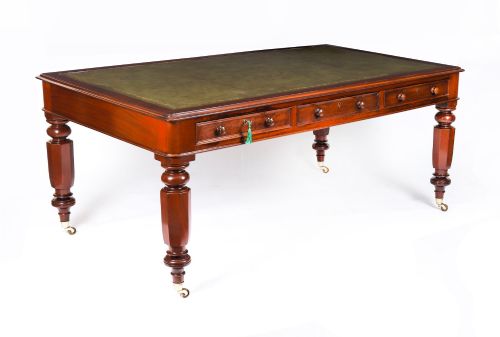
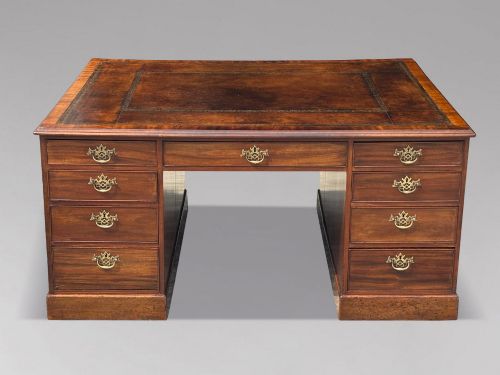
A traditional double sided desk, frequently catalogued as a partners desk, provides an expansive writing surface with matching pedestals or storage bays on either side. These pieces date across the eighteenth, nineteenth, and early twentieth centuries, spanning periods from George III through Victorian and Edwardian revivals.
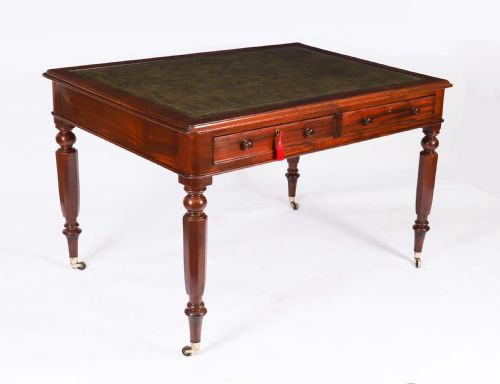
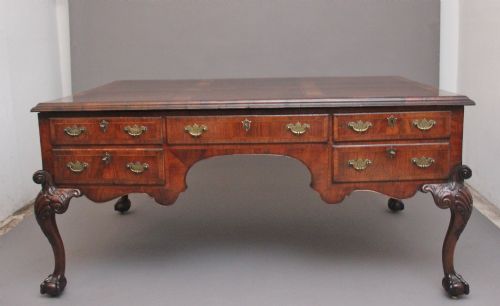
The most common examples encountered on this page are substantial pedestal desks and writing tables constructed in mahogany, oak, or walnut. Many incorporate inset leather writing surfaces and multiple functional drawers arranged around a central kneehole.
The format serves libraries, studies, and large reception rooms where two people require workspace simultaneously. Proportions range from standard library tables to massive eighteen-drawer configurations designed for institutional or estate use.
Materials and construction methods
Makers relied primarily on solid timbers and fine veneers of mahogany, oak, and walnut, frequently selecting flame mahogany or burr walnut for prominent surfaces. These woods were joined to robust carcases designed to withstand heavy daily use in offices and libraries.
Working surfaces typically feature inset leather panels, often tooled with gilt and blind embossing, bordered by solid timber frames. Brass handles, escutcheons, and occasionally castors complete the hardware requirements of these substantial pieces.
Pedestal construction involves stacking banks of graduated drawers or cupboards on either side of a central recess, supporting a heavy top frame. Secondary timbers such as oak or pine are utilised for internal drawer linings and hidden structural components.
Listings span multiple decades of the nineteenth century alongside eighteenth-century Georgian periods and early twentieth-century revivals.
Distinctions in construction and design
Quality rests upon the selection of timber veneers and the precision of the joinery, particularly in the dovetailing of drawers and the matching of grain across large surfaces. Superior examples demonstrate continuous grain patterns across drawer fronts and flawless integration of pedestals.
The presence of secondary detailing, such as finely carved mouldings, panelled backboards for the reverse side, and original brass hardware, elevates a piece above standard utility furniture. Workshop execution by notable makers ensures balanced proportions and refined hardware integration.
Holland & Sons·Gillows
The Traditional Double Sided Desk Glossary
- Partners desk
- A large double-sided desk designed with drawers and cupboards on both front and reverse so two individuals can work face to face. This form originated to accommodate business partners or senior officials sharing an office.
- Pedestal desk
- A freestanding desk comprising two supporting columns of drawers or cupboards that carry a heavy top slab. The pedestals flank a central kneehole space.
- Flame mahogany
- A veneer figure characterised by flame-like patterns created by slicing through boughs or forks of mahogany timber. It was highly prized for grand nineteenth-century cabinet work.
- Burr walnut
- A highly figured wood veneer taken from walnut tree growths or burls, producing intricate swirling patterns. It appears on high-status Victorian and Edwardian writing furniture.
- Kneehole
- The central recessed space beneath the desk top allowing room for the user's legs when seated. In double-sided formats, kneeholes typically exist on both opposing faces.
Traditional Double Sided Desk: Frequently Asked Questions
What is a traditional double sided desk?
A traditional double sided desk is a large piece of furniture featuring drawers and workspaces accessible from both the front and the back. This layout allows two people to sit opposite one another while working.
Such desks were traditionally used in offices, libraries, and large estate rooms where shared administration took place. They combine expansive writing surfaces with substantial storage capacity built into dual pedestals.
How do I date a partners desk?
Dating relies on examining the secondary timbers, drawer construction methods, and prevailing architectural styles of the period. Georgian examples often display simpler linear proportions, while Victorian pieces incorporate heavier mouldings and richer veneer selections like burr walnut.
Hardware styles, including brass handles and lock plates, also provide reliable chronological markers. Structural details underneath and inside the drawers confirm whether a piece belongs to the eighteenth, nineteenth, or early twentieth century.
Are these desks suitable for modern offices?
These desks function effectively as central room statement pieces or large executive workspaces in contemporary studies. Their finished backs and double-sided storage mean they do not need to be pushed against a wall.
Placing them in the middle of a room allows full utilisation of the dual-facing drawers and maintains historical proportion. Care must be taken to measure room dimensions, as these pieces generally require significant floor space.
What woods were used to build them?
Mahogany remains the predominant timber found in these listings, appearing in solid form, flame veneers, and curl figures. Oak and walnut, including burr walnut variations, also feature prominently across nineteenth-century examples.
Secondary woods such as pine or oak were typically employed for internal drawer construction and framing. Leather inserts on the writing surfaces complete the primary material palette.