
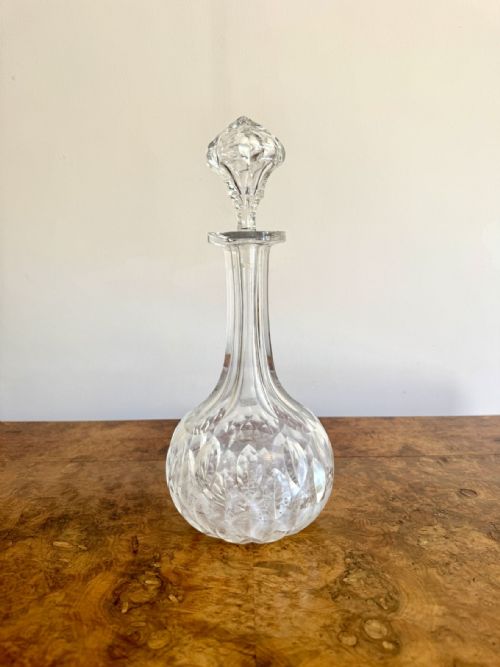


Traditional Crystal Carafe
These heavy glass vessels span the Victorian and Edwardian decades, bringing sparkle and substance to a traditional crystal carafe table.
Traditional Crystal Carafe
A traditional crystal carafe typically takes the form of a cut glass decanter, spanning periods from the late Regency era through the Victorian years and into Edwardian times. These vessels served to hold and pour spirits, wine, and water at the dining table or sideboard.
The pieces appearing on this page most frequently date from the Edwardian period and the Victorian era, alongside examples from the wider nineteenth century. Collectors encounter both single vessels and matching pairs, often shaped with bells or tall silhouettes.
How they were made
Makers shaped these vessels using lead crystal, clear glass, and cut glass, applying heavy facet cutting and wheel engraving by hand. The brilliance of the material relies on lead content and deep surface incisions.
Vessels such as spirit decanters required thick walls to support intricate geometric patterns while maintaining structural balance during pouring.
Certain tall Victorian decanters are heavy enough double as impromptu table weights.
What varies in quality
Depth and crispness of the glass cutting separate standard work from the finest examples, alongside the clarity and weight of the crystal. Superior vessels exhibit sharp, well-defined facets that catch light directly.
Proportion and form dictate the visual impact, particularly in bell-shaped decanters and tall nineteenth-century designs where symmetry and heavy bases matter greatly.
The Traditional Crystal Carafe Glossary
- Cut glass
- Glass shaped and patterned by holding it against a rotating abrasive wheel. This technique creates sharp geometric facets across the body.
- Lead crystal
- Glass containing substantial lead oxide, which increases weight, brilliance, and refractive index. It allows for deeper and clearer surface cutting.
- Edwardian
- A period spanning the reign of King Edward VII from nineteen hundred to nineteen ten. Glassware from this era often retains Victorian weight while showing lighter decorative motifs.
- Victorian
- Spanning the long reign of Queen Victoria during the nineteenth century. Pieces from this era show great variety in deep cutting and heavy forms.
- Regency
- An architectural and decorative period running through the early nineteenth century. Surviving pieces often display classical proportions and refined cutting.
Traditional Crystal Carafe: Frequently Asked Questions
What is a traditional crystal carafe used for?
These vessels were designed to hold and serve wine, spirits, and water upon the dining table or sideboard. Their heavy construction kept contents cool while adding ceremony to formal meals.
Today they function both as decorative dining accessories and as working vessels for decanting beverages.
How do I tell Victorian from Edwardian pieces?
Victorian examples generally date from eighteen fifty to nineteen hundred, showing heavy proportions and deep, dense geometric cutting. Edwardian pieces, dating from nineteen hundred onwards, often exhibit slightly crisper outlines and cleaner profiles.
Examining the weight, stopper fit, and overall silhouette helps separate the two periods.
Are these vessels made of lead crystal?
Many examples on this page are explicitly catalogued as lead crystal or cut glass. The high lead content gives the material its notable heft and bright refractive quality.
Plain glass and clear glass alternatives also appear among nineteenth-century listings.
Do they come with stoppers?
Surviving decanters and carafes frequently retain their original matching stoppers, which were ground to fit each individual neck. The presence of a correct stopper adds significantly to the completeness of the vessel.
Collectors look closely at the fit and matching cut patterns between stopper and body.