
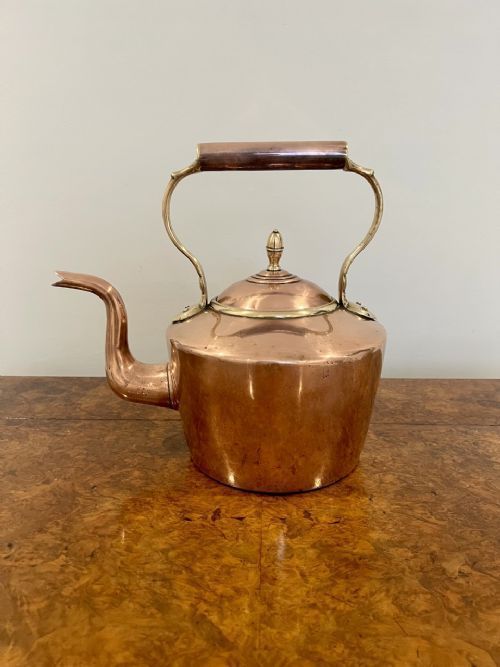
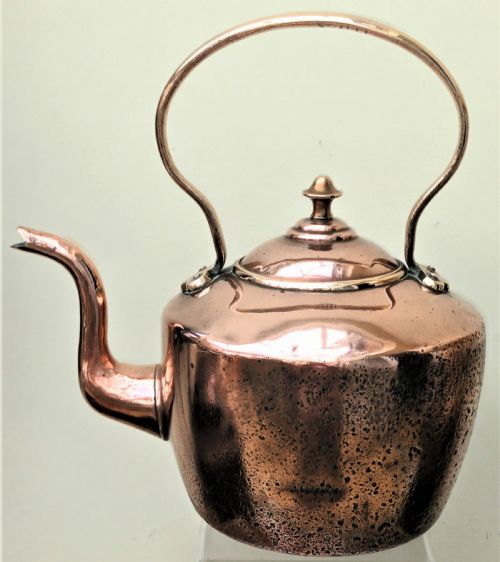
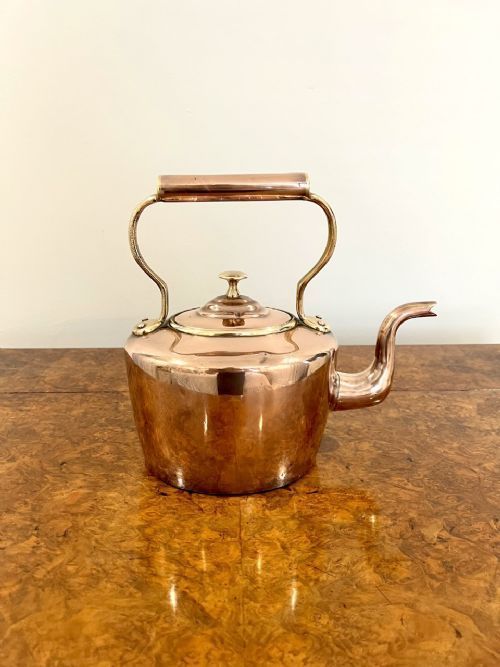


Traditional Copper Tea Vessel
These traditional copper tea vessel examples combine utility and hearthside warmth, offering collectors tactile pieces of 18th and 19th-century domestic metalwork.
Traditional Copper Tea Vessel
A traditional copper tea vessel is primarily represented on this page by Georgian and Victorian kettles and tea urns. These pieces include large and small formats, occasionally featuring oval shapes alongside the more common forms.
The objects span the George III period through the nineteenth century, originating from English workshops. Kettles and samovars dominate the current selection, providing direct insight into historical beverage preparation.
Materials and construction methods
Makers utilised hammered copper sheets as the primary material for these vessels, frequently combining them with cast brass details. Additional elements in wood, bone, and ebonised wood appear on handles and insulators to manage heat.
Construction relies on traditional metalworking techniques suited to utilitarian vessels of the Georgian and Victorian eras. Polished finishes highlight the warm tone of the copper and the contrasting bright brass fittings.
Current listings feature copper and brass kettles and tea urns spanning the Georgian period and the nineteenth century.
Assessing quality and proportion
Quality in these vessels reveals itself through the crispness of the hand-shaping and the harmony of proportion between the body and the handle. Superior examples maintain balanced forms whether built on a large scale or scaled down to a small format.
The integration of secondary materials such as bone or ebonised wood demonstrates the maker's attention to detail. Refined finishing of the brass components and well-executed oval or round profiles separate standard utility items from finer decorative pieces.
The Traditional Copper Tea Vessel Glossary
- Copper
- A malleable reddish metal forming the primary body of these vessels. It takes a high polish and conducts heat efficiently.
- Samovar
- A heated metal container traditionally used to boil water for tea. These large urns often incorporate brass spigots.
- Ebonised wood
- Timber treated to imitate ebony, providing dark, contrasting insulation for handles and lifting knobs. This material appears frequently on Victorian pieces.
- George III
- A stylistic and regnal period spanning the late eighteenth and early nineteenth centuries. Pieces from this era often display classic proportions.
Traditional Copper Tea Vessel: Frequently Asked Questions
How do I date a copper kettle?
Dating relies on stylistic cues, construction methods, and materials associated with periods like the Georgian era or the nineteenth century.
Examining handle attachments and the integration of brass or ebonised wood helps place the vessel within a specific timeframe.
What is a copper samovar?
A samovar is a large heated urn designed for boiling water, functioning similarly to a tea kettle on a grander scale.
These pieces often include brass taps and were utilised for entertaining larger gatherings in nineteenth-century homes.
Are these kettles safe for boiling water?
While these are historical metal vessels, modern usage depends on the internal lining and current condition of the copper.
Many collectors choose to display them as decorative items rather than utilising them for daily beverage preparation.
Why do some kettles feature bone handles?
Bone acts as a poor conductor of heat, making it an effective material for handle spacers or insulators.
Its inclusion protected the user's hand from the hot metal body of the boiling vessel.