


Traditional Club Sofa
A traditional club sofa brings deep-seated comfort and enduring leather character to a room, built for decades of heavy use.
Traditional Club Sofa
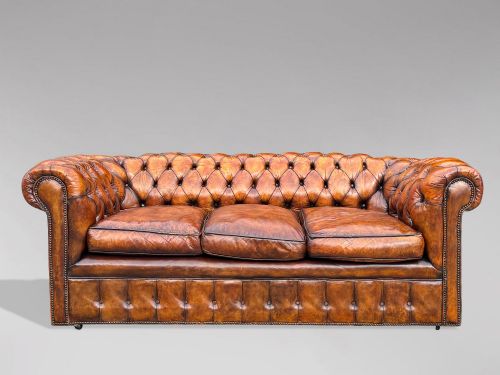
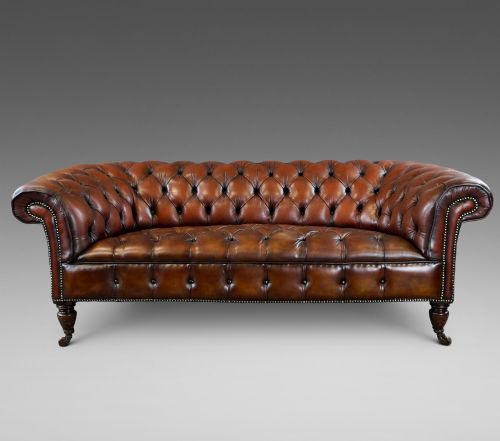
A traditional club sofa is built around the classic Chesterfield form, defined by deep buttoning and rolled arms that match the height of the back. These pieces appear across the Victorian, Edwardian, and Art Deco periods, ranging from large three-seat couches to compact two-seater settees and gentleman's moustache backs.
Most examples found here date from the nineteenth and early twentieth centuries, constructed with substantial hardwood frames designed to anchor a library or study. Alongside standard chesterfields, the selection includes drop-arm chaise lounge variants and complete three-piece lounge suites with matching armchairs.
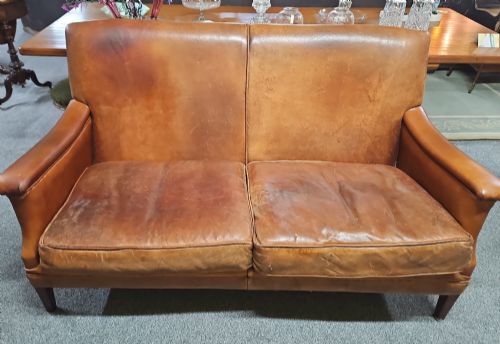
The aesthetic bridges formal Victorian drawing rooms and relaxed twentieth-century club rooms, often finished in hand-dyed whiskey or brown leathers. Buyers encounter both fully restored pieces with fresh upholstery and untouched originals bearing the marks of long use.
How they were made
Makers built the structural foundations of these sofas from heavy hardwoods such as mahogany, utilising traditional joinery to support the substantial weight of internal stuffing. Horsehair fill and deep buttoning provided the firm, resilient spring needed for the signature tufted upholstery.
Outer covers relied heavily on durable leather, alongside occasional velvet or cotton applications, fixed securely with brass tacks. Wood elements frequently featured hand-carved floral details or turned legs fitted with metal castors for mobility.
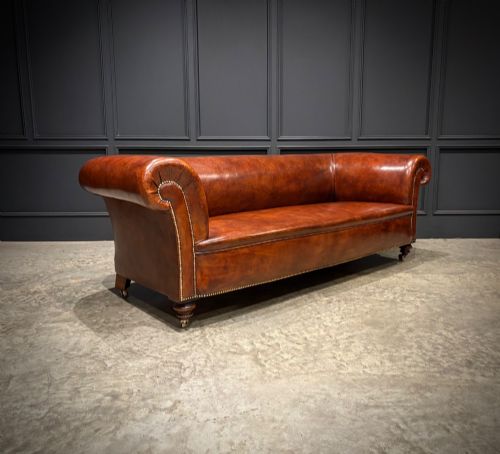
One exceptional Victorian model arrives upholstered in Alfa Romeo leather, proving that classic club comfort adapts happily to unexpected engine-bay origins.
What varies in quality
The standard of a traditional club sofa rests on the integrity of its internal frame and the depth of its original materials. Pieces retaining horsehair stuffing and solid hardwood structures demonstrate superior longevity compared to later reconstructions.
Leather quality and finishing also dictate the tier of a piece, from rich hand-dyed hides with natural patination to standard commercial replacements. The precision of the deep buttoning and the crispness of any hand-carved wood elements further separate standard workshop output from premier London makers.
Howard and Sons·Hampton and Sons of Pall Mall·Maple and Co
The Traditional Club Sofa Glossary
- Chesterfield
- A traditional sofa style characterised by arms and back of the same height, featuring deep button tufting. This form remains the defining archetype for leather club seating.
- Drop arm
- A sofa mechanism allowing one arm to lower into a horizontal position, creating a daybed or chaise lounge configuration. This feature adds versatility to nineteenth-century forms.
- Horsehair fill
- Traditional upholstery stuffing material harvested from equine manes and tails, prized for its spring and durability. It provides the firm support characteristic of period seating.
- Moustache back
- An ornamental upper back rail carved with curves resembling a nineteenth-century moustache. This decorative flourish appears on select Victorian gentleman's club chairs and sofas.
- Deep buttoning
- An upholstery technique where buttons are pulled deep into the padding to create a uniform diamond pattern. This method secures the internal filling while providing structural tension.
Traditional Club Sofa: Frequently Asked Questions
What is a traditional club sofa?
A traditional club sofa is a heavily upholstered nineteenth or twentieth-century seat, typically covered in leather and featuring deep button tufting across the back and arms.
These pieces were originally designed for private men's clubs and Victorian drawing rooms, offering a sturdy frame and deep seating intended for long hours of relaxation.
How do I identify a Victorian chesterfield?
Victorian chesterfields are identified by their substantial hardwood frames, heavy leather upholstery, and characteristic low backs with rolled arms matching the back height.
Look for period details such as hand-carved wooden legs, brass castor wheels, and traditional horsehair filling beneath deep diamond buttoning.
Are these sofas comfortable for daily use?
These sofas are built with dense internal stuffing and sturdy spring systems designed to support heavy daily sitting over many decades.
Because original pieces vary in firmness depending on whether they retain horsehair fill or modern foam, seating comfort depends on the specific interior restoration history of the individual sofa.
What is the difference between restored and original leather?
Original leather retains the untouched surface patina, minor scuffs, and natural ageing accumulated over a century of use.
Restored leather has undergone professional cleaning, re-dyeing, or conditioning to revive the hide, balancing historical character with a smoother modern finish.