
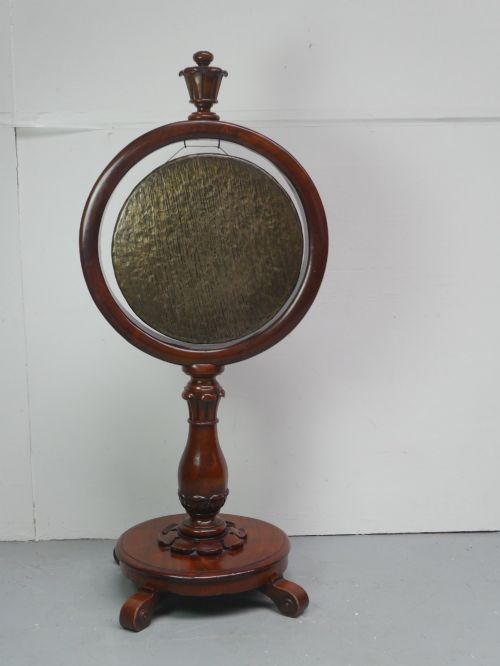


Traditional Brass Dinner Gong
A traditional brass dinner gong calls a household to the table with a resonant deep note that echoes through timber hallways.
Traditional Brass Dinner Gong
A traditional brass dinner gong brings a striking acoustic presence and period character into a hallway or dining room. These pieces combine a resonant metal disk suspended in a sturdy support frame designed to sit upon a sideboard or hang from a wall bracket.
Most examples found here date from the nineteenth century and the Victorian era, reflecting a time when domestic summons involved distinct auditory cues. Formats range from simple wooden table stands to elaborate carved frames incorporating bamboo, cattle horn, or wrought iron.
Geographic influences vary across the selection, moving from British Gothic Revival and Arts and Crafts oak frames to Chinese export pieces and Burmese designs. The core function remains unchanged across all styles, serving as both a practical household instrument and a decorative focal point.
How they were made
Makers shaped the sounding disks from bronze and brass, hammering and turning the metal alloys to achieve the correct acoustic resonance and tonal depth. Frames were constructed using solid native timbers like oak and mahogany, alongside exotic materials such as bamboo.
Suspension cords made of sturdy textiles fasten the heavy metal disks to their supporting structures, allowing the metal to vibrate freely without dampening the sound. Additional decorative elements include hand-carved dragon motifs and mounted cattle horn accents.
Joinery techniques on the wooden stands mirror the prevailing cabinet-making standards of the nineteenth century, utilising mortise and tenon joints to withstand the vibrations of regular striking.
Listings feature pieces spanning the nineteenth century, including Victorian, Arts and Crafts, and Gothic Revival styles alongside Chinese and Burmese examples.
What varies in quality
The resonance and sustain of the metal disk separate a fine instrument from a purely decorative piece, determined by the purity of the brass or bronze alloy and the uniformity of the hammering. A superior gong produces a rich fundamental tone with sustained harmonics rather than a flat metallic clatter.
Frame construction and material selection dictate the overall integrity of the piece, with dense seasoned oak and intricate hand-carved detailing indicating higher workshop standards. Original suspension cords and matching strikers add considerable substance to the complete assembly.
The Traditional Brass Dinner Gong Glossary
- Gong
- A percussion instrument consisting of a flat or shaped metal disk that produces a resonant note when struck with a mallet. It forms the primary sounding element of any dinner gong assembly.
- Striker
- The mallet or beater used to sound the metal disk, often featuring a turned wooden handle and a padded or weighted head. Correct weight ensures the proper tone without damaging the metal surface.
- Gothic Revival
- An architectural and decorative style popular during the nineteenth century that draws on medieval forms, frequently seen in pointed arches and heavy carved oak frames. This style gives many dinner gongs a robust, ecclesiastical appearance.
- Arts and Crafts
- A design movement emphasising handcraftsmanship and simple vernacular materials over mass production. Pieces from this tradition showcase honest construction and natural timber grains.
Traditional Brass Dinner Gong: Frequently Asked Questions
How do I hang a wall gong safely?
Ensure your wall fixings anchor directly into solid masonry or substantial timber studs rather than standard plasterboard. The weight of the timber frame and suspended metal disk places continuous downward strain on the mounting points.
Check that the hanging cord or chain is securely knotted and shows no signs of fraying where it meets the frame. Regular inspection prevents accidental slips when the instrument is struck.
Can I use any mallet as a striker?
Using an incorrect striker can damage the metal disk or produce a harsh, flat sound instead of a resonant tone. Traditional strikers use specific weights and padded heads calibrated to draw out the deepest vibrations from the alloy.
Keep the original striker with the piece whenever possible to maintain historical accuracy and proper acoustic performance. Substitutes should match the original density and striking surface material.
How do I date a Victorian dinner gong?
Examine the timber species, joinery methods, and decorative motifs for clues regarding the period of manufacture. Nineteenth-century examples often feature hand-cut joints, dense oak or bamboo framing, and specific stylistic markers like Aesthetic Movement or Gothic Revival carving.
Inspect the suspension cord and mounting hardware for signs of age, hand-forging, or period-specific manufacturing techniques. Comparing these elements with documented examples from the same era helps confirm the timeline.