
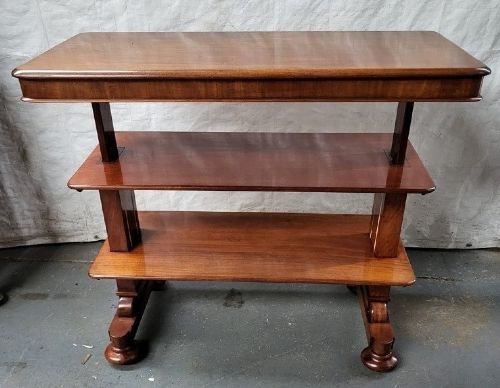

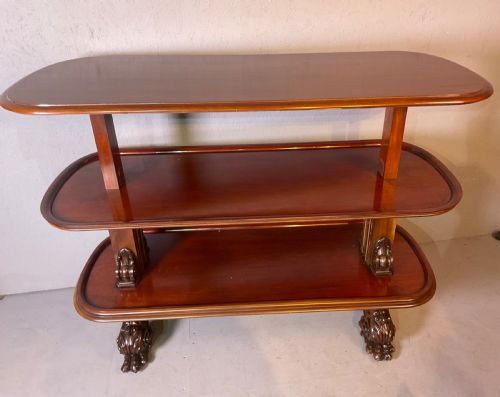


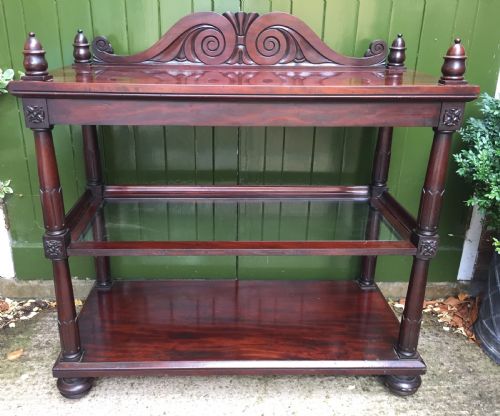


Three Tier Mahogany Sideboard
A three tier mahogany sideboard offers tiered shelving for serving and display, bringing substantial timber and practical tiers to a dining room.
Three Tier Mahogany Sideboard
A three tier mahogany sideboard is typically encountered in forms such as buffets, dumb waiters, etageres, and tiered stands across nineteenth century periods. These pieces serve dining spaces by providing multiple levels of mahogany shelving supported by uprights, often moving on castors.
The versions most frequently met on this page date from the Victorian, William IV, George IV, and Regency eras, with labels ranging from serving tables to metamorphic dumb waiters. Their design prioritises stacked display surfaces over enclosed cupboards, reflecting nineteenth century dining and serving customs.
Construction and materials
Makers built these pieces primarily using mahogany timber, sometimes selecting figured grains for visual depth on the shelves and panels. Construction methods join the horizontal tiers to vertical supports or turned columns, forming stable multi-level frameworks.
Metal and ceramic elements appear in subsidiary roles, with brass and ceramic components utilised in castors for mobility. Glass and brass fittings occasionally integrate into specific metamorphic or adjustable designs within the nineteenth century group.
Materials documented across the pieces include mahogany timber, brass hardware, ceramic elements, and glass components.
Distinctions in quality
Quality varies according to the selection of mahogany and the execution of turned or carved details on the supports. Finer pieces demonstrate careful timber matching across the tiers and robust joinery that sustains the weight of stacked shelving.
The presence of working mechanisms in adjustable or metamorphic examples, alongside original brass or ceramic castors, separates standard production from superior workshop output. Maker attribution, such as pieces bearing stamps or labels, further distinguishes the top tier of survival.
Maple & Co·James Shoolbred & Co
The Three Tier Mahogany Sideboard Glossary
- Mahogany
- A durable hardwood noted for its reddish-brown colour and fine grain. It served as the primary material for high quality nineteenth century furniture.
- Dumb waiter
- A tiered stand or serving piece designed to hold dishes or glassware near a dining table. These pieces often feature multiple shelves supported by a central column or upright corners.
- Metamorphic
- A descriptive term for furniture that alters its form or height through mechanical action. These pieces adjust for different serving or display functions.
- Castor
- A small wheel attached to the base of furniture to allow easy movement. Nineteenth century examples frequently combine brass sockets with ceramic or metal wheels.
Three Tier Mahogany Sideboard: Frequently Asked Questions
What is a three tier mahogany sideboard?
A three tier mahogany sideboard is a nineteenth century serving piece featuring three horizontal wooden shelves arranged vertically. These stands function as buffets, dumb waiters, or etageres for dining rooms.
They provide open display surfaces rather than enclosed storage cupboards, relying on upright supports and frequently resting on castors for movement around the room.
How were these pieces used originally?
Originally, these tiered stands served dining rooms by holding extra plates, dishes, glasses, and serving dishes within reach of the dining table. Servants utilised the multiple tiers to stage courses during long meals.
Over time, their role shifted toward display, allowing households to exhibit decorative ceramics, silver, or glassware on the stacked mahogany shelves.
How do I date a three tier mahogany sideboard?
Dating relies on stylistic markers associated with periods such as Regency, George IV, William IV, and Victorian eras. Regency and George IV pieces often display cleaner classical lines, while William IV and Victorian items introduce heavier proportions and bolder carved supports.
Mechanisms, castor types, and construction methods also provide clues, with specific joinery and hardware aligning with mid to late nineteenth century workshop practices.
Are these pieces adjustable?
Some examples incorporate metamorphic or adjustable designs that allow the tiers to alter in height or configuration. These mechanical variations required specialised hardware concealed within the upright supports.
Standard versions remain fixed in height, but adjustable models offer flexibility in how the tiers display items.