



Three Bottle Decanter Set
A three bottle decanter set organises after-dinner hospitality with secure frames and matched glass, holding spirits ready for the table.

Three Bottle Decanter Set
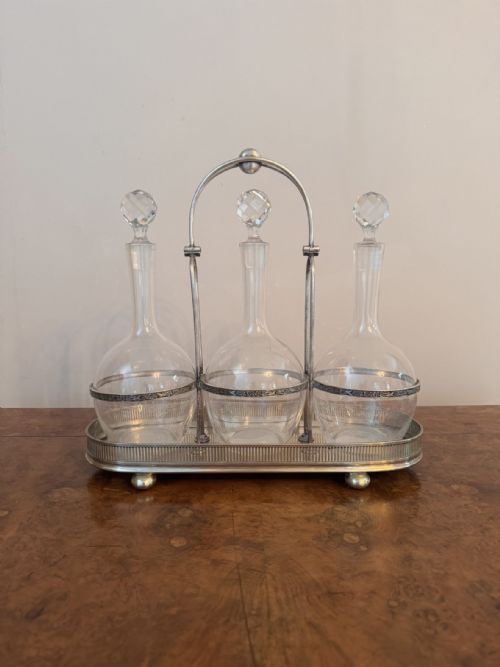
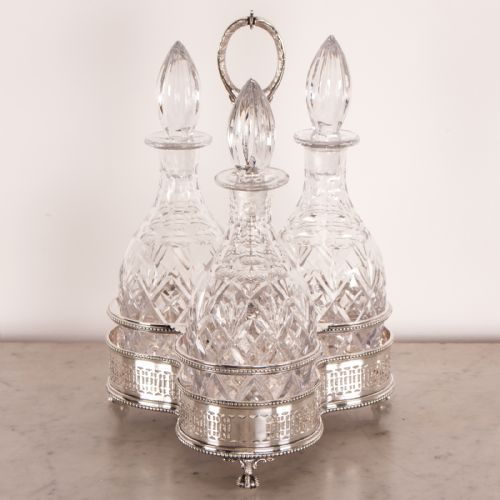
A three bottle decanter set brings together matching glass vessels within a secure frame or tantalus, designed for serving spirits after dinner. These assemblies range from open metal cruet stands to locking wooden caskets that keep the contents secure.
The versions most frequently met on this page date from the Victorian and Edwardian eras, constructed from oak or silver plate. They combine utilitarian barware with decorative joinery and heavy cut crystal.
How they were made
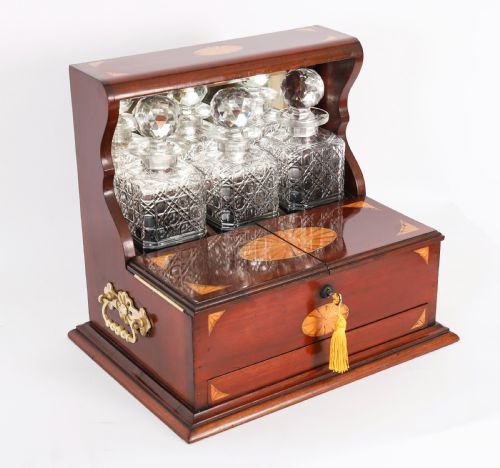
Makers shaped these objects using dense timbers like oak and coromandel, often embellished with brass mounts, marquetry stringing, and satin wood inlay. Frames were built to house three individual bottles snugly within fitted compartments.
The bottles themselves utilise cut glass or crystal, sometimes finished with silver-plated collars, stoppers, and matching sterling silver labels on chains. Metal stands rely on silver plating or old Sheffield plate over a base metal.
Listings span the Victorian and Edwardian periods, utilising materials such as oak, coromandel, cut crystal, and silver plate.
What varies in quality
The refinement of the woodwork and the weight of the glass establish the grade of a piece, separating standard production stands from bespoke caskets. High-grade examples incorporate intricate marquetry, substantial brass locking mechanisms, and heavy cut crystal bottles.
Makers such as Betjemann or Elkington applied superior plating and precise joinery, while simpler oak frames relied on standard commercial production methods. The presence of matching hallmarked silver mounts and original keys alters the standing of the piece.
Walker & Hall·Betjemann’s·Elkington·The Goldsmith Co.·Philip Ashberry
The Three Bottle Decanter Set Glossary
- Tantalus
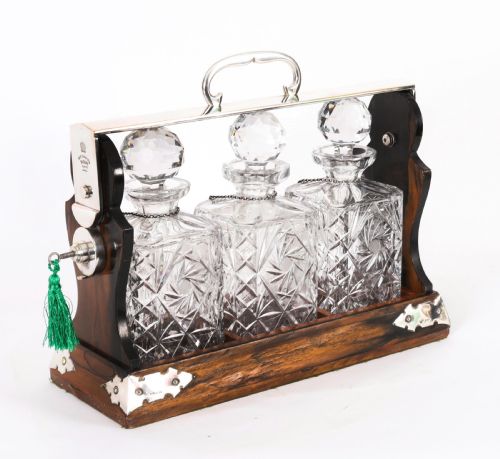
- A locking drink cabinet that displays three decanters while preventing access to the contents without a key. The metal bar secures the stoppers in place.
- Cruet
- An open stand designed to hold bottles or jars for the table, allowing the vessels to be lifted out freely without a locking mechanism.
- Coromandel
- A dense, dark timber imported from Asia, valued for its rich grain and utilised in high-end nineteenth-century boxes and tantalus frames.
- Old Sheffield Plate
- An early composite material made by fusing a thin sheet of silver to a copper base, creating a durable metal used before electroplating.
- Hock decanter
- A tall glass vessel traditionally used for white wine, often found in coloured or cut crystal variants within nineteenth-century sets.
Three Bottle Decanter Set: Frequently Asked Questions
How do you lock a tantalus?
A tantalus secures three decanters by positioning a metal bar directly over the glass stoppers, which prevents them from being lifted out of the frame.
Turning a key in the lock engages the mechanism at the side or top, holding the bar firmly across the necks of all three bottles until unlocked.
Are the decanters usually matching?
Many surviving sets retain their original matching set of three cut crystal or glass bottles, fitted specifically to the compartments of the wooden or metal stand.
Some pieces accumulated replacement bottles over time, making it important to inspect the matching cut patterns and glass tints across all three vessels.
How do I date an oak tantalus?
Oak tantalus frames from the Victorian period frequently display heavy brass mounts, late Victorian carving, or marquetry stringing, dating from the mid to late nineteenth century.
Edwardian examples from around 1900 often feature simpler oak frames, silver-plated handles, and machine-cut crystal bottles without the ornate carving of earlier decades.