

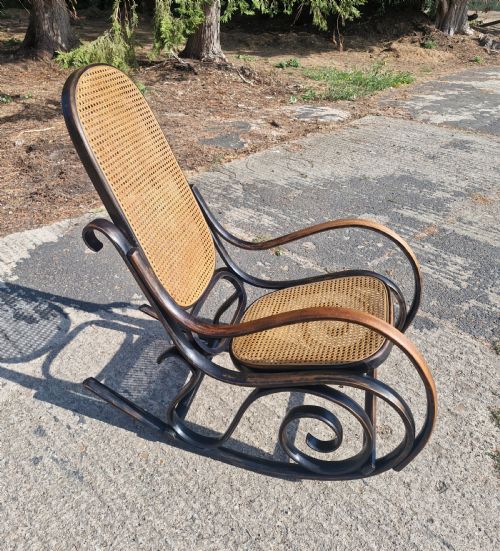
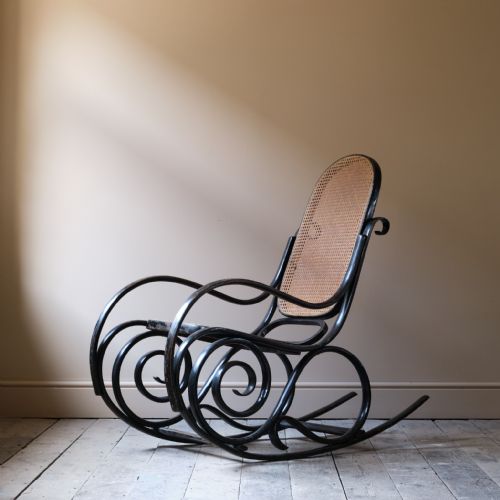


Thonet Rocking Chair
A thonet rocking chair brings fluid steam-bent curves and resilient cane work into a room.
Thonet Rocking Chair
A thonet rocking chair is a triumph of steam-bent wood technology, appearing primarily in forms from the nineteenth century through the Edwardian period and the Vienna Secession. You are most likely to meet bentwood rocking armchairs featuring woven cane seats and backs, alongside occasional ebonised or painted variations.
The objects span standard seating, child's rockers suitable for dolls, and Italian or Austrian interpretations. Forms remain light and springy, relying on continuous flowing loops of timber rather than heavy joined framing.
Materials and construction
Makers utilised solid beech and beech wood, steaming the timber until pliable enough to pull into tight, graceful curves for the runners, armrests and frames. Plywood also appears in structural elements.
Seats and backrests are frequently infilled with natural rattan cane or cane webbing, though leather and fabric upholstery occasionally surface in the archive.
Materials recorded across the archive include beech, plywood, leather, fabric, and rattan cane.
Judging quality in bentwood rockers
Quality rests upon the tautness of the steam bends and the purity of the wood grain through the curves. Meticulous execution of the scrollwork distinguishes standard production from finer exhibition pieces.
The integrity of the woven rattan cane and the retention of original surface finishes dictate the desirability of an example.
Thonet·Jacob and Josef Kohn
The Thonet Rocking Chair Glossary
- Bentwood
- Wood shaped by exposure to steam and pressure into curved forms. This technique allowed makers to discard traditional joinery in favour of continuous flowing lines.
- Cane
- Woven material made from the outer skin of rattan palms. It provides a lightweight, flexible surface for seats and backrests.
- Ebonised
- Wood finished to resemble ebony through staining or painting. This dark surface treatment was favoured during the Victorian era for a dramatic silhouette.
- Vienna Secession
- An art movement of the early twentieth century focusing on geometric forms and modern design. It influenced the cleaner lines seen in later bentwood seating.
Thonet Rocking Chair: Frequently Asked Questions
How do I date a thonet rocking chair?
Dating relies on construction methods, paper labels, branded stamps into the wood, and stylistic markers such as Vienna Secession geometry or Victorian ebonising. Earlier examples from the nineteenth century often show heavier gauge runners and simpler, robust scrollwork.
Later pieces from the Edwardian era and the nineteen-twenties exhibit lighter frames and more stylised apertures in the plywood seats or back panels.
Are these chairs comfortable for daily use?
The springy nature of bentwood combined with the flexible give of woven cane creates a surprisingly responsive and gentle rocking motion. They offer an ergonomic sit due to the curved backrest supporting the spine.
Users should respect the age of vintage cane panels by avoiding overly heavy impacts or harsh point loads on the woven surfaces.
What is a Thonet Number 3 rocker?
Numbered models refer to specific design patterns issued in historical manufacturer catalogues. A Number 3 designates a particular proportion and scroll configuration in the bentwood frame.
These catalogue numbers help researchers and collectors match surviving physical chairs to production timelines.
How should I clean the cane seat?
Natural rattan cane benefits from gentle dusting with a soft brush and occasional wiping with a damp cloth to maintain moisture. Keeping the cane slightly humidified prevents it from becoming brittle over decades of indoor use.
Harsh chemical cleaners and soaking must be avoided to protect the organic fibres and the surrounding wooden frame.