



Thatched Cottage Landscape
A thatched cottage landscape records the rural vernacular of earlier centuries through the brush of painters drawn to pastoral quiet.
Thatched Cottage Landscape
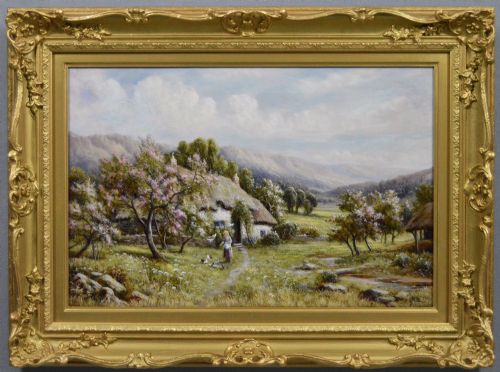
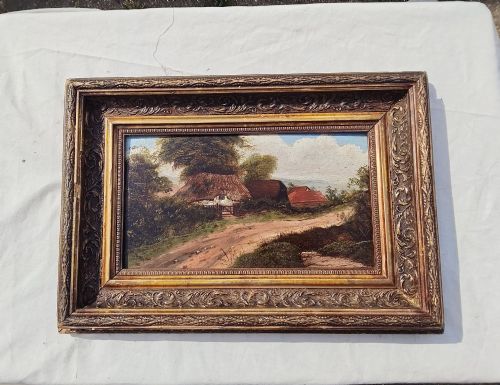
A thatched cottage landscape depicts rural dwellings set within English and British countryside scenes, capturing a traditional way of life that absorbed artists throughout the nineteenth and early twentieth centuries. These works span Victorian village genre studies and Edwardian pastoral views, reflecting a persistent cultural attachment to agrarian simplicity.
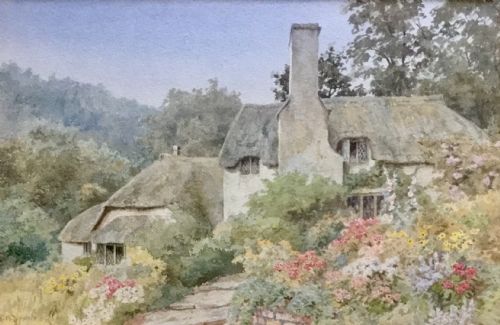
The most common iterations encountered here are watercolours and oil paintings dating from the Victorian and Edwardian eras up to the mid-twentieth century. Artists frequently placed figures, domestic animals or garden pathways around timber-framed, straw-roofed homes to construct an idyllic narrative of domestic harmony.
Paintings range from intimate watercolours executed on paper to substantial oil paintings on canvas and card, often framed in gilt wood. Regional subjects frequently highlight specific counties such as Devon, Somerset, Warwickshire and Surrey, mapping a vanished topography through pigment.
How They Were Made
Artists built these compositions primarily using watercolour pigment on paper or oil paint applied to canvas and card, sometimes supported by wood panels. Pigments were layered to capture atmospheric light, particularly in depicting the heavy texture of straw thatch and timber framing against woodland or river backgrounds.
Listings feature works spanning the Georgian, Victorian, Edwardian and mid-twentieth-century periods executed in oil and watercolour.
What Varies in Quality
Quality rests upon the artist's command of perspective, handling of natural light and ability to render human or animal figures with anatomical conviction rather than formulaic repetition. Stronger works demonstrate careful observation of architectural timber and botanical detail within the cottage gardens.
The sensitivity of the colour palette distinguishes accomplished compositions from generic village scenes, particularly in how painters balance the neutral textures of thatch against surrounding foliage and sky. Provenance and the survival of original framing also influence the standing of individual pieces.
Robert John Hammond·John McDougal·Harry Sylvester Stannard·Robert Hollands Walker·Thomas James Lloyd·Joseph Kirkpatrick·Arthur Claude Strachan·Walter Henry Sweet·Thomas Nicholson Tyndale·David Heward·Yeend King·Joseph Hughes Clayton·Alfred Leyman·Georgina Lara·Thomas Rowlandson·Joseph Paul·Singleton Jowett·Peace Sykes·David Woodlock·Sidney Valentine Gardner·Christian Berthelsen·David Bates·W H Davis·C F Watson·Henry Charles Fox
The Thatched Cottage Landscape Glossary
- Watercolour painting
- A work executed with water-soluble pigments on paper, valued for its translucent washes and immediacy of execution.
- Oil on canvas
- A painting technique utilising pigments suspended in a drying oil medium applied to stretched woven fabric, allowing for rich texture and deep colour saturation.
- Gilt wood
- Wood carved and coated with a thin layer of gold leaf or metallic powder, commonly used to finish traditional picture frames.
- English pastoral realism
- An artistic movement focused on depicting authentic rural life and landscape scenery without romantic idealisation.
- Victorian rural genre
- Artworks concentrating on everyday scenes of country labour, domestic chores and village communities during the nineteenth century.
Thatched Cottage Landscape: Frequently Asked Questions
What periods do these paintings represent?
The available works span from the Georgian period through the Victorian and Edwardian eras into the mid-twentieth century.
Most pieces concentrate around the late nineteenth and early twentieth centuries, reflecting a peak in British pastoral painting.
Where are the depicted cottages located?
The scenes frequently document specific English counties including Devon, Somerset, Warwickshire, Surrey and Yorkshire.
Artists often travelled to rural villages to record local vernacular architecture and coastal settlements.
How should these paintings be framed?
Many works retain period gilt wood frames that complement the traditional subject matter and age of the canvas or paper.
Displaying them away from direct sunlight protects watercolour pigments and oil paint from environmental degradation.