



Tessellated Wood Inlay
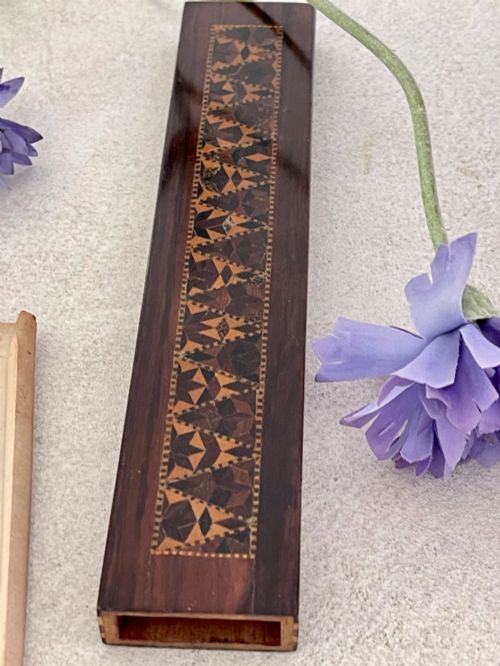
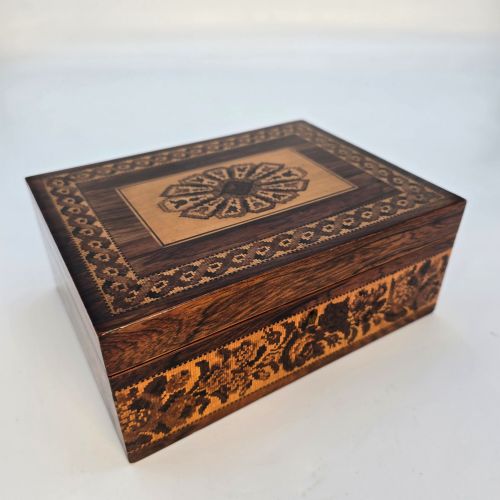
These tessellated wood inlay pieces are intricate works of Victorian craftsmanship, prized for their minute geometric and pictorial designs.
Tessellated Wood Inlay
When you search for tessellated wood inlay, you are looking at small domestic items and decorative objects built from thousands of tiny tinted and natural wood splints. The pieces on this page are predominantly Victorian Tunbridge Ware, alongside North African mosaic work.
The forms range from functional desk and vanity items such as tea caddies, stationery boxes, glove boxes, and jewellery boxes to wall plaques and octagonal dishes. Most examples originate from the nineteenth century, reflecting the height of precision woodwork.
You will encounter specialised sewing accessories and cribbage boxes among the selection, demonstrating how makers applied microscopic timber mosaics to everyday Victorian items. Each piece relies on tightly packed tesserae to form complex visual motifs.
How they were made
Makers constructed these objects using a vast palette of native and exotic timbers including rosewood, walnut, boxwood, holly, and sycamore. They glued together hundreds of differently coloured wood rods into a bundle, which was then sliced transversely across the grain to produce numerous identical mosaic tiles.
Craftsmen applied these mixed hardwood veneers and geometric strips onto sturdy wooden carcasses to cover small boxes, trays, and plaques. This mosaic technique required extreme precision to ensure the microscopic timber blocks aligned perfectly without visible gaps.
Tessellated Wood Inlay Retail Price Guide 2026
Typical asking prices for tessellated wood inlay among the pieces listed under this phrase on Sellingantiques today, from the lower quarter to the upper quarter. They describe what is for sale here now, not the wider market.
Makers sometimes embedded microscopic views of local castles and British butterflies into spaces smaller than a postage stamp.
What varies in quality
Quality in tessellated wood inlay rests upon the sheer density and microscopic scale of the individual wood blocks. Finer items incorporate thousands more tiny tesserae to build complex pictorial scenes of butterflies, castles, or perspective cubes.
The choice of contrasting natural timbers also dictates distinction, where makers utilised undyed boxwood, holly, and burr walnut alongside stained woods to create depth. The crispness of the geometric borders and the preservation of the delicate wood veneers separate standard boxes from exceptional collector pieces.
Edmund Nye·Henry Hollamby
The Tessellated Wood Inlay Glossary
- Tunbridge Ware
- A distinct type of wooden mosaic ornament produced in Tunbridge Wells, characterised by microscopic geometric and pictorial tessellation. The technique reached its peak during the Victorian period.
- Tesserae
- The individual small blocks or tiles of coloured wood used to build up the mosaic pattern. Makers sliced these from bundled rods of timber.
- Veneer
- A thin sheet of superior or patterned wood applied to a secondary timber carcass. In these pieces, mosaic panels function as the decorative surface.
- Marquetry
- The art of forming decorative patterns by fitting together dissimilar strips and blocks of wood. It differs from inlay by being assembled first and then applied to the surface.
Tessellated Wood Inlay: Frequently Asked Questions
What is tessellated wood inlay?
It is a decorative technique where tiny blocks of various coloured woods are assembled to create microscopic geometric patterns and pictures.
Craftsmen sliced these mosaic designs from bundled timber rods and applied them to boxes, tea caddies, and plaques.
How do I care for these wooden boxes?
Keep them away from direct sunlight and dramatic changes in household humidity to protect the delicate timber veneers.
Dust gently with a dry, soft cloth and avoid applying liquid polishes or modern cleaning chemicals.
How are Tunbridge Ware and mosaic inlay related?
Tunbridge Ware is the specific English manifestation of tessellated wood inlay originating from Kent during the nineteenth century.
While similar mosaic work appears in North African pieces, Tunbridge items typically feature local British scenes and geometric borders.
What woods did makers use?
Makers utilised a wide variety of natural and chemically treated hardwoods to achieve a diverse palette of colours.
Common selections included bright white holly, yellow boxwood, dark rosewood, walnut, and pale sycamore.