
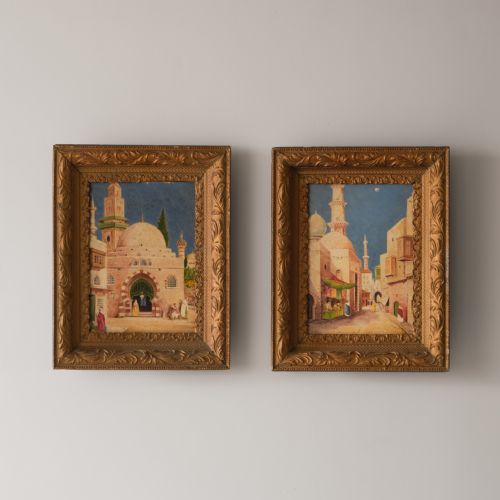
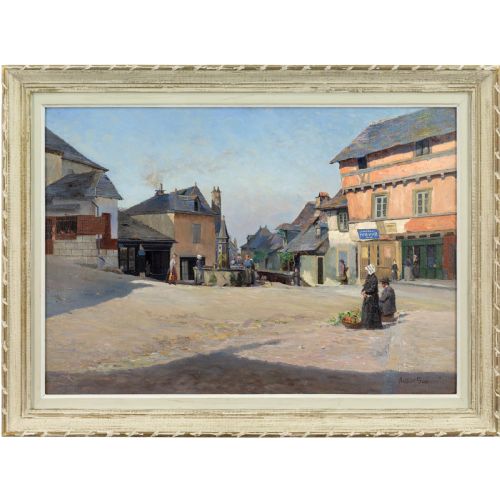
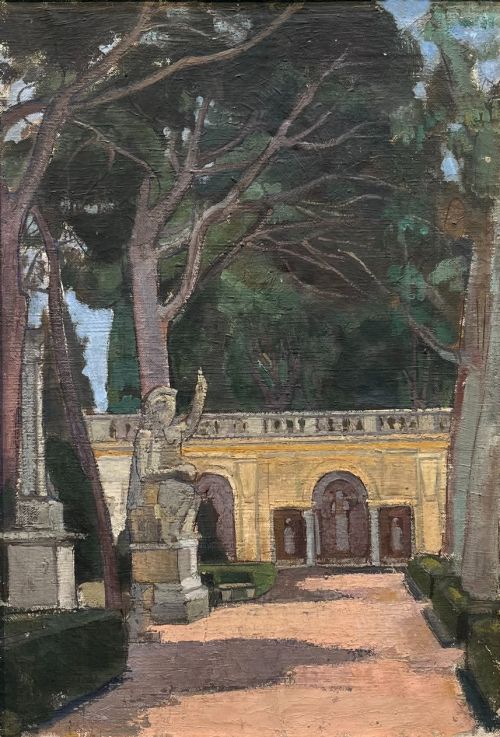
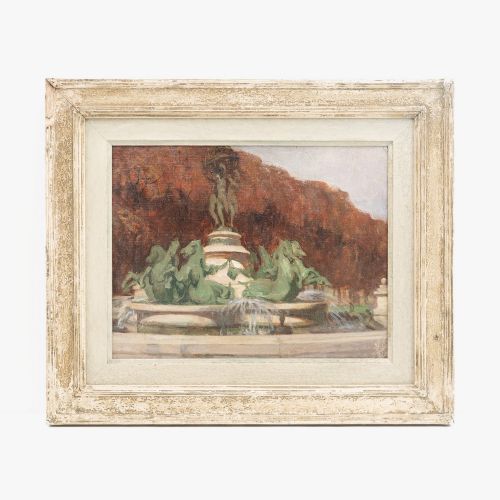


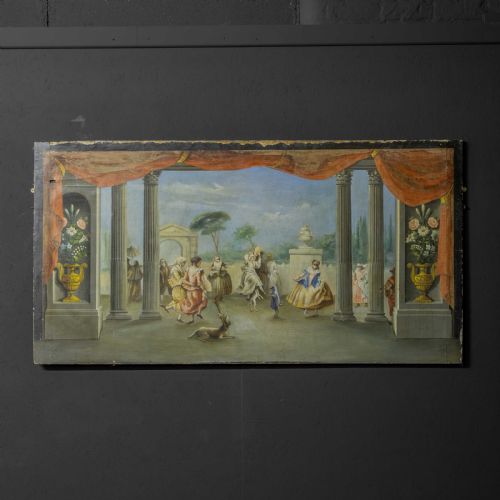

Terracotta Architectural Oil Painting
These terracotta architectural oil painting works bring distinct warmth and structure into a room, capturing buildings and masonry in pigment.
Terracotta Architectural Oil Painting
When you search for terracotta architectural oil painting, you encounter works focused on buildings, urban vistas, and masonry tones captured in pigment. The selections span the nineteenth century through the mid-twentieth century, encompassing British Impressionism, naive art, and mid-century modern idioms.
You meet framed canvases and panel works depicting cityscapes, gardens, and village scenes. The creators range from named continental artists to the British school in Rome and unrecorded hands working in distinct twentieth-century styles.
How they were made
The works utilise oil paint applied to canvas, wood, or board supports, sometimes building significant impasto texture onto the surface. Frames of gilt wood or plain timber frequently accompany the canvases, completing the composition.
Artists layered pigments to capture the warmth of southern light and masonry, employing techniques from flat naive application to energetic post-impressionist brushwork.
Several artists packed their oil paints and travelled south to Rome, Venice, and Baghdad just to capture ancient stone under the sun.
What varies in quality
Distinction lies in the sureness of the brushwork and the clarity of spatial depth within the urban or architectural composition. Stronger pieces demonstrate confident handling of light upon stone surfaces and balanced tonal relationships.
The integration of the supporting frame with the painted canvas alters the overall presence of the piece, as does the preservation of the original pigment layer over the decades.
Arthur Gué·Alexander Jamieson·Armand Guillaumin·Christiaan Pieter Snyders
The Terracotta Architectural Oil Painting Glossary
- Impasto
- Paint applied thickly to a canvas or board, standing out from the surface so that the texture of the brush or palette knife remains visible. This technique adds tactile dimension to architectural elements like walls and roofs.
- Post-Impressionism
- An artistic movement developing roughly from the late nineteenth century, extending impressionist methods while emphasising geometric forms and expressive use of colour. Works in this style often use simplified shapes to build architectural weight.
- Board
- A rigid flat surface made of wood pulp, paperboard, or timber panel used as a support for oil painting instead of stretched canvas. It provides a firm resistance for the artist's brush.
- Gilt wood
- Timber carved and coated with gold leaf or a gold-coloured metallic finish to create a decorative frame. These frames protect the edges of the canvas and complement the warm tones of the painting.
Terracotta Architectural Oil Painting: Frequently Asked Questions
What periods do these paintings date from?
The works span from the Victorian era and the nineteenth century through the 1900s, 1920s, 1930s, 1940s, 1950s, and into the 1960s. Each era brings distinct movements such as British Impressionism and mid-century modern abstraction.
Dates are drawn from the recorded creation periods of the individual pieces, showing how artists captured architectural subjects across changing decades.
How should I hang an oil painting?
Select a wall with stable ambient conditions away from direct sunlight and excessive moisture to protect the pigment and canvas. Ensure the fixing matches the weight of the framed piece securely.
Allow adequate space around the frame so the architectural composition can be viewed clearly without visual crowding from neighbouring items.
What is naive art?
Naive art refers to work created by artists without formal academic training, often characterised by a charming directness in perspective and proportion. These pieces possess an unpretentious view of buildings and street scenes.
Such works rely on intuitive colour choices and honest mark-making rather than strict adherence to classical rules of perspective.
What materials support these artworks?
Painters used traditional canvas stretched over wooden frames, alongside wooden boards and panels. Oil paint serves as the primary medium across these different supports.
Many pieces retain their period frames constructed from wood or gilt wood, which form an integral part of the physical object.