
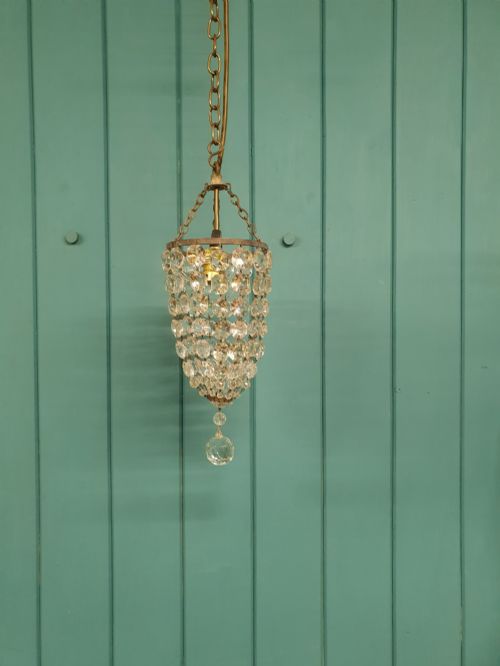


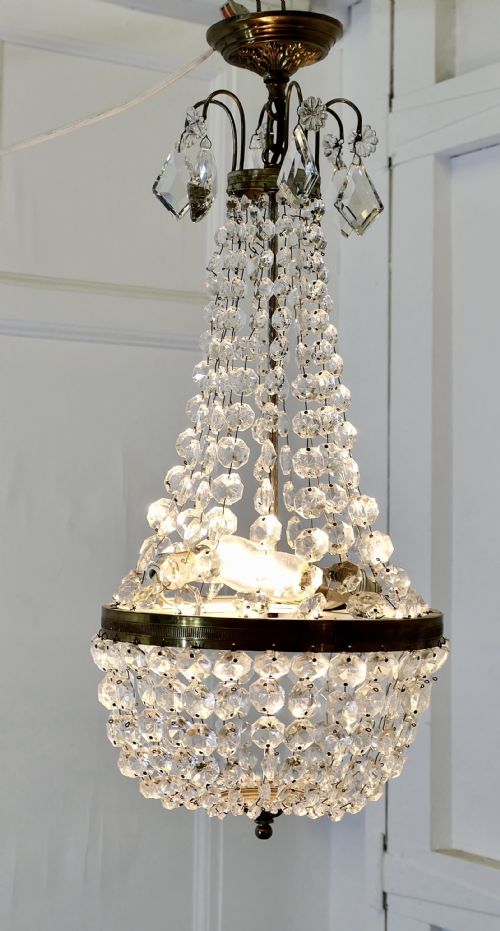


Tent and Basket Chandelier
A tent and basket chandelier combines upper rows of strung drops with a lower gathering of glass, bringing brilliant light and classic French character into a room.
Tent and Basket Chandelier
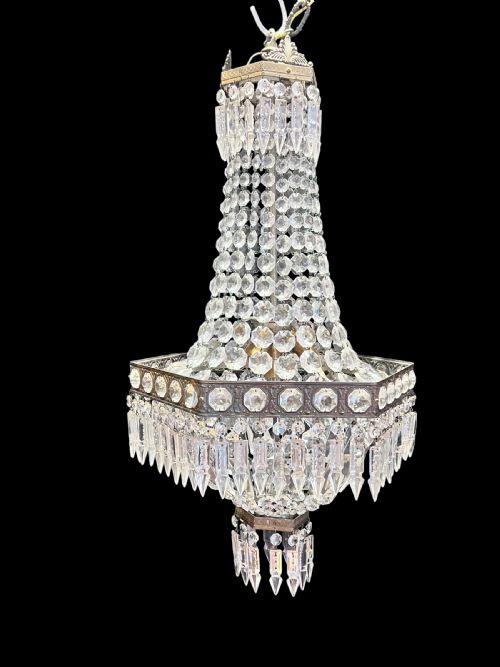
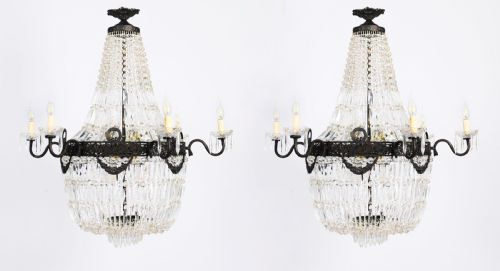
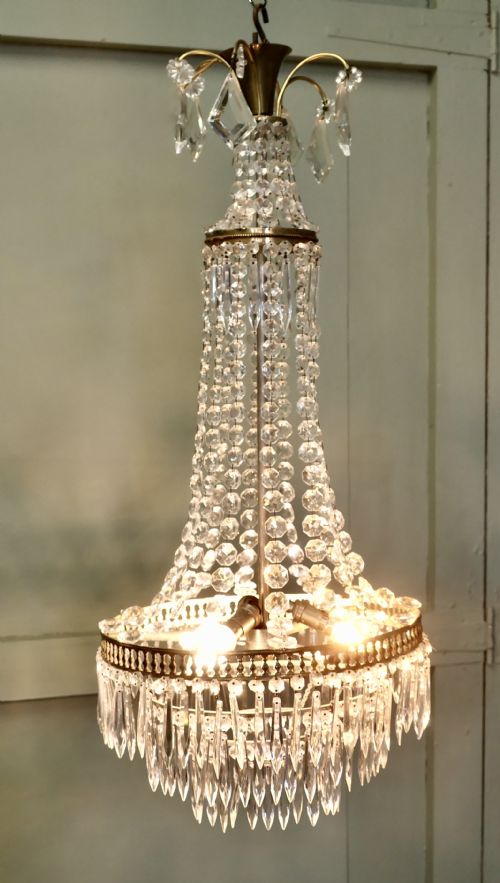
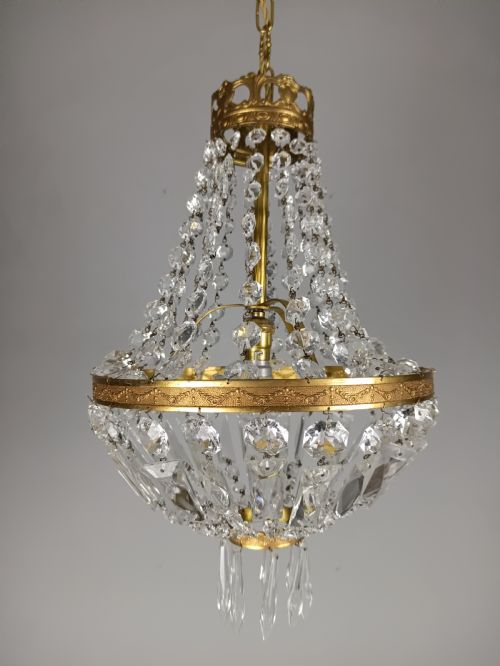
When you search for a tent and basket chandelier, you are looking at elaborate light fixtures defined by an upper crown of glass drops hanging in a tent formation above a lower basin or bag. These pieces frequently appear in French Empire and Regency styles, drawing on decorative traditions from the nineteenth and early twentieth centuries.
The versions you are most likely to meet on this page date from the Edwardian era up through the nineteen-thirties, often manifesting as French Empire style or Louis Revival designs. They range from small single-light fixtures measuring only inches across to large fourteenth-light ballroom fittings fashioned from brass, bronze, and wire.
Makers and designers working in this idiom utilised traditional forms like the waterfall, bag, and tent configurations, mounting cut glass and crystal onto metal frameworks. Each piece reflects historical European interior tastes, adapting classical motifs into domestic and grand lighting solutions.
Materials and construction
These chandeliers rely on structural frames formed from brass, gilt bronze, and wire to support the considerable weight of the glass elements. Metal mounts secure the various tiers while providing a sturdy armature for internal lighting components.
Cut glass and cut crystal form the optical heart of each piece, shaped into beads, spears, and drops that make up the signature tents and baskets. Precision in cutting ensures that light refracts clearly across the room when the fixture is illuminated.
Some miniature chandeliers measure a mere five inches, offering all the drama of a grand ballroom fixture on a remarkably domestic scale.
Evaluating quality and execution
The distinction between standard examples and finer works rests upon the clarity of the cut crystal and the complexity of the metal mounts. Higher quality pieces utilise heavier cast brass or gilt bronze alongside finely faceted glass drops that catch and disperse light with greater brilliance.
Proportion and scale dictate the visual success of a fixture, with superior examples displaying balanced tiers and harmonious relationships between the upper tent and lower basket. The integrity of the wirework and the precision with which the glass beads are strung further define the standard of execution.
The Tent and Basket Chandelier Glossary
- Tent
- An upper section of a chandelier where strings of glass beads hang from a central ring up to a crown, creating a tent-like silhouette.
- Basket
- The lower bowl or bag portion of the fixture, closely gathered with glass drops to form a rounded profile beneath the tent.
- Waterfall
- A cascading arrangement of glass drops that flows downwards, often combined with tent formations to increase visual depth.
- Cut crystal
- Glass that has been hand-cut and polished to create sharp facets, enhancing the refraction of light through the chandelier.
- Louis Revival
- A nineteenth and twentieth century decorative style drawing heavily on the court aesthetics of French monarchs.
Tent and Basket Chandelier: Frequently Asked Questions
What rooms suit a tent and basket chandelier?
These chandeliers suit formal living spaces, dining rooms, and hallways where height allows the cascading glass to catch the light effectively.
Smaller examples work well in compact settings, while grand multi-light ballroom fixtures require higher ceilings to balance their substantial scale.
How do I date my chandelier?
Dating relies on examining the metal composition, wiring methods, and the style of the cut glass drops relative to documented periods.
Edwardian and early twentieth century pieces often display specific mounting techniques and brass finishes distinct from nineteenth century examples.
How are these chandeliers cleaned safely?
Cleaning requires a gentle glass cleaner applied directly to a cloth rather than sprayed onto the fixture, protecting the metal mountings and delicate wirework.
Individual crystal drops can be carefully wiped in place to maintain their refractive brilliance without disturbing the structural stringing.