
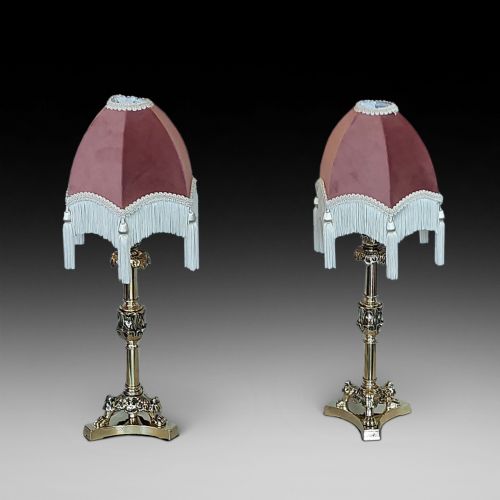


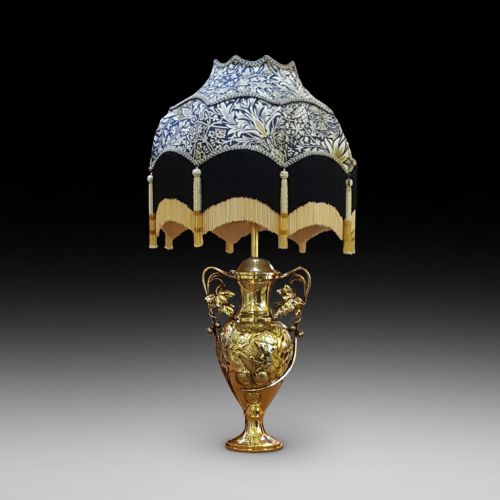
Tasselled Fringe Lampshades
These tasselled fringe lampshades bring soft lighting and tactile texture to interiors, drawing collectors seeking period illumination.
Tasselled Fringe Lampshades
When you search for tasselled fringe lampshades, you enter a field of period lighting dominated by floor and table lamps paired with period bases. The pieces available span the Victorian era, the Edwardian period, and the early twentieth century, including nineteen-hundred and eighteen-hundred examples.
The forms you are most likely to meet on this page include brass table lamps, floor lamps, and converted candlesticks. These items often showcase styles such as Art Nouveau, Arts and Crafts, Victorian Neoclassical, and Orientalist designs.
How they were made
Makers utilised brass, copper, and gilt metal for the structural bodies and standards of these lamps. Beaten and pressed techniques shaped the metal components.
Fabric, silk fringe, thread, and glass beads formed the soft elements and shades associated with the lighting fixtures. These textile components added texture and colour to the finished pieces.
The listings show items spanning the Victorian era, Edwardian period, and nineteen-hundred, constructed from brass, copper, and fabric.
What varies in quality
The sophistication of the metalwork defines the upper tier of these pieces. Hand-beaten copper and intricate pressed brass show a superior handling of materials compared to simpler standard production.
The integrity of the conversion and the retention of original period elements separate finer examples from heavily altered stock. Original pairings of bases and shades maintain greater historical coherence.
The Tasselled Fringe Lampshades Glossary
- Brass
- An alloy of copper and zinc used extensively for lamp bases and standards. It polishes to a bright golden finish or ages to a darker patina.
- Art Nouveau
- A stylistic movement characterised by organic, flowing lines and natural motifs. Pieces in this style frequently appear in early twentieth-century listings.
- Arts and Crafts
- A design movement prioritising handcraftsmanship and simple forms. Copper and brass items from this tradition show visible worker input.
- Standard lamp
- A tall floor lamp designed to stand independently in a room. These often feature weighted bases to support decorative upper fittings.
Tasselled Fringe Lampshades: Frequently Asked Questions
How do I date a brass lamp?
Examine the construction methods and stylistic markers visible in the metalwork. Pressed and beaten techniques often align with specific decades.
Compare the form against known periods such as Victorian, Edwardian, or Art Nouveau to narrow the decade of production.
Were these lamps always electric?
Many early pieces began life as oil lamps or candlesticks before conversion to electricity. Brass candlesticks from the early nineteenth century frequently underwent this adaptation.
Look for wiring holes and altered burners that indicate the transition from flame to bulb during past decades.
Where should I place a floor lamp?
Tall standards suit corners of reception rooms where they cast downward illumination over seating areas. Their height allows them to anchor empty wall space.
Ensure the heavy brass or copper base sits on a stable surface away from heavy foot traffic.
What distinguishes Arts and Crafts lighting?
This design approach emphasises visible hammer marks and honest construction in metals like copper. Decoration remains tied to the natural properties of the material.
Such pieces contrast with mass-produced items through their tactile surfaces and straightforward silhouettes.