
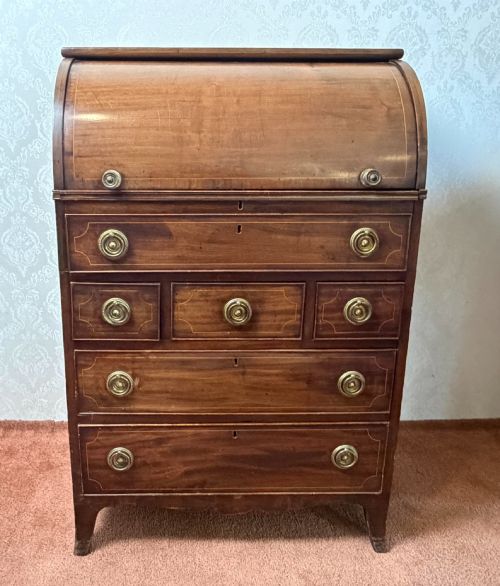
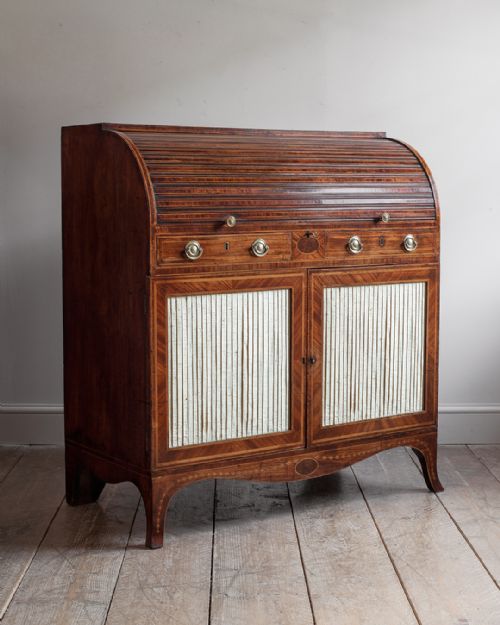


Tambour Front Writing Cabinet
A tambour front writing cabinet offers a sliding slatted shutter that conceals fitted interior compartments with distinct elegance.
Tambour Front Writing Cabinet
A tambour front writing cabinet combines a compact writing surface with an ingenious slatted sliding door that rolls back into the carcass. These pieces appear across several distinct historical eras, including the Georgian, Victorian, and Edwardian periods.
The primary forms on this page include desks, bureaux, and stationery cabinets constructed to organise correspondence and writing materials. Many examples originate from British workshops, spanning styles from George III to Arts and Crafts and French Revival.
Buyers seeking this phrase frequently encounter mahogany, oak, and walnut carcasses fitted with internal pigeonholes and small drawers. The sliding tambour mechanism remains the defining architectural feature that unites these diverse desks and cabinets.
How they were made
Cabinet makers constructed the curved slatted shutters by gluing individual wooden strips onto a backing of stout textile or paper, allowing the flexible curtain to run smoothly in recessed tracks. Mahogany, satinwood, and oak supplied the structural timber for these frames and carcasses.
Surfaces frequently display fine marquetry or contrasting string inlay alongside brass hardware. Master artisans shaped the internal stationery compartments by hand to maximise storage within compact proportions.
What varies in quality
The distinction between standard utility pieces and exceptional examples rests upon the choice of timber figures and the precision of the joinery. Finely figured satinwood or kingwood veneers elevate a cabinet above plain utilitarian oak.
Smooth operation of the tambour tracks demonstrates the underlying skill of the original maker. Well-executed internal compartments with secret drawers and balanced proportions distinguish superior items.
James Shoolbred & Co
The Tambour Front Writing Cabinet Glossary
- Tambour
- A flexible shutter made from narrow strips of wood glued to canvas or paper. This mechanism slides along tracks to cover desk interiors.
- Bonheur du jour
- A light lady's writing desk featuring a small cabinet or superstructure upon the top surface. These elegant pieces emerged during the eighteenth century.
- Marquetry
- Decorative patterns formed by fitting together small pieces of veneer into wooden surfaces. Craftsmen utilise various coloured timbers to create floral or geometric designs.
- Pigeonhole
- A small compartment within a desk interior used for sorting letters and papers. These recesses often sit above small internal drawers.
Tambour Front Writing Cabinet: Frequently Asked Questions
How do tambour doors work?
The door consists of thin vertical slats of wood attached to a flexible canvas or paper backing. This construction lets the shutter curve smoothly around internal tracks.
When pushed, the shutter slides entirely out of sight into the body of the cabinet.
Are these desks suitable for laptops?
Most historic writing cabinets were built for stationery, ledgers, and correspondence rather than modern technology. Interior dimensions vary significantly across Georgian and Victorian examples.
Buyers should measure internal writing surfaces carefully before placing modern equipment inside.
What is a bonheur du jour?
This term describes a light writing desk topped with a small set of drawers or a cabinet. The style became fashionable during the eighteenth century for private correspondence.
Such pieces often incorporate fine satinwood veneers and delicate proportions.
How do I distinguish Edwardian from Georgian pieces?
Georgian cabinets often display rich mahogany or satinwood with refined string inlay and classical proportions. Edwardian items frequently utilise oak or walnut with heavier framing influences.
Construction details and secondary timbers inside the drawers also help indicate the period.