



Tall Pricket Candleholders
Tall pricket candleholders are striking altar-type lighting pieces bringing vertical presence and historical weight to a room.
Tall Pricket Candleholders
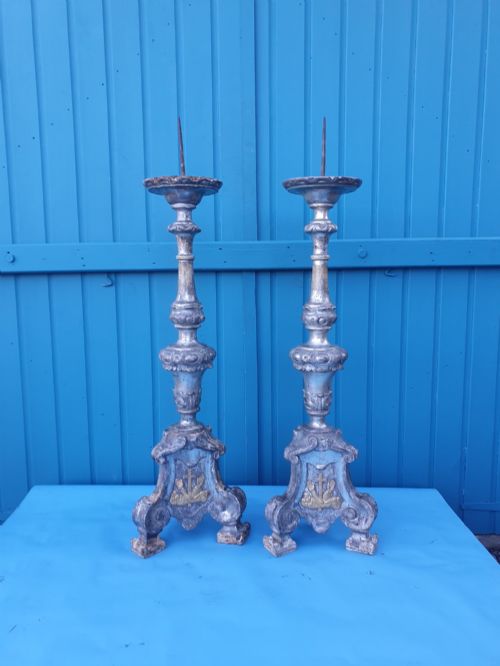
When you search for tall pricket candleholders, you are looking at substantial altar-style candlesticks that support candles on a central spike rather than inside a socket. These items appear across several distinct periods, most notably the eighteenth and nineteenth centuries, spanning diverse aesthetic movements including Gothic Revival, Baroque, and Italian Neoclassical.
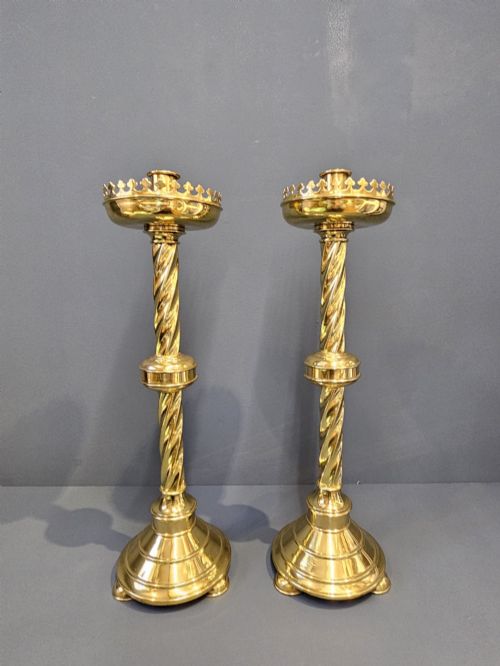
On this page, you are most likely to meet pairs fashioned from carved and gilt wood, brass, or wrought iron. Forms range from Italian Venetian-style giltwood and silvered mecca pieces to heavy Victorian church brassware and French decorative wooden candle holders.
Origins stretch from regional European workshops, particularly Italian centres producing altar-type fixtures, to Japanese bronze interpretations. The common thread among them is height and the characteristic spike, designed originally for large church or chapel candles.
How they were made
Carved wood examples rely on traditional timber manipulation, often finished with gesso, gold leaf, silvering, and polychrome paint to achieve a rich surface. Gilding techniques such as mecca give Italian wooden pieces their warm, translucent metallic sheen.
Metal versions utilise brass casting or hand-forging in wrought iron, whilst bronze pieces demonstrate detailed foundry work. Artisans built these objects to command attention in large ecclesiastical or domestic spaces, combining robust structural cores with decorative surface treatments.
Tall Pricket Candleholders Retail Price Guide 2026
Typical asking prices for tall pricket candleholders among the pieces listed under this phrase on Sellingantiques today, from the lower quarter to the upper quarter. They describe what is for sale here now, not the wider market.
The inventory records regional interpretations ranging from Italian Venetian altar-type fixtures to Japanese bronze pieces and French decorative holders.
What varies in quality
Quality rests in the crispness of the carving, the depth and integrity of the original gilding or silvering, and the proportionality of the turned or forged elements. Pieces displaying harmonious balance between height and base width demonstrate superior workshop execution.
The sophistication of the surface finish dictates distinction, particularly how gesso, paint, and metal leaf interact over time. Hand-wrought ironwork or finely chased bronze shows greater artisan commitment than mass-produced alternatives.
The Tall Pricket Candleholders Glossary
- Pricket
- A sharp metal spike on a candlestick designed to impale the base of a candle and hold it upright. This ancient method predates socket candlesticks and remains common on altar pieces.
- Giltwood
- Timber that has been coated with a thin layer of gold leaf or gold dust over a prepared gesso ground. It provides a luxurious reflective surface popular in Baroque and Neoclassical design.
- Mecca
- A transparent golden or yellowish varnish applied over silver leaf to simulate the rich, warm tone of gold at a lower cost. It is frequently found on Italian altar candlesticks.
- Gesso
- A plaster-like mixture applied to wood surfaces as a smooth base for gilding and painting. Its application quality often defines the tactile refinement of carved pieces.
- Polychrome
- The practice of decorating architectural elements or wooden objects in a variety of painted colours. This finish adds visual complexity to carved altar-type candle holders.
Tall Pricket Candleholders: Frequently Asked Questions
What is a pricket candleholder?
A pricket candleholder is a vertical candlestick that uses a sharp spike, or pricket, to secure the candle rather than a traditional socket cup. This design originated in ecclesiastical settings where large wax or tallow candles were burned on altars.
Today, these pieces function as striking decorative objects or floor and table lighting. Their height and spike construction give them a distinct historical silhouette compared to standard domestic candlesticks.
How do I date an old candlestick?
Dating relies on examining the materials, tool marks, and stylistic vocabulary evident in the construction. Eighteenth-century pieces often feature hand-carved wood with layered gesso and gilt finishes, while Victorian items frequently showcase heavy cast brass.
Stylistic cues such as Baroque scrolls, Gothic Revival tracery, or Neoclassical symmetry help narrow the period. Comparing the construction methods of the base and the pricket itself to known regional traditions offers further chronological clarity.
Were these used in churches?
Many tall pricket candleholders were indeed created for ecclesiastical use on church altars. Their imposing proportions and spike design suited the heavy wax candles burned during religious services.
Over time, many altar-type pieces transitioned into secular domestic interiors as decorative furnishings. Their ecclesiastical origins explain their grand scale and formal aesthetic.
How do I clean giltwood safely?
Giltwood requires gentle dust removal using a very soft, dry brush or a feather duster. Moisture and abrasive cleaners will strip the delicate gold leaf and underlying gesso.
Preserving the surface involves keeping the pieces away from direct sunlight and excessive humidity. Professional conservation is recommended for any significant accumulation of grime.