


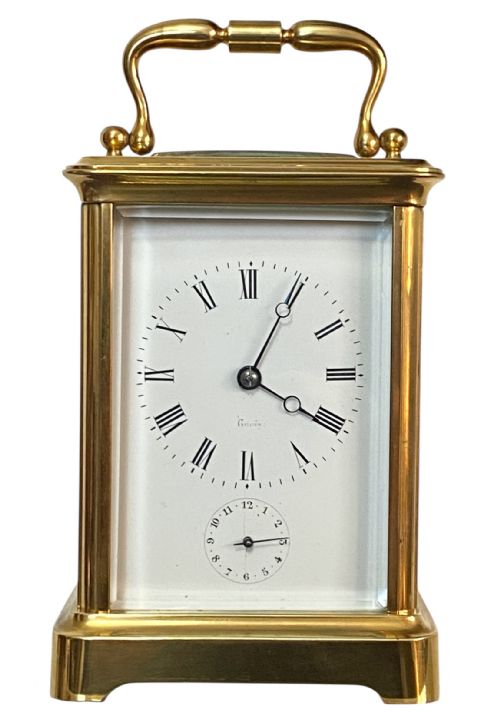


Swiss Mechanical Table Clock
A swiss mechanical table clock brings precision engineering and striking desk presence together, offering both reliable timekeeping and a handsome conversation piece.
Swiss Mechanical Table Clock
A swiss mechanical table clock encompasses a variety of sophisticated timepieces designed for desks, mantels, and travel, with the 1950s and 1960s Mid-Century Modern Atmos models and perpetual motion designs dominating the selection.
Buyers will encounter formal desk clocks, skeleton timepieces, and travel clocks, spanning periods from the Victorian era and the 1900s through Art Deco 1930s pieces and mid-century production.
The assortment relies heavily on precision Swiss manufacture, featuring mechanical movements that range from standard eight-day spring drives to complex perpetual motion mechanisms driven by atmospheric pressure changes.
Materials and Construction
Brass, gilt brass, and chrome-plated metal form the robust structural framework for many of these timepieces, often paired with glass panels to protect the delicate internal gears.
Rhodium and rhodium plating appear frequently on mid-century models to provide a bright, tarnish-resistant finish, whilst select pieces incorporate leather for travel cases.
Intricate assembly of mechanical components includes specialised jewelled movements, such as fifteen-jewel mechanisms, designed to reduce friction and maintain accurate time.
Certain models take the form of miniature street lighting, proving that even municipal infrastructure can be successfully miniaturised into a desk accessory.
Assessing Craftsmanship and Distinction
Superior examples demonstrate meticulous finishing of internal brass and rhodium components, alongside unblemished glass bell-jars and crisp dial markings.
The sophistication of the movement distinguishes standard desk timepieces from complex perpetual motion Atmos systems or skeleton movements that expose the intricate gear train.
Original packaging, matching papers, and specialised housings such as leather travel cases or distinct lamp-post designs elevate the desirability of individual specimens.
Harrods of London·Jaeger LeCoultre
The Swiss Mechanical Table Clock Glossary
- Atmos clock
- A mechanical timepiece driven by changes in atmospheric temperature and pressure, eliminating the need for manual winding. It operates via a hermetically sealed capsule containing a gas and liquid mixture.
- Skeleton timepiece
- A clock designed with transparent or openwork dial and plates to reveal the internal movement and working gears. This style highlights the visual mechanics of the escapement.
- Rhodium plating
- An electrolytic deposition process that coats base metals with a hard, reflective, and corrosion-resistant silver-white layer. It protects underlying brass from tarnishing over decades.
- Carriage clock
- A small, spring-driven timekeeper originally built for travelling in horse-drawn carriages during the nineteenth and early twentieth centuries. They commonly feature a swinging carrying handle on top.
- Perpetual motion
- A theoretical description applied to mechanisms that maintain operation without external power sources, achieved in practice by utilising ambient thermal fluctuations.
Swiss Mechanical Table Clock: Frequently Asked Questions
How does an Atmos clock wind itself?
An Atmos clock operates using a hermetically sealed expansion chamber inside the movement. Slight shifts in ambient temperature cause the gas and liquid mixture within the capsule to expand or contract, winding the mainspring continuously.
This clever thermodynamic system means the clock requires no manual winding or batteries to maintain steady operation.
What is a skeleton timepiece?
A skeleton timepiece is designed with minimal dial obstruction and open plates to display the inner gears, wheel trains, and escapement. This exposes the intricate mechanical choreography of the movement from multiple angles.
Such designs became particularly prominent during the mid-century period, emphasising the aesthetic beauty of precision engineering.
How do I care for a vintage desk clock?
Keep mechanical table clocks away from direct sunlight, extreme temperature fluctuations, and damp environments that could affect the delicate metal components and lubricants. Dust glass panels gently with a soft, dry cloth without applying pressure to exposed hands.
Allow professional horologists to service the internal mechanical movement periodically to ensure proper lubrication and timekeeping accuracy.
Are travel clocks different from mantel clocks?
Travel clocks are generally compact, robustly encased, and frequently include protective leather outer cases or folding metal struts for portability. Mantel clocks are heavier, stationary decorative objects intended to sit permanently on furniture.
Travel versions often incorporate alarm functions, whereas mantel and desk variants prioritize continuous time display or perpetual motion.