


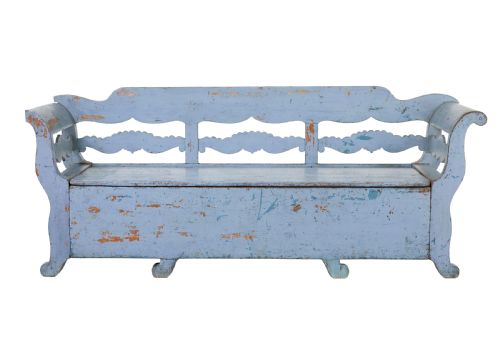


Swedish Style Painted Bench
These Swedish style painted bench designs bring bright Scandinavian calm into a room through pale painted woodwork and clean period lines.
Swedish Style Painted Bench
A swedish style painted bench is a traditional seating form rooted in Scandinavian country and Gustavian aesthetics, designed to offer practical long seating with decorative presence. You will frequently encounter nineteenth-century pine benches alongside earlier eighteenth-century settle benches featuring original painted surfaces.
The selection ranges from simple farmhouse seating to more refined Gustavian settees and sofas, often displaying classic proportions and pale colour palettes. Alongside standard benches, the inventory includes related forms such as settle benches and dining preparation tables sharing the same painted finish.
These items originate primarily from Swedish and Austrian country workshops, representing domestic furniture traditions from the eighteenth and nineteenth centuries. Each piece brings a distinct regional character defined by straightforward construction and enduring utility.
How they were made
Construction relies primarily on sturdy pine and softwood timbers, shaped by traditional joinery methods to build durable frames for daily use. Carpenters utilised local softwoods that accepted paint finishes readily, ensuring both strength and a smooth surface for decoration.
Surfaces were finished with paint, occasionally enhanced with parcel gilt details to highlight carved mouldings or structural lines. Certain examples incorporate fabric or cane elements to soften the seat, combining functional woodwork with upholstered comfort.
Many historic settles doubled as indoor windbreaks on freezing winter nights, trapping precious warmth around the seated household.
What varies in quality
Quality rests significantly in the authenticity and preservation of the painted surface, where original historic layers hold distinct visual character compared to later refinishing. The subtlety of the brushwork and the harmony of the aged patina dictate the overall aesthetic success of the piece.
Proportion and structural integrity also separate fine examples from standard vernacular pieces, particularly in Gustavian designs where classical restraint governs the ornamentation. Finer items demonstrate careful attention to moulding profiles and balanced joinery that survives intact through centuries of use.
The Swedish Style Painted Bench Glossary
- Gustavian
- A neoclassical Swedish design style spanning the late eighteenth and early nineteenth centuries. It takes inspiration from French Louis XVI aesthetics but adopts a simpler, lighter interpretation.
- Settle bench
- A high-backed wooden bench featuring solid sides and a storage box beneath the seat. This form provided effective protection against draughts in historic interiors.
- Parcel gilt
- A decorative technique involving the application of thin gold leaf to specific raised details or carved highlights on a painted wooden surface.
- Softwood
- Timber derived from conifers such as pine, commonly utilised in northern European furniture production for its availability and ease of working.
Swedish Style Painted Bench: Frequently Asked Questions
How do I identify a Gustavian bench?
Gustavian pieces display neoclassical influences with restrained carved details, straight tapered legs, and pale painted finishes. They often reflect French court styles filtered through a more austere Swedish sensibility.
Look for symmetrical lines and balanced proportions that distinguish these refined items from heavier country furniture.
What is a settle bench used for?
A settle bench served as versatile seating near the hearth, where high wooden backs and solid arms blocked cold drafts from stone floors. The enclosed base frequently doubled as a storage chest for household items.
In modern rooms, they provide a strong architectural anchor along a hallway or dining table.
How should I care for painted wood?
Protect antique painted surfaces by keeping them away from direct sunlight and fluctuating humidity, which can cause timber to move and paint to flake. Dust gently with a dry, soft cloth without applying modern chemical polishes.
Gentle maintenance preserves the historic patina and fragile layers of original paint.
Are these benches comfortable to sit on?
Most wooden benches were designed for upright seating and function best with the addition of loose cushions or squabs for extended lounging. Versions incorporating fabric or cane offer slightly more give than solid timber seats.
Consider adding custom textiles to match your interior while improving daily comfort.