

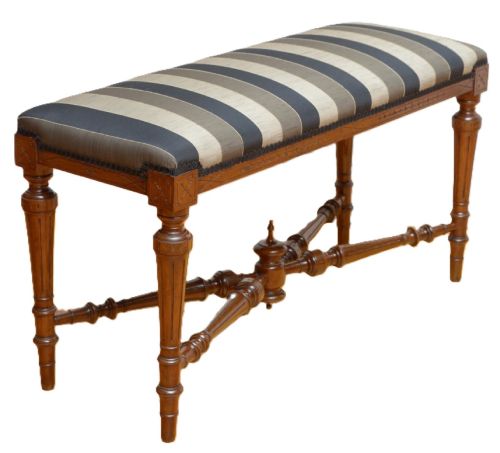
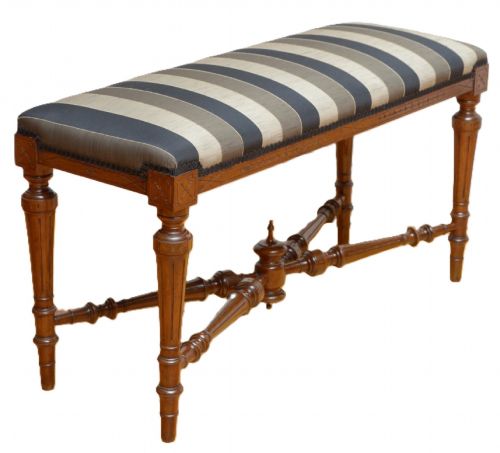


Striped Upholstered Window Seat
A striped upholstered window seat brings low, linear seating to an alcove or bed end, combining period wood frames with bold textile patterns.
Striped Upholstered Window Seat
A striped upholstered window seat is a form of bench or stool designed specifically for placement beneath a window or at the foot of a bed, appearing across the eighteenth, nineteenth, and twentieth centuries. These pieces function primarily as low seating or daybeds, encompassing specific variants such as duet stools, long bedroom stools, and piano stools.
The versions most commonly met on this page belong to the nineteenth century and the Georgian period, built from timber frames like mahogany, walnut, and satinwood. They arrive in various structural forms, ranging from serpentine shapes on square tapering legs to long buttoned ticking stools and French walnut designs.
Makers and designers from the Aesthetic Movement and firms such as Hampton and Sons of Pall Mall produced these furnishings, alongside pieces originating from Sweden and France. The selection spans straightforward wooden benches to ornate giltwood and simulated rosewood daybeds upholstered in fabric and ticking.
How they were made
The construction of a striped upholstered window seat relies heavily on solid timber frames shaped from hardwoods like mahogany, walnut, satinwood, burr maple, and birch. Craftsmen utilised these durable woods for structural longevity, often finishing surfaces with polished grains or giltwood details.
Upholstery techniques applied to these seats involve textiles, fabric, and ticking fabric, sometimes incorporating buttoned finishes across long rectangular forms. Frames reflect stylistic periods through architectural elements such as square tapering legs, serpentine front rails, and George III or Regency stylistic influences.
Striped Upholstered Window Seat Retail Price Guide 2026
Typical asking prices for striped upholstered window seat among the pieces listed under this phrase on Sellingantiques today, from the lower quarter to the upper quarter. They describe what is for sale here now, not the wider market.
Listings feature woods spanning mahogany, walnut, satinwood, burr maple, birch, and giltwood across the eighteenth, nineteenth, and twentieth centuries.
What varies in quality
Quality in a striped upholstered window seat separates pieces by the selection of cabinet timbers, where dense burr maple, figured satinwood, or heavy mahogany signify superior material grade over simpler woods. The precision of the joinery and the integrity of the frame construction dictate the durability of the bench.
The sophistication of the timber turning, carving on the legs, and the execution of applied finishes like giltwood or simulated rosewood distinguish finer workshops. Additionally, the refinement of the upholstery work, from buttoning to fabric choice, marks the distinction between standard utilitarian seating and high-end production.
Hampton and Sons of Pall Mall
The Striped Upholstered Window Seat Glossary
- Ticking fabric
- A tightly woven, durable textile historically utilised for mattress and cushion covers, frequently featuring linear stripes. This material provides the robust foundation seen on many nineteenth-century long stools.
- Duet stool
- An elongated piano stool or seating bench designed to accommodate two people simultaneously. These forms often appear from the Edwardian era and the nineteenth century.
- Serpentine shape
- A furniture contour that curves outward in the centre and inward at the sides, creating a gentle wave-like front rail. This profile appears on mid-eighteenth-century mahogany examples.
- Giltwood
- Timber that has been coated with a thin layer of gold leaf or gilt preparation for decorative effect. This finish denotes high-status decorative pieces from the nineteenth century.
- Simulated rosewood
- A painted or stained wood finish designed to imitate the rich dark grain and figuring of genuine rosewood. Craftsmen utilised this technique during the Regency period to achieve an exotic appearance using domestic timbers.
Striped Upholstered Window Seat: Frequently Asked Questions
What rooms suit a window seat?
A striped upholstered window seat fits naturally beneath low window frames, inside narrow hallways, or positioned at the foot of a bedroom bed. Their shallow depth allows them to occupy circulation spaces without blocking pathways.
Historically, these forms served dual purposes for resting during the day or sitting while playing instruments, making them versatile additions to living quarters and dressing rooms.
How do I date a wooden frame?
Dating relies on observing structural timber choices, such as the shift from eighteenth-century mahogany and walnut to nineteenth-century satinwood, burr maple, and birch. Leg profiles, including square tapering legs or giltwood turns, align directly with Georgian and Victorian stylistic shifts.
Construction methods and secondary woods inside the frame also provide clear chronological markers that separate earlier Georgian craftsmanship from later Edwardian or 1930s production.
Were these seats used at pianos?
Many long stools and duet forms were specifically manufactured as piano stools during the nineteenth and early twentieth centuries. These pieces provided stable, cushioned seating for one or two musicians.
They share the same structural frames and upholstery treatments as standard window benches, differing mainly in their proportion and historical association with music rooms.
What defines an aesthetic movement piece?
An Aesthetic Movement striped upholstered window seat reflects later nineteenth-century design philosophies that emphasised visual refinement and artistic expression over heavy historic revivalism. These pieces often feature clean structural lines paired with distinct textile choices.
They stand apart from rigid Georgian or ornate Victorian items through a lighter visual weight and a focus on decorative surface qualities.