


Striped Upholstered Settee
Striped upholstered settees bring tailored pattern and long seating into a room, joining robust timber frames with classic textile designs.
Striped Upholstered Settee
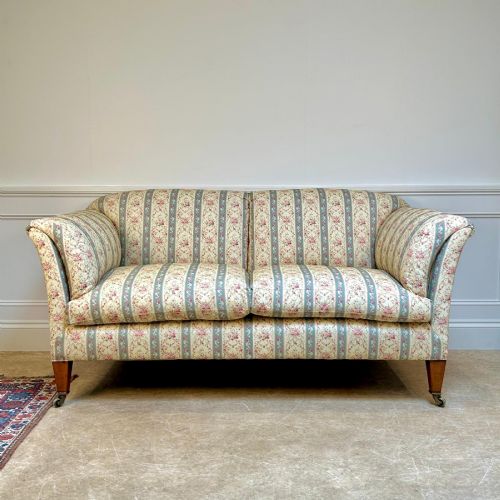
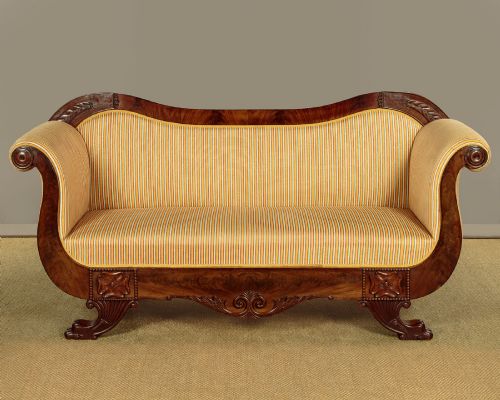
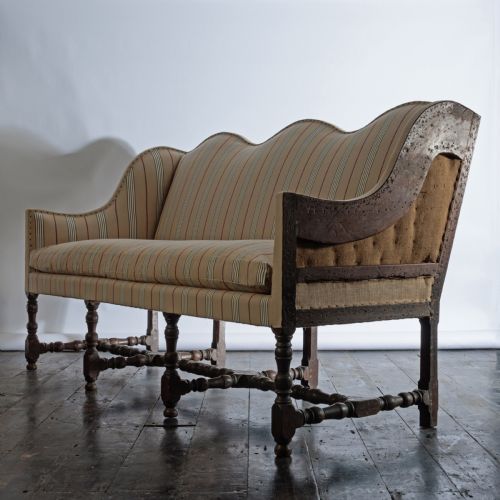
A striped upholstered settee combines long timber framing with fabric coverings that display linear patterns, offering generous seating for multiple people. When looking for a striped upholstered settee, buyers encounter pieces stretching from the seventeenth century through the Regency era and into the Edwardian period and nineteen-thirties.
The selection ranges from Regency scroll end couches in mahogany to Edwardian salon pieces and French painted triple back settees. Many examples showcase specific design traditions such as Louis XVI, Chippendale, and English Country styles.
Forms span standard sofas and settees, double scroll-ended sofas, chaise longues, and window seats. Frames appear in walnut, fruitwood, giltwood, satinwood, and simulated rosewood alongside exposed mahogany.
Materials and construction
Makers built the foundational structures using solid timbers like mahogany, walnut, fruitwood, and satinwood, often adding carved details, fluted legs, or brass accents. Frames were shaped to support extended seating forms, from scroll ends to straight-backed frames.
Upholstery involved textiles, cotton, and velvet, sometimes retaining original ticking under the outer fabric. Wood surfaces received finishes ranging from French paint and giltwood to polished mahogany and inlaid details.
Materials documented across the selection include brass, mahogany, walnut, fruitwood, satinwood, cotton, velvet, and standard textile.
Assessing quality and character
Quality rests in the crispness of timber carving, the integrity of the frame construction, and the proportion of the scroll ends or backrests. Finer pieces demonstrate careful attention to wood selection, such as figured mahogany or inlaid satinwood.
The execution of the upholstery work and the choice of textile contribute significantly to the overall presence of the piece. Well-balanced proportions and harmonious integration between the frame style and the fabric define the upper tier of these items.
Howard & Sons
The Striped Upholstered Settee Glossary
- Scroll end
- A sofa arm or terminal curved outward in a sweeping scroll shape, frequently seen on Regency designs.
- Giltwood
- Timber coated with a thin layer of gold leaf or gilt paint, common on French-style salon furniture.
- Satinwood
- A durable hardwood with a lustrous yellowish grain used for fine cabinetmaking and decorative inlay work.
- Ticking
- A tightly woven, sturdy cotton or linen fabric traditionally used as a base cover for padding and springs.
- Directoire
- A transitional French style bridging Louis XVI and Empire, characterised by restrained neoclassical lines.
Striped Upholstered Settee: Frequently Asked Questions
What is a striped upholstered settee?
A striped upholstered settee is a long, multi-seater timber framed seat covered in fabric featuring linear stripe patterns. These pieces range from early wooden frames to later nineteenth and twentieth-century upholstered forms.
They serve as decorative and functional seating options in reception rooms, bedrooms, and long hallways.
How do I identify a Regency sofa?
Regency sofas typically feature prominent scroll ends, carved mahogany timber, and classical lines reflecting early nineteenth-century design tastes. Many include show-wood frames and double scroll armrests.
They often appear alongside simulated rosewood finishes or brass mounts.
Where should I place a settee?
Settees suit living rooms, large entryways, and wide corridors where their length fills empty wall space effectively. They also work well placed at the foot of a bed or beside a window.
Their narrow profile compared to deep armchairs allows them to fit into transitional areas easily.
How do I clean antique upholstery?
Antique upholstery requires gentle surface cleaning through light vacuuming with a soft brush attachment to remove dust. Professional textile cleaners should handle deeper stains to protect historic fabric.
Keeping pieces away from direct sunlight prevents the striped cotton or velvet from fading.