
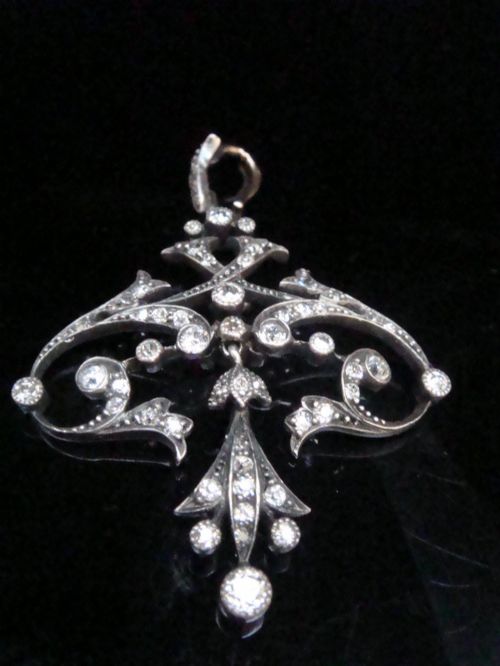


Statement Diamond Drops
Statement diamond drops bring movement and fire to the earlobe or neckline, capturing light with every turn.
Statement Diamond Drops
Statement diamond drops encompass necklaces, pendants, and drop earrings designed to command attention through scale and brilliance. These pieces arrive from periods spanning the Victorian era, the Edwardian period, the Art Deco years, and the mid-century decades. Buyers seeking statement diamond drops will find configurations pairing diamonds with platinum, silver, 18ct yellow gold, white gold, aquamarine, ruby, emerald, and pearl.
The most frequent examples on this page are drop earrings and necklaces set in platinum or 18ct yellow gold, often displaying the geometric clarity of Art Deco design or the delicate ornamentation of Edwardian work. Art Deco fringes and Edwardian lavaliere pendants demonstrate the versatility of these configurations across different decades. Each item unites precious stones with precious metal to create significant presence.
How they were made
The construction of these jewels relies upon platinum and gold alloys paired with precisely cut diamonds and occasional coloured gemstones such as rubies, emeralds, aquamarines, and pearls. Platinum emerged as a favored metal for its strength, allowing intricate pierce-work and secure claw settings that held substantial stones with minimal visible metal. Gold in 18ct yellow and white variations provides a warmer or more uniform backdrop for clusters and fringe arrangements.
Goldsmiths and platinum-smiths utilised hand-fabricated mounts to secure old European cut diamonds and mixed gemstone drops. The integration of stones involves careful balancing so that pendants and drop earrings hang correctly and catch the light from multiple angles during wear.
Materials featured across the selections include diamonds, aquamarines, pearls, rubies, emeralds, and yellow or white gold.
What varies in quality
Quality in these drops rests upon the harmony of the design, the weight and purity of the precious metals, and the visual impact of the stones. Superior examples demonstrate skilled metalwork where the articulation of individual links or drops allows fluid movement without stiffness. The integration of diamonds with contrasting gems like Burmese rubies, Columbian emeralds, or aquamarines elevates the distinction of a piece.
At the higher end, the stones possess strong natural colour saturation and clean cutting that maximises light return, supported by robust platinum or gold work that shows no sign of hasty repair. Lesser quality often reveals rigid settings, mismatched stone selection, or heavy-handed past alterations that restrict the natural swing of the drop.
The Statement Diamond Drops Glossary
- Old European cut
- A round diamond cut popular from the late nineteenth century through the Art Deco period, characterised by a small table, heavy crown, and a large open culet. This cut produces a softer, broader flash of candlelight rather than the sharp brilliance of modern brilliant cuts.
- Lavants and Lavaliere
- A pendant design featuring a drop suspended below a main necklace or chain, popular during the Edwardian era. The style emphasises grace and vertical movement.
- Fringe necklace
- A necklace formation where graduated drops hang vertically from a central collar or chain. This style achieves maximum visual impact by placing the largest stones at the centre.
- Platinum
- A dense, durable white metal widely utilised in fine jewellery from the Edwardian and Art Deco periods. Its strength permits delicate wirework and secure claw settings for heavy diamond loads.
- Columbian emerald
- Emerald origin prized for a vivid green hue. These stones frequently appear in mid-century and earlier fine jewellery drops.
Statement Diamond Drops: Frequently Asked Questions
How do I wear statement diamond drops?
These pieces require minimal additional jewellery to let the scale and brilliance of the drops remain the focal point. Pair drop earrings with an updo and a simple neckline, or let a pendant sit directly against skin or solid fabric.
Ensure the weight of drop earrings matches your comfort for extended wear, and store them flat in lined boxes to prevent tangling in chains or fringe elements.
How do I date a statement diamond drop?
Dating relies upon examining the combination of metals, gemstone cuts, and stylistic motifs present in the mounting. Edwardian pieces often display platinum millegrain work and delicate garlands, while Art Deco items favour rigid geometry and fringe layouts.
Mid-century examples introduce heavier gold construction and pronounced use of coloured stones alongside diamonds, reflecting the shifting aesthetics of the nineteen-fifties and sixties.
What is the difference between Edwardian and Art Deco drops?
Edwardian drops typically feature platinum and silver-topped gold worked into lace-like motifs, bows, and delicate swags. The overall impression is light, ethereal, and ornate.
Art Deco drops turn toward sharp geometry, symmetry, and bold lines, often utilising calibre-cut gems and calibrated diamond fringes that project a strong architectural silhouette.
Can I wear statement diamond drops daily?
Daily wear is possible provided the piece is robust and secure in its settings, though antique platinum and gold benefit from mindful care. Avoid wearing delicate fringe necklaces or antique lavalieres during vigorous physical activity.
Regular checks by a jeweller ensure that claws holding larger diamonds and emeralds remain tight and secure against accidental loss.