




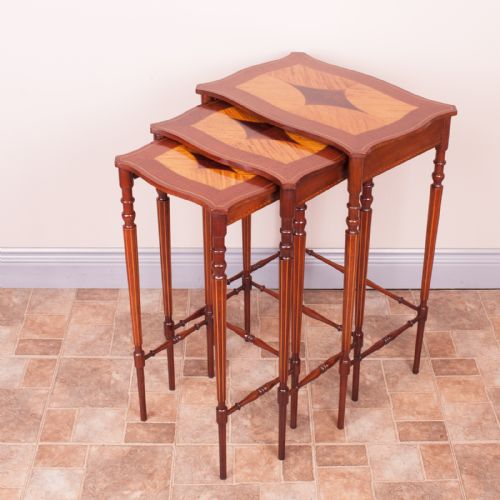


Stackable Coffee Tables
Stackable coffee tables are sets of graduated surfaces designed to tuck neatly away, offering flexible space in any room.
Stackable Coffee Tables
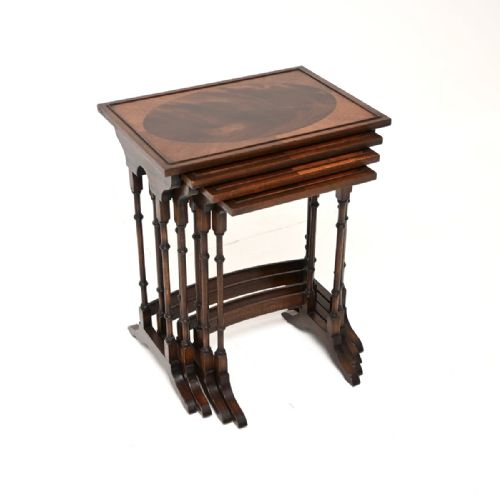
Stackable coffee tables, most commonly found as nests of tables or quartetto sets, are practical multi-surface items designed to slide beneath one another when floor space is at a premium. When searching for stackable coffee tables, buyers encounter pieces originating from the nineteenth century through the early twentieth century, including Edwardian and Art Deco periods.
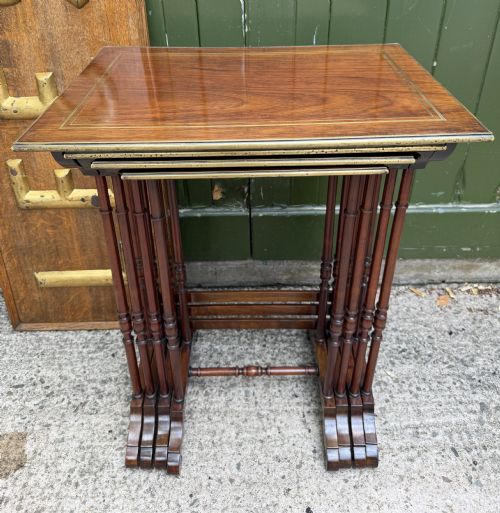
The forms span from sets of three or four graduated tables to specific designs with oval tops or brass-inlaid rosewood. Styles range from Georgian and Queen Anne to French Provincial and Chinese Qing, reflecting diverse aesthetic preferences across different eras.
Mahogany is the predominant wood seen across these tables, often accompanied by rosewood, walnut, satinwood, and exotic hardwoods. Craftsmanship from these periods incorporates fine veneers, boxwood stringing, and elaborate floral inlay work.
Materials and construction
Cabinet makers utilised solid hardwoods and choice veneers, applying mahogany, rosewood, and walnut to create durable yet lightweight frames. Satinwood and amboyna appear as contrasting elements in decorative panels and borders.
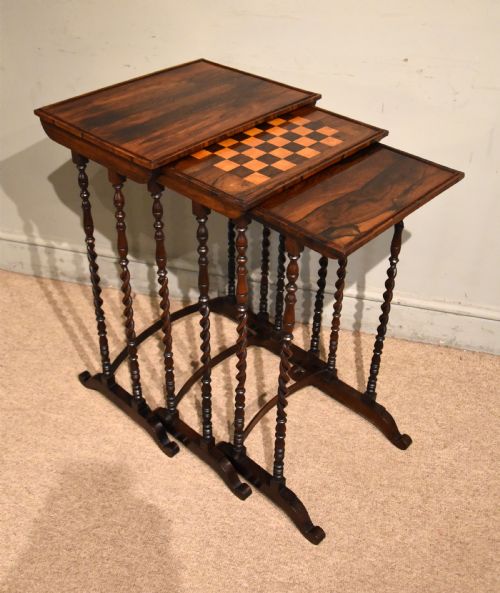
Inlay work defined finer examples, using boxwood and brass to create delicate lines and geometric or floral motifs. Parquetry and Chinoiserie surface treatments further embellished the tops of select tables.
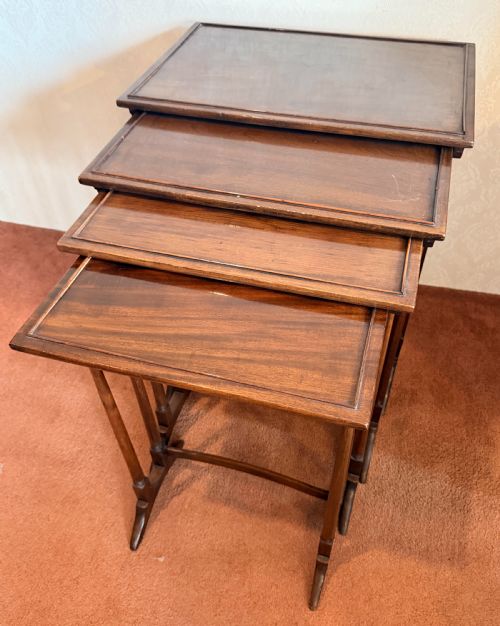
Tables were constructed to graduate precisely in size, allowing each smaller piece to slide smoothly beneath the preceding one without sticking.
Listings feature mahogany as the dominant wood, alongside rosewood, walnut, and satinwood across Edwardian, Regency, and nineteenth-century periods.
Assessing quality and execution
The standard of timber selection and veneer matching dictates the visual appeal of a set, with well-figured grain commanding attention. Superior execution shows in the precision of the graduated sizing and the smooth operation of the nesting action.
The refinement of decorative details, such as hand-cut brass inlay and intricate boxwood stringing, separates standard production from exceptional workshops. Maker attribution, such as pieces bearing the mark of Heal's, adds notable distinction.
Heal's
The Stackable Coffee Tables Glossary
- Quartetto
- A set of four tables designed to nest together. This term appears frequently in nineteenth-century descriptions.
- Nest of tables
- A group of graduated tables that fit one inside the other to save space. They function individually as occasional surfaces when separated.
- Stringing
- A narrow strip of contrasting wood inlaid into the surface of a table to form borders or linear decoration. It often frames the primary mahogany or walnut veneer.
- Parquetry
- Geometric patterns formed by fitting small pieces of wood veneer together on a tabletop. French walnut examples frequently display this technique.
- Chinoiserie
- European decorative motifs inspired by Chinese art and design. This style appears on lacquered or painted surfaces of specific period sets.
Stackable Coffee Tables: Frequently Asked Questions
How were stackable coffee tables used?
These pieces served as versatile furniture for entertaining guests in drawing rooms and parlours during the nineteenth and early twentieth centuries. Individual tables were pulled out to hold cups of tea or books, then returned to the main stack when finished.
Their compact nature made them essential for managing space in smaller Victorian and Edwardian sitting rooms without sacrificing surface area.
How do I care for rosewood and mahogany tables?
Protect the polished wood surfaces by keeping them away from direct sunlight and extreme temperature fluctuations. Regular dusting with a soft, dry cloth helps maintain the finish without building up residue.
Apply a quality furniture wax sparingly when the wood appears dry, rubbing gently in the direction of the grain.
How can I tell Edwardian pieces apart from earlier ones?
Edwardian pieces often feature lighter mahogany framing with delicate inlaid boxwood stringing and satinwood highlights. They reflect the revival styles popular around nineteen hundred.
Nineteenth-century examples frequently utilise heavier rosewood or denser mahogany timbers, sometimes incorporating brass inlay or simpler structural lines.
Can I use these tables on carpet?
Stackable tables slide easily on hard floors, but thick carpets can impede the nesting action if the legs catch the pile. Placing them on a firm rug or flat flooring ensures the tables slide smoothly underneath one another.
Ensure the smallest table clears the carpet backing when stacking the full set.