

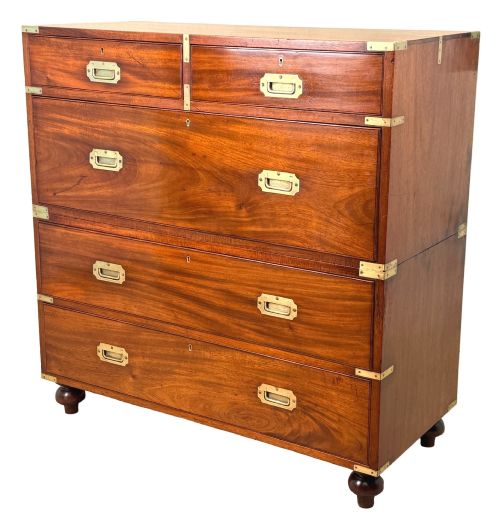
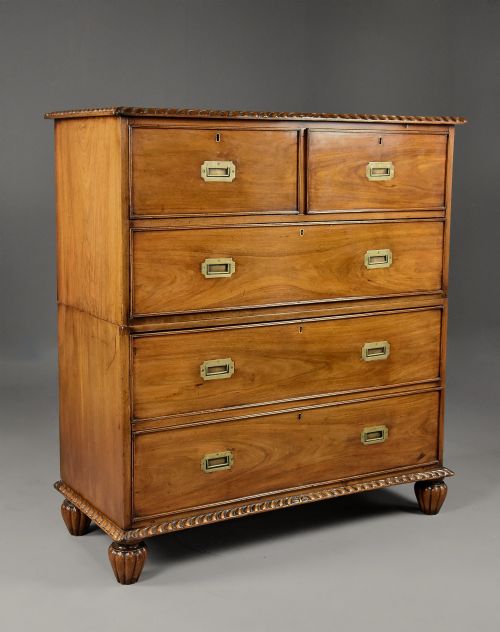
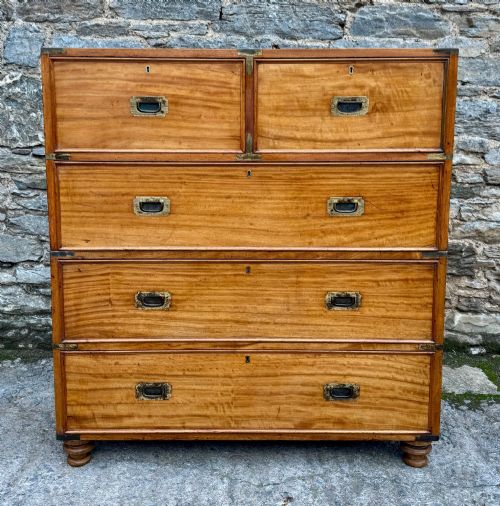
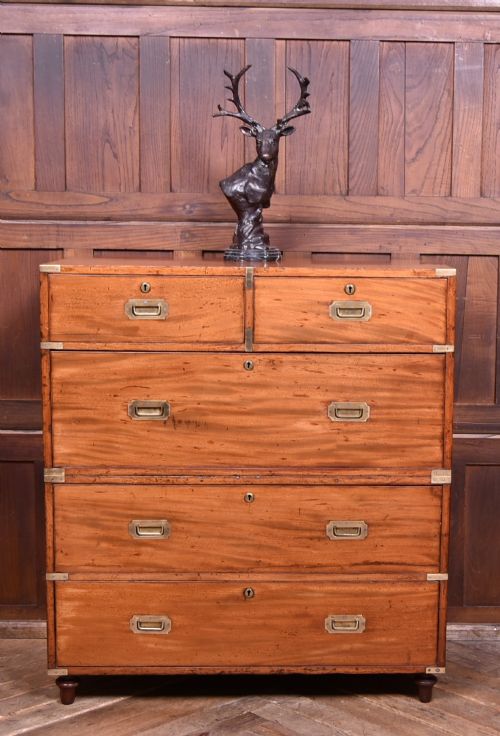


Split Section Military Chest
A split section military chest is a robust portable drawer unit built for officers on the move, combining clever engineering with rich hardwoods.
Split Section Military Chest
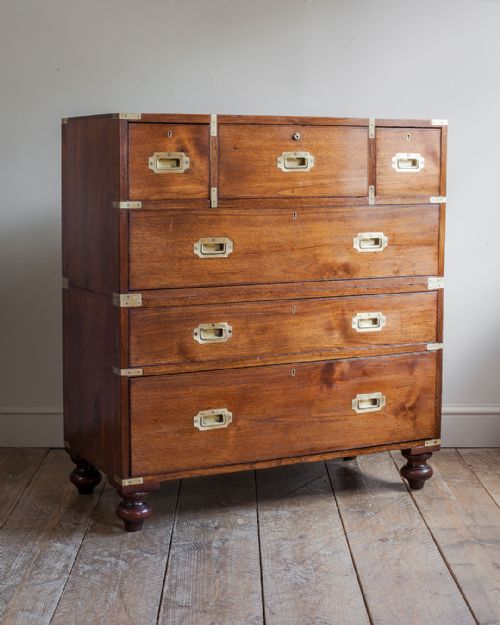
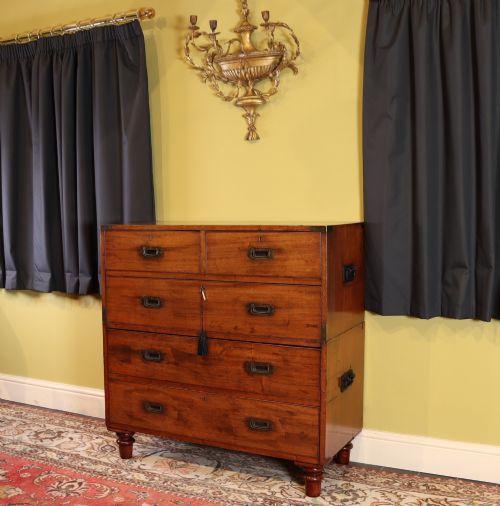
A split section military chest is built as two distinct modular carcases stacked together, designed to dismantle easily for transport by ship, rail or cart. Officers ordered these drawer units from outfitters to withstand the rigours of colonial service across the British Empire. Most examples encountered here date from the nineteenth century and bear the characteristic hallmarks of campaign furniture.
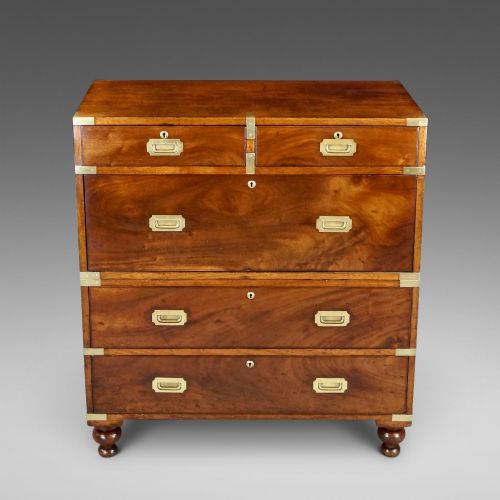
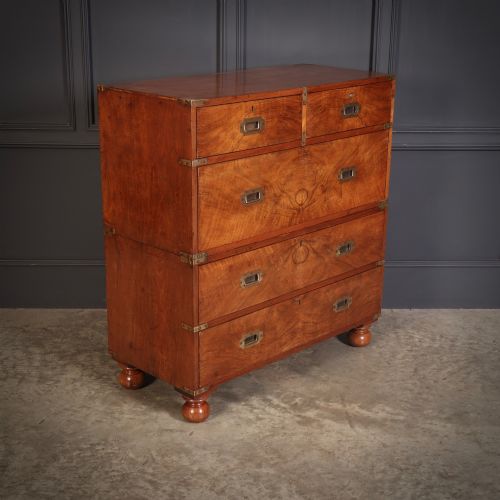
The primary forms take shape as chests of drawers, sometimes incorporating a fitted secretaire drawer for writing correspondence in the field. Woods like mahogany, teak, camphor wood and padouk dominate the selection, chosen for their durability and resistance to tropical humidity. Brass corners, binding and flush inset carrying handles protect the edges and make lifting the separate sections straightforward.
Materials and construction
Makers constructed these cabinets using dense timbers such as mahogany, teak, padouk and camphor wood, often panelled at the back to cope with extreme climate shifts without splitting. The timber is heavily reinforced with brass corners, straps and flush side handles screwed firmly into the wood to endure rough handling during transit. Drawers are typically arranged in a two-part format, secured by internal locking mechanisms or brass pins that lock the sections together when assembled.
Cabinetmakers utilised secondary woods like cedar for internal drawer linings while keeping the primary show wood dense and stable. Every joint and fitting is engineered for maximum strength and minimal wasted space, reflecting the utilitarian demands of military life. The brasswork is countersunk meticulously flush with the wood surface so that nothing catches or snags during packing.
Split Section Military Chest Retail Price Guide 2026
Typical asking prices for split section military chest among the pieces listed under this phrase on Sellingantiques today, from the lower quarter to the upper quarter. They describe what is for sale here now, not the wider market.
Distinctions in quality
Quality rests upon the selection of timber and the precision of the brass hardware integration. Superior examples display finely figured mahogany, walnut or padouk grain with tight dovetail joinery that remains square and true over generations of dismantling. The crispness of the brass corners and the smooth action of the flush handles signal the skill of the original maker.
The presence of a fitted secretaire drawer with pigeonholes and small compartments elevates the utility and desirability of a piece. Maker stamps or cabinet labels embedded within the woodwork add historical weight and confirm workshop provenance. Poorer quality pieces show clumsy timber repairs, mismatched brass replacements or poorly fitted carcase sections that fail to align cleanly.
S. W. Silver & Co. London & Liverpool·Army & Navy
The Split Section Military Chest Glossary
- Campaign chest
- A portable set of drawers made in two or more stackable sections with recessed handles and protective brass corners for military transport.
- Secretaire
- A drawer fitted with a drop-front writing surface, small pigeonholes and internal compartments for handling paperwork.
- Camphor wood
- An aromatic hardwood traditionally used for campaign chests due to its natural insect-repellent properties and resistance to dampness.
- Padouk
- A heavy, dense exotic hardwood with a distinct reddish hue frequently utilised in Anglo-Indian colonial furniture.
- Flush handle
- A metal pull inset into the wood so the outer surface remains completely flat during transit.
Split Section Military Chest: Frequently Asked Questions
What is a split section military chest?
A split section military chest is a sturdy set of drawers constructed in two separate modular carcases that stack on top of one another. This clever two-part design allowed nineteenth-century officers to pack and transport their personal belongings with ease during overseas campaigns.
Protective brass corners and flush recessed carrying handles further guarded the timber frame against the bumps and scrapes of active service travel.
Why are these chests made of exotic woods?
Cabinetmakers selected dense timbers like mahogany, teak, camphor wood and padouk because they possessed exceptional strength and resisted warping in humid colonial climates. Camphor wood offered the added benefit of naturally deterring insects from damaging uniforms and documents stored within.
These durable hardwoods ensured the cabinets could endure heavy handling aboard ships and on rough overland journeys without structural failure.
How do you separate the two sections?
The upper and lower carcases typically lock together using internal brass pins, hooks or sliding bolts concealed behind the drawer fronts. Once you remove these securing mechanisms and pull out the top drawers, the two halves lift apart easily from each other.
This modular construction was essential for reducing weight and bulk when military personnel had to move camp on short notice.